Showing posts with label Chicago and North Western. Show all posts

Thursday, October 19, 2023

Chicago and North Western 40' Riveted PS-1 Auto Car


The right side of the model

I finally found a few brief blocks of time to weather my model of CNW 57868, a riveted 40' PS-1 auto car. My build is the pilot model for the Speedwitch kit (more are coming) for these cars. An aside is that this is the most ambitious offering to date that I have offered for Speedwitch due to the large amount of etchings used to replicate the details of the prototype. It is one of the most challenging kits I've built, but not really more than some of the kitbashes I've done. Enough about the kit...

and the left side

Before painting, I blasted the model with 600-grit aluminum oxide. I painted the car with Badger Stynylrez grey primer followed by black for the ends, roof, underframe, and trucks. I violated the "rule" of painting light colors followed by dark because I knew that it would be easier to mask and paint the sides than the reverse. After applying masking tape, I touched up the areas of black overspray with more of the Stynylrez followed by Mig AMMO Dark Rust (no. 041), a good match for the CNW's freight car red. I applied a coat of Quick Shine to create a gloss surface for decaling. The decals, printed by Cartograf, went down flawlessly. I sealed them with a coat of Quick Shine followed by clear flat from Tamiya. All paints were applied with an airbrush.


As part of the finishing process, I applied some chalkmarks both before and after weathering. As I wanted a car that was weathered, but not derelict-looking, I applied a wash of Titanium White oil paint heavily diluted with odorless mineral spirits followed by a coat of Tamiya clear flat. I then added a coat of Bragdon Powders Grimy Grey, which is fairly light once sealed with a flat coat. I cleaned the truck wheel treads, added the couplers, applied paper routing instructions, and CNW 57868 was ready for service. I believe this is one of the finest resin kits I have built, although I am slightly biased


Thursday, March 9, 2023

Update on Etchings from Presentation

 During my presentation at the latest Hindsight 20/20, I alluded to the fact that due to the shipping delays in receiving my test etchings due to the Royal Mail hack from late December, I could not inspect and assess what I had received. I spent a few more hours looking at some of the parts, and have a few photos to share.

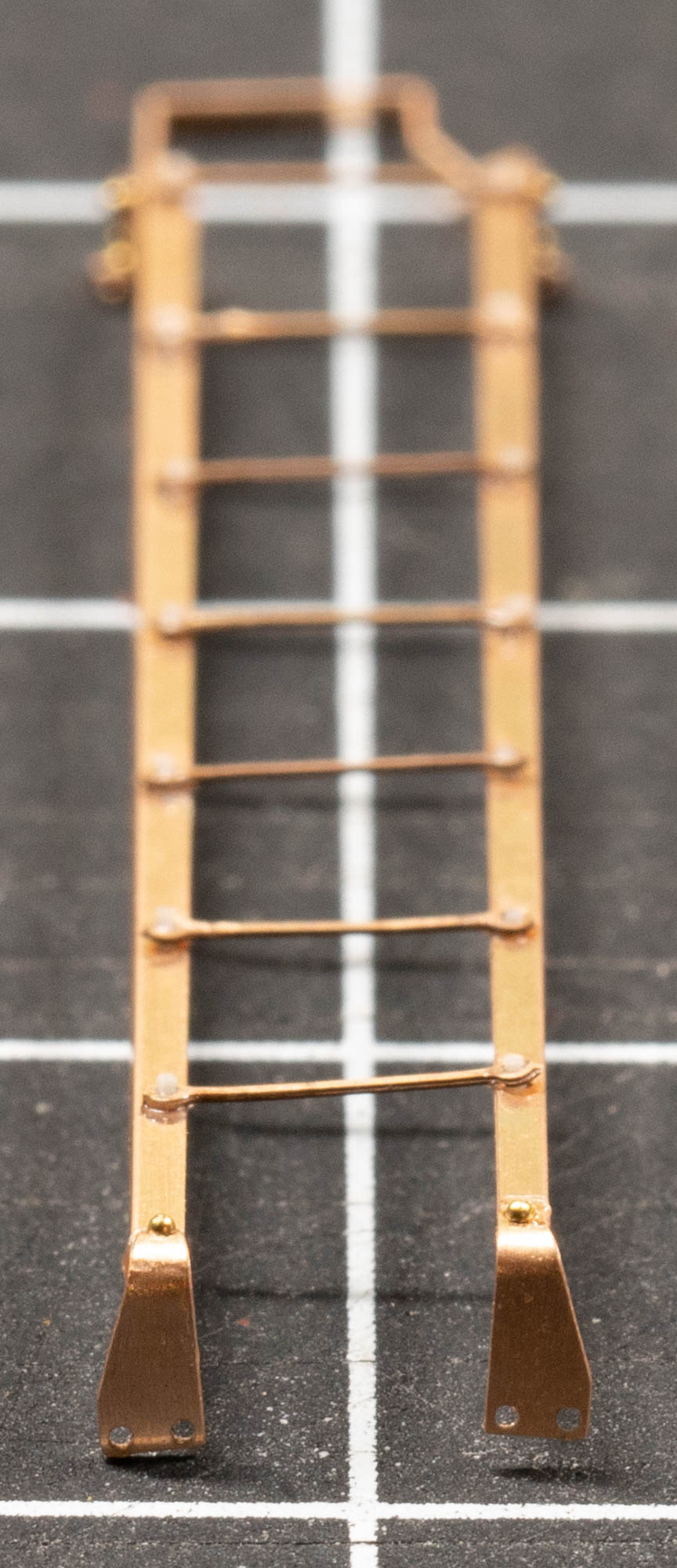
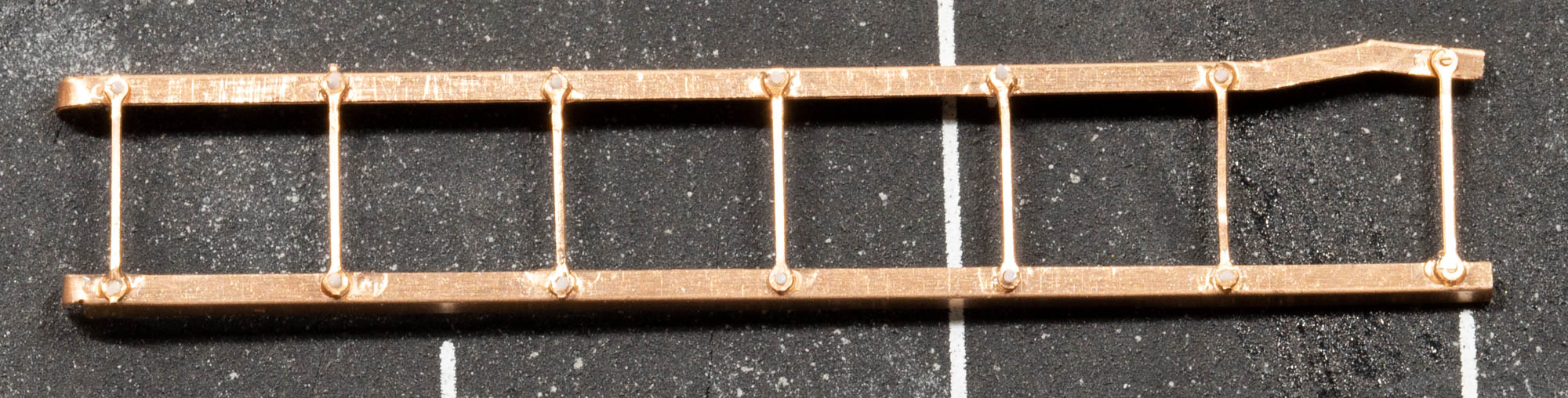
The first photos are of the ladders for PFE R-40-25/-26 reefers. The primary difference between the two is the -25 class used traditional ladders with treads (rungs) riveted to the ladders stiles while the -26 used Wine-style ladders where the rungs had bends that fit into holes in the stiles, that once attached to the car held the rungs in place. What is displayed here is the -25 riveted style. Compare the prototype photo, above, to the etchings shown below. The sill steps were attached to a bracket that was also integral to the bottom of the ladder stiles, with the entire assembly attached to the bottom face of the side sill in two locations.


The next group of photos are of etchings for a Chicago and North Western PS-1 auto car. Common to all but the earliest PS-1s, that arrangement featured an integral ladder stile, sill step, and bracket attached to the bottom of the side sills, similar to the R-40-25 shown above. [the prototype photo below illustrates this arrangement on a Maine Central PS-1 box car]

There was an interim style of end ladder on PS-1s, with a "jog" in the lower portion of the right stile. Early PS-1s had straight stiles, while later ones had the same "jog," but with two wider bottom rungs, as opposed to one. [note: I could've done a better job bending the little jog to make it straight!]

The last parts I will highlight are two types if zee bars. Most PS-1s had crossmembers that were 4" zee bars. An etching to replicate that is shown in two views. The other simulates a 3" zee bar that will be used to replicate the stringers between the body bolsters and end sills. The photo illustrates the cross section. Etchings such as these have many applications as zee bars were quite common. Until I have more to report...


Saturday, December 21, 2019

More on Lettering

San Diego, Sept. 5, 1955, Col. Chet McCoid photo, Bob's Photo

One of my early posts on this blog was about decal artwork from prototype lettering and I had a follow up post about the vagaries of lettering for the same road. Tony Thompson has had a couple of posts recently about lettering, as well, on his Modeling the SP blog. Recently, I again had reason to mull the subtleties of lettering. In the process of creating artwork for a decal set for CNW Emergency box cars, I noticed a peculiar difference in the lettering on the cars built by Pullman-Standard versus those constructed by American Car & Foundry. The Pullman cars followed standard CNW lettering, while the numbers on the AC&F cars (see '79350' below) were clearly non-CNW standard, using a more condensed type. The capacity and dim data also used a non-standard type, which can be clearly discerned in the builder's photos (not included here.) The reason is not clear. However, with the set, I make clear that I can only vouch for the set for as-built Pullman cars or repaints. This is just another illustration of the fact that even for the same cars on the same road, the lettering is decidedly not the same. Buyer (or modeler) beware!

 
Pullman-built lettering above and AC&F-built lettering below

Tacoma, Feb. 19, 1955, Col. Chet McCoid photo, Bob's Photo

Tuesday, December 17, 2019

More Prototypes for Universal 5700XL Hand Brake with M2049 Hand Wheel


PFE R-40-20 45819, Baltimore, Maryland, Sept. 28, 1951, Col. Chet McCoid photo, Bob's Photo

I have been doing some additional sleuthing and have found several more prototypes that can use the Universal 5700XL Hand Brake with M2049 Hand Wheel as created in HO scale by Kadee. Here they are, with photos in some instances. This list is still a work in progress. 
Previous post may be accessed via this link.

  • Chicago and North Western Modified 1937 AAR Box cars nos. 71000-71998, 76900-77414 and 80252-81450 (all even nos.) Also, CNW 73154, even though the Hawkins Mod. '37 AAR data indicates that it shouldn't have this hand brake.
  • Chicago and North Western 50-foot Express Box cars nos. 68000-68048 (even) 
  • Chicago and North Western Hart Ballast Hopper cars nos. 13501-13999 (odd)
  • Chicago, Minneapolis, St. Paul & Omaha Express Box cars nos. 20000-20048 (even)
  • Erie Hopper cars nos. 28600-28899
  • New York Central Lot 694-B Automobile cars nos. 62300-62599
  • [I am quite certain that there are a lot more New York Central System (NYCS) box cars that used this power hand brake, as it seemed to the design of choice for the NYCS from the late 1930s to the mid-1940s; I am basing all listings upon photo sources and other verifiable materials.]
  • Pacific Fruit Express R-40-20 Refrigerator cars nos. 45701-46200
  • Pacific Fruit Express R-40-23 Refrigerator cars nos. 5751-6000, 7001-7500, and 47703-48202
  • Pacific Fruit Express R-30-21 Refrigerator cars nos. 64135, 64973
  • Pacific Fruit Express R-40-18 Refrigerator car no. 60417… maybe
  • Pacific Fruit Express R-40-24 Refrigerator car no. 68057
  • Pacific Fruit Express R-50-5 Refrigerator cars nos. 200367, 200375 (likely the entire series 200301-200375)
  • Union Pacific B-50-17 Box car 180931 — Ajax with Universal M2049 wheel
  • Union Pacific B-50-36 Box car 195381 (likely others, too)

 
  • Burlington Refrigerator Express 74000-74499 and 74500-74697 Emergency Refrigerator cars
  • Fruit Growers Express 38000-38199 and 38200-38265 and 38266-38373 Emergency Refrigerator cars
  • Western Fruit Express 66400-66499, 66500-66549 and 66550-66624 Emergency Refrigerator cars
  • Fruit Growers Express 38375-38499 Refrigerator cars
  • Fruit Growers Express 38500-38634 Refrigerator cars
  • Fruit Growers Express (FOBX) Overhead Bunker Refrigerator cars


Monday, November 25, 2019

Universal 5700XL Hand Brake with M2049 Hand Wheel


In my recent post on the Kadee early version of the 40' PS-1 box car decorated for New Haven, I noted the new Universal 5700XL power hand brake with M2049 hand wheel (and NOT the significantly more common M1704 hand wheel) on the model. Although it is incorrect for this particular New Haven PS-1 (or any New Haven car to my knowledge) it does have several applications. Here is a list of prototypes I have assembled (with photos in some instances) that I am sure is by no means exhaustive:
  • CNW Emergency box car (photo below)
  • CNW Modified 1937 AAR box car
CNW Emergency box car at left. Note top operated coupler
EJ&E Modified 1937 AAR box car at right. Note Barber S-1 trucks and Wine ladders
  • DICX 218 dry ice car (Mainline Modeler, March 1986)
  • EJ&E Modified 1937 AAR box car (photo above)
  • IHB 1937 AAR box car Lot 729-B
  • IHB Modified 1937 AAR box car Lot 730-B
  • MDT 500-series/8000-series refrigerator cars (Mainline Modeler, March 1986)
  • NRC 17000-series refrigerator cars (Mainline Modeler, March 1986)
  • NYC 50' AAR box car with end door Lot 693-B
  • NYC 10'0" inside height Postwar AAR box car Lot 737-B (many reassigned to Pacemaker service, photo below)
 
At left, the old way to simulate this style of Universal hand wheel, using a Detail Associates Ureco part, on a kitbashed model of an NYC Lot 693-B end door box car
Right, a postwar 10'0" inside height AAR box car from Lot 737-B transitioned to Pacemaker service
  • P&LE 50' AAR box car Lot 698-B
  • PRR X38A automobile car (photo below)
  • PRR X38B Emergency box car
  • SP and T&NO B-50-25 10'0" inside height 12-panel box car (car nos. SP 21500-21749; T&NO 54850-55199)
At left, a PRR X38A automobile car with Universal power hand brake and, at right, a closeup of the same hand brake on the lone X38B Emergency box car (note M2049 cast into the wheel at roughly 5 o'clock)
  • UP HK-50-5 Emergency ballast hopper (photo below)
  • some of the UP (and sister line) B-50-24 and -27 alternate center rivet (ACR) lightweight box cars may have used this version of the Universal hand wheel. Photos needed for verification
Union Pacific HK-50-5 Emergency ballast hopper


Tuesday, October 15, 2019

Wordy Wednesday - Chicago and North Western Emergency Box Cars and Ron Sebastian

San Diego, Sept. 5, 1955, Col. Chet McCoid photo, Bob's Photo
The Chicago and North Western had a sizable fleet of Emergency box cars. They were delivered in two groups with differing specialties. They were delivered by Pullman-Standard (417 cars, nos. 77416-78248, even nos. [part of an order for all-steel cars that was modified due to restrictions imposed by the War Production Board], Viking roofs and both Superior and Youngstown corrugated steel doors) and American Car & Foundry (500 cars, nos. 79250-80250, even nos., Murphy panel roofs and Superior doors.) Only the Northern Pacific received more Emergency design box cars.


Tacoma,  Feb. 19, 1955, Col. Chet McCoid photo, Bob's Photo
HO scale modelers have been blessed with two routes to replicate these distinctive prototypes. Sunshine Models offered resin kits to duplicate most versions of Emergency box cars. Intermountain followed with models that replicate most of the tall (10'5" - 10'6" inside height) cars. One nice detail that is included in undecorated kits as well as on the decorated cars that require it is the Viking corrugated steel roof (this part was offered by Des Plaines Hobbies as an add-on to the IMWX/Red Caboose 1937 AAR box cars and then re-tooled to fit the Intermountain AAR box car offerings.)


Some of the Des Plaines Hobbies parts in my stash (the steps are partially used)
One other point of this post is to indirectly pay homage to the late Ron Sebastian. Over the last ~50 years, Ron was a giant in the hobby, owner of Des Plaines Hobbies, where many made the pilgrimage, either on visits to the Chicago area or as part of the annual Sunshine Models Naperville now RPM Chicagoland. Ron was also a driving force in the manufacturing side of the industry, both directly and indirectly. In addition to the Viking roof referenced above, Des Plaines obtained and temporarily resuscitated the Storzek line of HO resin kits, he produced other injection molded parts, he heavily influenced several projects with major manufacturers, he was the driving force behind other manufacturers, and he was a promoter and supporter of all types of modeling, including his efforts to expand the S scale community and his donations to RPM modeling door prizes, clinics, and giveaways over many decades. His legacy is immense and he will be missed not only for his contributions to the hobby, but his jovial, kind way. I considered him to be a friend as well as a mentor to Speedwitch and I am deeply saddened by his passing.

Monday, July 31, 2017

"Fixture" on CNW/CMO AAR Recommended Practice Gondolas

Jim Gerstley Collection
Yesterday, I posted a question to the Steam Era Freight Cars list (STMFC) on Yahoo! Groups in the hopes that someone could identify a detail on the CNW/CMO AAR Recommended Practice Gondolas built between 1945 and 1956. Here is the query:
If one looks at photos of the CNW/CMO AAR recommended practice and related "11-panel" gondolas of 1945-1956, there is a distinctive detail at the lower right corner of the far left panel (adjacent to the left end). It appears to be a casting of some sort. In looking at my photos, I cannot identify it or its purpose. Since it is on both sides of the car, it is unlikely a defect card holder, as these were usually only on one side of the car. Does anyone know what this detail is? 
It can be seen in the articles on these cars by Jeff Koeller in Mainline Modeler, May and June, 2005. 
The Sunshine kits do not duplicate this feature.
Page 42 from May 2005 Mainline Modeler

I received a few requests for photos or at least to be pointed to photos. To that end, I have created this blog post. Click on any of these images to view a larger version. The two-part article by Jeff Koeller is excellent and I recommend adding it to your library if you do not already have it.
Detail of CMO 88173 from page 42 of May 2005 MM.
CMO 88173 has its defect card holder (a different type of defect card holder) mounted in the same location as CNW 70351 shown above.

Can anyone identify this detail? It almost looks like one of those beer bottle openers mounted to the face of a bar... just sayin'