Showing posts with label Prototype Railroad Modeling. Show all posts

Wednesday, August 21, 2024

A Photo and a Story


E. M Bittner

This image (click on it to see a larger view) is an ebay purchase. It's a vintage Ektachrome slide that given the decades and Ekta's propensity for color shifting, is actually in tremendous shape. I did little to adjust the color. About the image... as one can see, Yankee Stadium is in the background. The waterway in front is the Harlem River, a strait between the Hudson and East Rivers, separating upper Manhattan from The Bronx. There are two businesses behind the tracks. The one at left is a food distributor and likely the reason for the five food-related cars on the track. From left are an Atlantic Coast Line ventilated box car, a Pacific Fruit Express reefer, a Seaboard Air Line ventilated box car, a Santa Fe reefer, and another ACL ventilated box car. 

It is the business at right that yielded an interesting story. It is Hans Holterbosch. I did a little sleuthing and found the following obituary for H. Dieter Holterbosch:

"Born on July 26, 1921 in Dusseldorf, Germany to Marta and Hans Holterbosch, he immigrated to the United States with his parents and sister at the age of five. Raised in Manhattan, NY, he attended Columbia Prep and then went on to attend Penn State University. He served his adopted country proudly in the Coast Guard during World War II, stationed primarily in Brussels. A self-made man, he built a business empire in the years following the war that included running a family vineyard, importing and building the Lowenbrau* beer brand and starting the largest beer distributorship of major brands in New York State. A life long connoisseur of the fine and rare, he was known for his innate good taste. His first major collection of European royal carriages became the foundation of the permanent collection at the Museums at Stony Brook. He subsequently amassed one of the world's finest private collections of vintage automobiles. Recognized as a respected authority on vintage cars, he served as the chief Mercedes judge at the Concours d'Elegance at Pebble Beach for 20 years. A wonderful raconteur, he was known by his friends and colleagues for his integrity, generosity and great good humor."

Back to the photo... while it's grainy and not too sharp, I was drawn to the pallets and kegs in front of the building that would make a good detailing addition to a similar scale model scene. This scene could be replicated for many different sizes of towns, from the modest track holding five cars, to the vehicles, and the buildings themselves along with their details.

*If you watched any television in the late 70s and 80s, you are familiar with the "Tonight, let it be Lowenbrau" advertisements. Here is an example.

Saturday, June 29, 2024

NERPM 2024


The 2024 Northeast/New England RPM was held at the Springfield Sheraton from the evening of May 30th through June 1st with "self-service" layout tours on June 2nd. As has been the trend, the event gets better every year and this year continued the trend. The biggest news from this year's meet was the new venue. While only about a mile from last year's site, the difference couldn't be more stark. The facilities at the Sheraton were top notch, with great rooms for vendors, displays, and clinics, all adjacent in a large open air "Hyatt-style" area. Both evenings, the open space was the location of the raffle and there was a bar and bartender there to keep the random drawings fair. We missed Funaro & Camerlengo while Steve recovered from an operation, but the vendors, display models, and clinics were again some of the best you will find anywhere. The team did a great job assembling a murderers' row of entertainment and attractions. I can't wait for 2025 as Dave Owens and the team already have some improvements in store. If you didn't make it this year, I highly recommend that you put next year's event in ink on your calendar... it's worth it!

I did find time to photograph some models and even pay a visit to Bill Schneider's to see his O&W layout. The layout was open and welcoming... unfortunately, the pool was off limits! Enjoy! 

P.S. info about my clinic can be found here.


Bob Cronin built this impressive 3D printed WM well hole flat car from Plate C

Ken Freeman 'bashed a PC N8A cabin car

Dale Kritzky, who knows a thing or two about real trucks, models them, as well


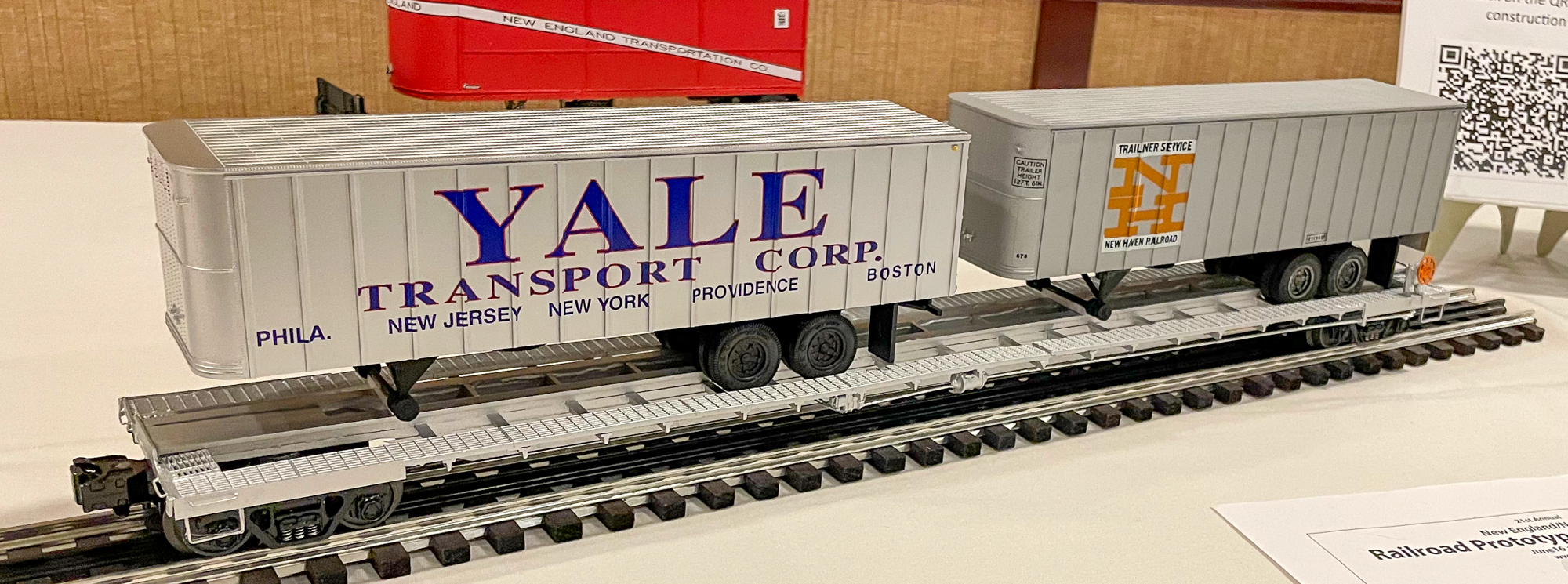
Don Sierakowski showed off a scratchbuilt O scale New Haven Clejan flat along with two trailers

When not modifying O&W brass steam, Mal Houck finds time to scratchbuild O&W rolling stock


This Rutland flat car in S scale is a 3D printed model detailed by Jeff English

Chad Rancourt displayed this fine CV MOW car modeled by the late Armand Premo

John Riddell finsihed off an Eastern Car Works depressed center flat with a load from Yelton Models

This finely detailed gon and load is the work of Maxwell Brisben

This nicely weathered covered hopper is the work of Alex Formanek

Not only did Jim Fellows present a clinic on modeling passenger equipment, but he also brought many nice models to illustrate

This New Haven baggage RPO is the work of Bill Chapin

In progress models are always a treat as you can see what has gone into a model. This Maine Coastal GP29 is the work of Chris Hall

These impressive group of loaded gons is the handiwork of Carlton Rohmer

Joe Biagioni has been busy recreating the motive power of the Susquehanna

Tom Murray displayed plenty of Conrail and Amtrak equipment, including this nicely detailed SDP40F

Brian Carlson added a nice load to an equally nice Red Caboose/SPH&TS F-70-6 flat car

This in-progress Erie unit is the work of Tim Moses

John Terry showed off this weathering tour de force

Ryan Mendell brought some of his excellent Grand Trunk MOW models

This finely detailed kitbash is the work of Mike Evans

Joe Smith is one of the finest kitbashers out there. The baggage-parlor car Dudley is one of his best!

This PC (ex-NH) parlor-club car, Nathan Hale, is the work of Bob Marquardt. The finish is excellent

Ted DiIorio offers hands on weathering clinics. These models display the before and after

One of the hosts of the event, Dave Owens, shared his fire and military equipment. Models include Roco, Sylvan and Ralph Ratcliffe, among others

This effectively and believably weathered car is the work of Kevin Hamelin

Gareth Thomas is working to build his N scale fleet by 3D printing. This will be a B&M ARA box car

This exquisitely detailed White Superpower log truck features a Sylvan cab and frame plus scratchbuilt bunks and a "log" load from his back yard

This Southern Car & Foundry resin two-compartment car (Standard Tank Car prototype) was skillfully built and finished by Vince Lee 

Not just a one-trick Alco NH switcher cab 3D printer, Mike Redden showed this beautiful B&O cab

Chris Adams always seems to be modeling an Alco switcher. This NH unit features one of Mike Redden's cabs plus Chris's handiwork

Bob Cronin built and finished this Bar Mills "over-nighter" kit

These two photos, as well as the one at the top, are from my visit to Bill Schneider's impressive O&W layout, which was open to visitors on Sunday


Wednesday, October 4, 2023

Rivet Counters!


“Rivet Counter” 

The term conjures different perceptions to many people in our hobby and like many things in our contemporary world, they are frequently highly polarized. “Damn rivet counters!” and “Those rivet counters are ruining the hobby!” or “If the rivet counters don’t stop, Rapido [or Tangent, Kadee, Atlas, ….] won’t make models for Santa Fe [or Pennsy, New Haven, Espee, B&O, …] any more” are common refrains, albeit what you have heard might be slightly paraphrased and include some additional, colorful adjectives. Well, as a rivet counter, I would like to provide some context (granted, it’s my own) and also correct a few (mis)perceptions.


First, what is a “rivet counter”? I don’t know of a dictionary definition, but I will provide what I believe is an adequate one. Rivet counters are railroad modelers who demand a high degree of accuracy and fidelity in the models they create. “Rivet counter” seems to apply primarily to rolling stock and locomotive modelers, although there are modelers of structures, vehicles and other subjects that fit the bill. And in certain instances, that does involve "counting" the rivets on a model.*


What is a “high degree of accuracy and fidelity”? That has many facets. Does the subject follow a known prototype? Are the features dimensionally accurate, within acceptable tolerances? Are the features the same as the prototype, e.g., does that model lettered for a C&O AAR box car that is supposed to have a Viking roof have a Murphy panel roof, making the roof inaccurate for the prototype it is lettered to represent? Is the lettering accurate, e.g., does that same C&O box car have a “3-46” reweigh date, but a ‘straight line “FOR PROGRESS”‘ emblem, making it an anachronism? The list is long, but the net goal is to replicate the prototype in miniature as accurately as possible, within the bounds of the materials used.

It is the last phrase in the previous sentence that I believe is where the conflict arises. The modelers of 50, 60, 70 or more years ago were constrained in ways that we are not. Styrene was not a readily available medium. Airbrushing to apply paint was not a common technique. Etching as a process was not available for modeling. Precision machining and injection molding were for highly specialized items and did not have the resolution we enjoy today. Resin casting and the materials to support it as a tool for creating models were not available. “Printed” details like rivets and other surface features that could be applied via decal backing did not exist. Finally, 3D printing and the world of possibilities it offers were a flight of fancy (and for many things they still are, but are coming!) Lastly, we have access to troves of information that were far more difficult to access in the bygone pre-internet or even early internet days. 

How does all this progress intersect with those “rivet counter” types? Over the past few decades, we have seen a dramatic shift in the accuracy and availability of railroad models of all types. We have specific cars and trains for passenger modelers, ready-to-run freight car models of railroad-specific (or a couple railroads or fleets like UTLX), and plastic or brass hybrid models of road-specific steam locomotives, to name a few. While some of the connections may be thin, I can draw a straight line to this phenomenon and it is the work of a devoted rivet counter and a manufacturer who was willing to listen and take the plunge. Circa 1994 Richard Hendrickson collaborated with Life-Like to create the freight car kits under the Proto 2000 moniker. In an unheard of move, the cars were only decorated for railroads that actually rostered the prototypes!** This was a huge shift, but the cars were extremely well received for their separate details and ease of assembly. At about the same time and soon thereafter, Branchline launched the Blueprint series and Kadee released their PS-1 (both through collaboration with Ed Hawkins, another rivet counter.) The shift to accurate models was in full swing and it was the result of prodding by rivet counters. Countless cars and locomotives later, we are enjoying the bounty of models. Even resin kits have evolved with markedly improved details and 3D printed cars are coming into their own.


A different misperception about rivet counters that I wish to dispel is that we are elitist, exclusionary, mocking, etc. I am unsure of the genesis of the idea, but some people have a sense that at any gathering of model railroaders, we wander around with some imaginary scorecard of things we see that we can ridicule or tear apart. This couldn't be farther from the truth. We do walk around, but it is to admire others' work and to discover new techniques to improve our own modeling. And if you think that rivet counters are an exclusionary bunch, attend an RPM. You will find a welcoming bunch accepting of all levels of interest in the hobby, eager to share information and stories about modeling, layouts, and the prototype. Come see for yourself.


So while you may not be a rivet counter and may shake your fist at their ilk, you are likely a direct beneficiary of the tenacity of rivet counters to get things right. The availability of high quality accurate models and troves of information is in no small part due to their desire to create accurate models and drag the rest of us along for the ride, be it in the aisles of a hobby shop or at an RPM meet.


*when I say that a rivet counter counts the rivets on a model, that usually means the most noticeable ones. I have included some examples, but it doesn't generally mean counting to make sure that there are 238 rivets in that row. What it means is that if a certain feature or detail should have 3 rivets and the model has 2 or 4 or 5, that error is quite noticeable. Please see the examples below


**there are some things amiss with a few of the Proto 200 models, as time and the availability of information has shown, but in general, they raised the bar for what a freight car model and locomotive should be


Some Burlington XM-32 Modified 1937 AAR box cars had several distinctive features as highlighted below:


Soo Line and DSS&A Modified 1937 AAR box cars also had some distinctive features as highlighted below, plus square corner 5/5 Dreadnaught ends (highly unusual on the Modified 1937 AAR box car):


Tuesday, September 26, 2023

Mid-Atlantic RPM 2023


Tom Devenny redetailed, renumbered and weathered an Accurail hopper

I attended the Mid-Atlantic RPM on Friday and Saturday, September 15-16 in Hunt Valley, Maryland. As usual, the crew put together a great schedule of clinics at a top rate venue. Modelers obliged by bringing a bunch of fine models to display. I snapped photos of a few to share. Enjoy the fine work! [note that Jim Dufour also captured some of the work displayed and uploaded it to his flickr site.]

One of the hosts Shannon Crabtree had a train of RF&P hoppers on display

Jim Dufour brought a train's worth of finely detailed and weathered freight cars

Fenton Wells presented a clinic about kitbashing and displayed several of the subject cars, including this DT&I rebuild (Tichy base model) and the Norfolk Southern auto car shown below, kitbashed from an old McKean kit


Mike Pulaski displayed this finely weathered car

Randy Hamill displayed several passenger and headend cars with a high level of detailing 

Bill Schultheiss showed off a scratchbuilt (in-progress) B&M sand house

Toss Hermann had a few Ironton subjects for display including this caboose

Plate C had several 3D printed kits for sale, all well rendered


David Olsen had this Southern waffle side car to show

Louis Papineau used a Tichy car as the basis for the SCL stump car

Ramon Rhodes had a few models on display, including this nicely finished BNSF power

Not limited to resin freight cars, Bob Cronin showed off his vehicle modeling chops

John Flanigan IV lettered and weathered this WM Jordan spreader

Tom Potthast carried the S scale torch and had a lrge number of models to show

Eric Thur has been a one-man marketing department for MultiScale Digital and their amazing line of 3D printed loads

Eric also had some cars without visible loads, including this Proto2000 tank car with decals applied