Showing posts with label auto car. Show all posts

Wednesday, July 29, 2026

My presentation from the St. Louis RPM


This past weekend, I was fortunate to have the opportunity to present at the St. Louis RPM, at the convention center in Collinsville, Illinois. If you have not had the chance to attend, the only way I can describe the event is a supersized RPM times two. The attendance figures are approx. 1,000 and the sheer number of vendors and display models is mind boggling. It is an experience all who attend RPMs (and even those who do not) should enjoy at least once. 

My presentation was the Pennsylvania Railroad's early welded box and automobile cars, an evolving project as my models come to fruition. The file can be found at the Speedwitch files page, linked here.

Over the next couple days, I will also post about an interesting model kit from the meet and some photos of display models. Please check back


Thursday, March 9, 2023

Update on Etchings from Presentation

 During my presentation at the latest Hindsight 20/20, I alluded to the fact that due to the shipping delays in receiving my test etchings due to the Royal Mail hack from late December, I could not inspect and assess what I had received. I spent a few more hours looking at some of the parts, and have a few photos to share.

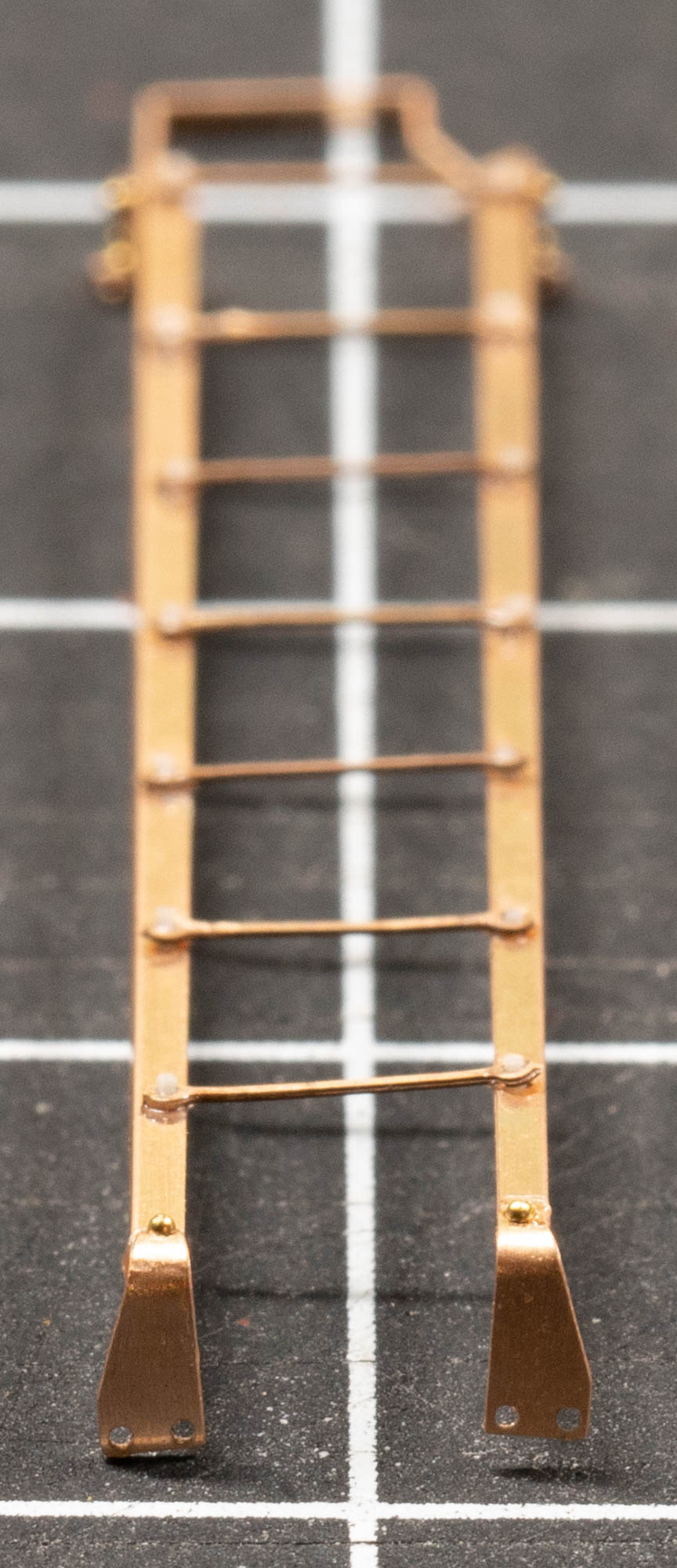
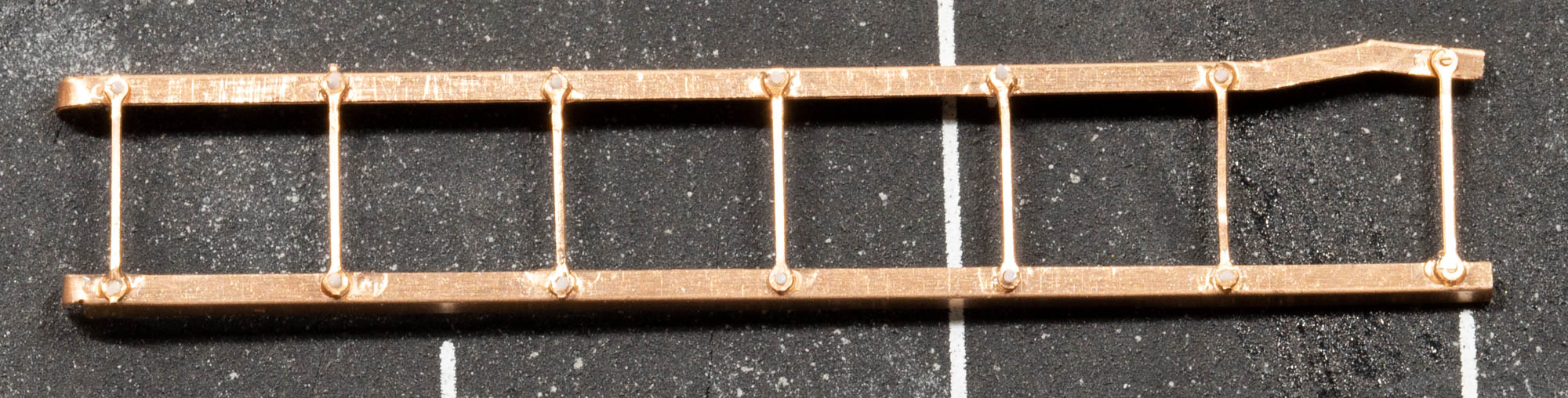
The first photos are of the ladders for PFE R-40-25/-26 reefers. The primary difference between the two is the -25 class used traditional ladders with treads (rungs) riveted to the ladders stiles while the -26 used Wine-style ladders where the rungs had bends that fit into holes in the stiles, that once attached to the car held the rungs in place. What is displayed here is the -25 riveted style. Compare the prototype photo, above, to the etchings shown below. The sill steps were attached to a bracket that was also integral to the bottom of the ladder stiles, with the entire assembly attached to the bottom face of the side sill in two locations.


The next group of photos are of etchings for a Chicago and North Western PS-1 auto car. Common to all but the earliest PS-1s, that arrangement featured an integral ladder stile, sill step, and bracket attached to the bottom of the side sills, similar to the R-40-25 shown above. [the prototype photo below illustrates this arrangement on a Maine Central PS-1 box car]

There was an interim style of end ladder on PS-1s, with a "jog" in the lower portion of the right stile. Early PS-1s had straight stiles, while later ones had the same "jog," but with two wider bottom rungs, as opposed to one. [note: I could've done a better job bending the little jog to make it straight!]

The last parts I will highlight are two types if zee bars. Most PS-1s had crossmembers that were 4" zee bars. An etching to replicate that is shown in two views. The other simulates a 3" zee bar that will be used to replicate the stringers between the body bolsters and end sills. The photo illustrates the cross section. Etchings such as these have many applications as zee bars were quite common. Until I have more to report...


Saturday, February 10, 2018

Modeling the Southern Pacific A-50-17 Part I

Modeling the SP in late 1951 means I would like to have models of the following auto (double door) cars on the roster:

Class (HO scale model)

  • A-50-4 (Speedwitch)
  • A-50-5/6 (Funaro & Camerlengo)
  • A-50-7 (no kit; radial roof version of A-50-6)
  • A-50-9/10/11 (Speedwitch kit coming for A-50-11)
  • A-50-12 (Sunshine)
  • A-50-13 (Sunshine)
  • A-50-14 (Proto 2000 redetail [not really a full-blown kitbash])
  • A-50-15 (kitbash of Branchline)
  • A-50-16 (Sunshine)
  • A-50-17 (Branchline kitbash)


Prototype photo of SP 192866. Note the panels called out as having rectangular corrugations. Fayetteville, North Carolina, July 14, 1952, Col. Chet McCoid photo, Bob's Photo

The last class on this list is the subject of this post, Part I of what will be several. The A-50-17 class was built in 1950-1951, car nos. 190000-190499 and 192000-192999. All cars in the 190000-series were equipped with Evans Type F automobile loading racks (a note in SP Freight Cars, Volume 3 from Signature Press indicates that 100 cars mixed in the 192000-series also had auto racks, although the October, 1951 Official Railway Equipment Register does not yet show any cars in the 192000-series with racks.) Interestingly, cars in series 192000-192499 are classified XM "Box, All Steel" while cars in 192500-192999 are classified as XM "Auto, All Steel". The difference is not clear (if there is any difference) and no special loading equipment is noted in the ORER

While Branchline made a rather nice kit for late 1940s and 1950s 50' auto cars, the SP's A-50-17 incorporated details not covered by the Branchline models. There are two notable differences. The A-50-17 had sides that used "hat-section" structural members, necessitating two rows of rivets (one alternating) where the side sheets overlapped. Additionally, the A-50-17 had four steel sheathing "panels" to the left of the doors and six to the right, fewer than the five and eight of the Branchline models. This will be addressed and described in a separate post.

The other significant difference is that the roof employed was a hybrid of diagonal and rectangular panels. By the time these cars were constructed in late 1950 and early 1951, diagonal panel roof corrugations had superseded rectangular corrugations. However, in this instance, two panels near each end of the car used rectangular corrugations to accommodate automobile loading racks on cars so equipped (all cars had the "hybrid" roofs, regardless of whether equipped with racks). 


To replicate this unusual roof, I decided to marry pieces from a Branchline 50' diagonal panel roof and a Branchline 40' rectangular panel roof. The edges of the underside of the center portions of Branchline roofs do not have any "depth" like the ends do.  If not filled, this lack of depth would adversely affect the cuts with the razor saw, as well as efforts to square the cuts with a Northwest Shortline True Sander. I added strip styrene to fill in these areas (0.040" x 0.040" on the rectangular panel roof and 0.030" x 0.040" on the diagonal panel roof - white strips in the photo below). After sawing, the pieces were spliced together as shown here. I used a razor saw and mitre box to make the cuts, leaving excess material to be sanded using a Northwest Shortline True Sander. My goal was to reassemble the pieces using the "center" of the roof seam caps as the mating line, creating relatively easy joints to sand clean (the photo shown here is prior to sanding the seam caps.) 


Once I had the pieces glued together, but while the joints were still "soft" from the MEK, I placed the roof into the car body, with light pressure applied with rubber bands. This ensured that the parts would be in fairly good alignment and flat as the joints dried and hardened.


I am pleased with the results. I will have copies made for offer at some future time (along with decals for the A-50-12 through A-50-17 classes of SP auto cars).

Know of another prototype that used this roof? Please leave a comment below...

Monday, April 4, 2016

Interesting tarp cover on a gondola


I have seen plenty of photos of tarped loads on flat cars, usually covering equipment. However, I can't recall seeing a gon with a tarp. I'm certainly not saying this photo is unique, but given the number of photos I have seen, this one stood out. It would make an interesting and relatively easy thing to recreate. I'm leaning towards a microfiber cloth dyed to simulate the canvas tarps of the late Steam Era. I think it's worth a try. When I do it, you'll see it here.

The gon is PRR 337254, a GRA, reweighed in March, 1950 at the Rose Lake, Illinois, eastbound shops on the Pennsy.

The subject of the photo was a New Haven I-4 Pacific in the Hartford Yards, but this is far more interesting, so I zoomed in and cropped to show all of the gon that I could. All three cars can be modeled in HO. The gon can be replicated using the Westerfield kit, the Texas & Pacific automobile car can be built using an MDC single sheathed auto car (read about how in Prototype Railroad Modeling, Volume 3) and the Pere Marquette auto car can be built from Speedwitch kit K111 (wow! two Speedwitch plugs in one sentence!)

Thursday, January 28, 2016

Interesting New York Central System Auto Car End

We humans are drawn to the unusual. It may be our natural programming for survival to spot the unusual or different things around us. Whatever the cause, many of us manifest that in our selections and choices of freight cars. We want vinegar tank cars, auto frame loads, three-, four- or even six-compartment tank cars, the PFE reefers that had the colors in the stripes in the UP shield accidentally reversed when painted by a shop, etc. However, the laws of probability and statistics dictate that as rarities, anomalies, and oddballs pile upon one another, they become more and more unrealistic. That doesn't stop us from craving them, though.
from Standard Oil of New Jersey photograph
This portion of the end of NYC 196551 was a very small portion of a photo of a worker tending to a UTLX tank car in a Standard Oil of NJ photo. My attention was captured by the large corrugation in the top of the end. It is roughly triangular in shape. I scanned the image to focus on this car.
It turns out that it is part of a group of 1,000 cars built by MDT in 1926-1927 and 1928 and assigned to series 53000-53499, Lot 540-B and 53500-53999, Lot 572-B, respectively. They had end doors, as shown above, plus 10' door openings and a cubic capacity of 3,544 feet. By the time of this photo, the car above had been renumbered into the series 196500-196999, a transition started for this series of cars in 1941 (the other series was renumbered into 196000-196499 at the same time).
Sirman Collection
MDT also constructed an additional 1,000 cars for NYC Lines road CCC&StL in two groups in 1928 and 1929. These cars share the same basic design, right down to the 3,544 cu.ft. capacity, but had 12' door openings instead. The first group was assigned to CCC&StL 91000-91499, Lot 578-B, and the second group was placed in CCC&StL 91500-91999, Lot 585-B. Beginning in 1937, they were merged into series NYC 58000-58999, and three short years later, in 1940, were assigned to NYC 67000-67787. In 1941 and 1943, they were split back into two groups, 203000-203499 and 203500-203999, respectively. It is unclear if the 1941 and 1943 renumbering resulted in mixing of the original lots.
For both types of cars, there were additional renumberings and conversions to box cars and plating of the end doors in the 1950s. As I develop my CAD capabilities, I will put this end door car, with its distinctive corrugation, on my to-do list. It's unusual and there were 2,000 cars with this end door design, making it less of an oddball car.