Showing posts with label Milwaukee Road. Show all posts

Thursday, January 8, 2026

Milwaukee Road 50' Single Sheathed Automobile Car


This model is based upon a group of 500 cars delivered to the Milwaukee in 1929 by Pullman Car & Manufacturing Co. The cars were placed in series 271500-271999 (note there is a similar, but different group of fifty-foot cars in series 271000-271499 that are not covered by this kit.) Features of these cars included Youngstown corrugated steel doors, Dreadnaught steel ends (with a small lumber door in the A end,) Hutchins Dry Lading roofs, Dalman one-level trucks, and unusually for cars of this type in this era, an underframe without fishbelly center sill sections.


The kit incorporates all of these details. I made the side and end patterns many years ago and created the underframe pattern and modified my existing Hutchins roof a couple years ago. The trucks (included in the kit) were developed and 3D printed by Plate C based upon prototype drawings. The kit includes one-piece cast resin body, other resin parts, etchings for many of the details, decals printed by Cartograf, and other parts. This is the first one-piece body offering that I have cast myself, so it's a bit of a milestone.


The A end, including the lumber door

The car shown is the pilot model built to create instructions (I will add the link to that file to the kit page in a few days once review is complete.) With construction complete, I blasted the model using 600 grit aluminum oxide powder (source for that can be found in this post.) I primed the car with Stynylres from Badger. The model was painted with MiG Ammo ATOM Rotbraun RAL 8012 (ATOM-20046.) I chose this color because it has a red hue, similar to what I have seen in many Milwaukee single sheathed box, auto, and stock cars photos of the Transition Era. It airbrushes beautifully. I did thin it a little bit extra using the manufacturers thinner (thank you to George Toman for the sample and recommendation!)

I weathered the model with a combination of oils and powders. I applied a very light wash of white oil paint diluted with mineral spirits over the entire model. I added additional washes of Payne's Grey and Burnt Umber, with additional applications to the roof and along the side sills. I also added PanPastel powders (Payne's Grey and Burnt Umber) in specific areas to complement the washes. 


Prior to each step where I applied decals, I airbrushed a coat of Future to create a gloss surface. Some chalkmarks were applied at the time of the bulk of the decaling (prior to weathering) and others were added after weathering, at the same time as the reweigh, repack, and brake test stencils. For the fresh paint patches of the reweigh, repack, and brake test stencils, I airbrushed plain decal stock with the color used on the car body plus a coat of Future and then cut and applied rectangle decals as needed. The clear flat coats are Mr. Hobby clear flat thinned with Mr. Hobby self leveling thinner; these were applied several times during the decaling and weathering processes, as well as the final overcoat on the model.

Note the hand brake rod, with the small segment at the bell crank and the longer segment above it, spanning to the chain, accurately replicating the arrangement of the prototype. Another notable detail is that on the prototype, the angles formed by the stiles of the ladders were oriented in an opposite fashion from most cars, with the angle of the stiles "open" to the "outside" of the ladder; that arrangement is also faithfully replicated on the model


Thursday, November 27, 2025

URTX Postwar Reefers and a Teaser


This is one of the first group of cars with the Dartnot end. GATC photo, Bob's Photo

Like the other major refrigerated car fleet operators, Union Refrigerator Transit bolstered its fleet in the postwar years through the addition of new equipment. URTX was owned by General American so naturally the cars were constructed at the company's East Chicago plant. The 1,000 cars were forty-foot steel cars with some interesting details. 

The deep crossbearers and some of the brake arrangement is visible in this excellent image. Bob's Photo

As can be seen, they had horizontal steel sheathing, with two sheets per half of the side (one overlapping the other at the edges) riveted to U-section flanged ("hat" section) structural steel members. The cars were also equipped with the Duryea Cushion underframe. The last group incorporated an unusual roof with two "flat" panels adjacent to the end panels with the hatches (most cars had one such flat panel.) All had air circulating fans, as well. General American seemed to have a preference for the Barber S-2 truck design and these were equipped with that type of truck.

Sept. 16, 1949, Vancouver, BC, Walter E. Frost, City of Vancouver Public Library

The ends were also either Dartnot (no smaller intermediate corrugations in the end panels; see image at top of page for a good view) or a combination of Dartnot/Improved Dreadnaught designs. The photo of URTX 37754 below illustrates this second "hybrid" type.

This car, URTX 37754, was equipped with the hybrid end as described in the text. Bob's Photo

Photos seem to indicate that as built all of these cars were leased to the Milwaukee Road, although in the absence of conflicting/supporting photos or information, I cannot state that definitively.

This car in service to Iowa Beef Packers, ca. late 60s, illustrates the full length side sill reinforcement applied to many cars in the 1960s

In later years, the side sills were augmented by full length support sections instead of the tabbed sections as built. Many were also leased to meat packers and emblazoned with large colorful schemes, although some remained decorated with the tilted Milwaukee emblem. There was an article in the September, 1999, Mainline Modeler by Loren Martens that included drawings of the second group of cars.

The teaser: years ago, George Toman created sides and one of the end styles used on these cars and Ryan Mendell created the parts for the Duryea underframe. I contributed with the other end and the roof with two flat panels at each end. Next year, I will be offering kits for both designs incorporating all these cool parts. Watch for the announcement. Thanks to George and Ryan for their usual phenomenal work!

Side with horizontal steel sheathing panels

Center of side with accurate door hinges

Duryea underframe components

Dartnot type end

"Hybrid" end

Roof with two flat panel sections at each end

Monday, May 20, 2024

Green Bay & Western Single Sheathed Automobile Cars

April 12, 1954, Muscatine, Iowa, Rich Wilson photo, John Harker collection, Remembering the Rock Island facebook group files*

Awhile back, I posted about some Milwaukee Road forty and fifty-foot single sheathed cars. I hinted in that post that in addition to kits for the fifty-foot cars, I also was entertaining the forty-footers. Since then, I have done some pattern work for the sides of the Milwaukee cars, as I have drawings for both the 40 and 50-foot cars and there are a lot of similarities. 

Feb. 23, 1954, Cedar Hill Yard, New Haven, Col. Chet McCoid photo, Bob's Photo

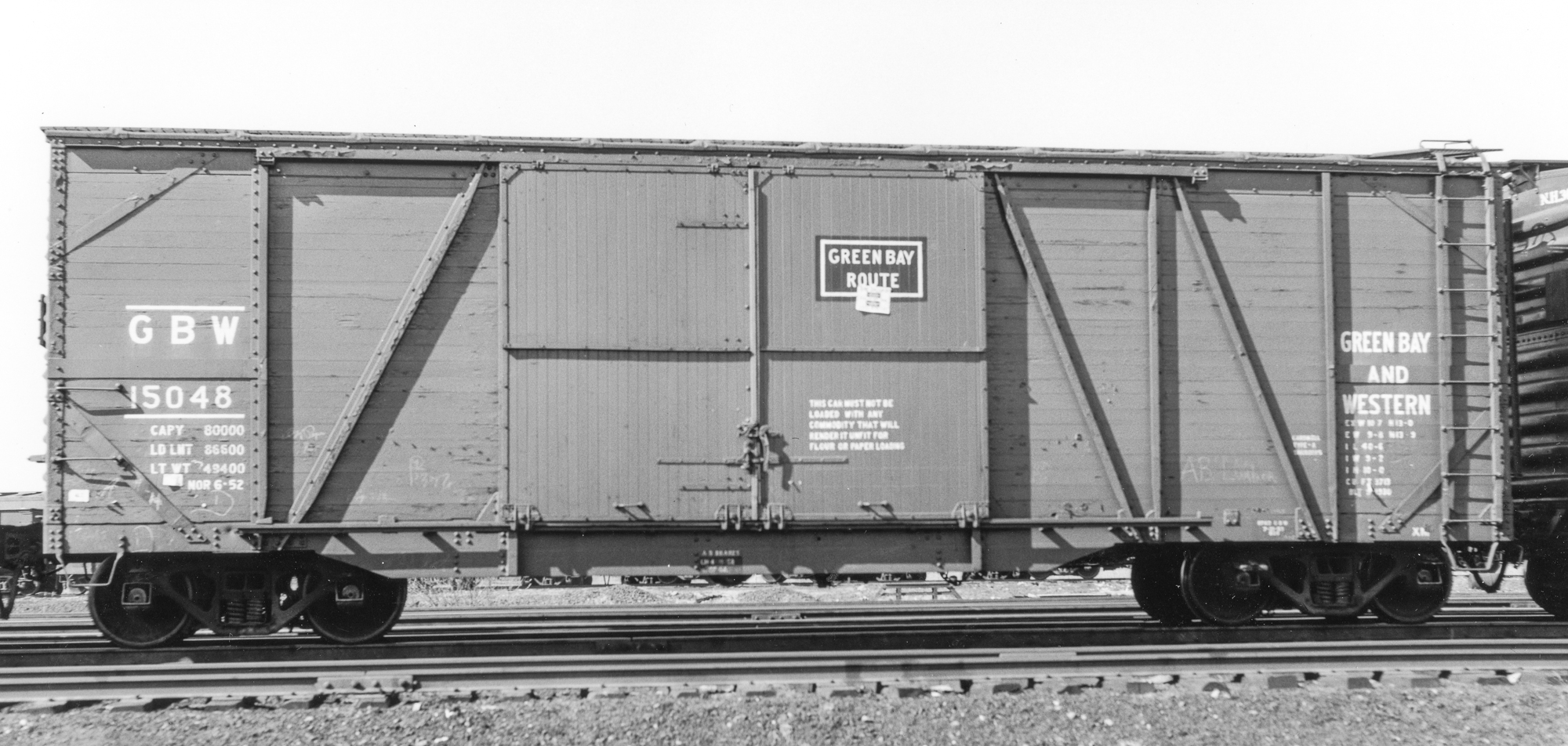
Recently, an image popped up online that had me go looking through my photos to see what I had on the Green Bay & Western's single sheathed auto cars. The GB&W car in the image made me think "Milwaukee" and I wanted to see if my instincts were on the money. I was correct, but there is a very interesting twist. The GB&W cars were built at the same time and by the same builder as one of the Milwaukee's group of cars: the Bettendorf Co., circa late 1929 to early 1930. The GB&W received 50 cars total from Bettendorf in 1930, assigned to series 14000-14050 and 15000-15098. Cars moved between these two groups depending upon whether they had auto loaders installed. The 14000-series cars originally had the loaders, although by the 50s there were not loaders in either group and there are no differences noted in the Equipment Registers of the time.

circa late 50s; no additional information about this image

The twist is that while the GB&W cars are identical to the Milwaukee cars dimensionally and in almost all details, the GB&W cars have the panels adjacent to the doors swapped, which quite noticeably changes the overall layout and appearance of the car sides (excepting the wood vs. steel doors, too.) An examination of the various rivets on the side sill and side sill supports illustrates that the GB&W cars used the same underframe; it's just the sides that were modified. Below is a composited image for comparison of the two sides. I have already (excitedly) worked out all the specifics to make a second side pattern to add the GB&W cars to this project, including the later single door versions, like GBW 15082 shown above.) What a cool discovery!

* from John Harker: "Rich Wilson captured this view looking to the northeast of the Milw derailment that occurred on the RI in downtown Muscatine, Iowa on Monday morning April 12, 1954. The derailment occurred about 5:00 am. This morning view shows some of the derailed cars that stretch from about Iowa Avenue by the Hotel Muscatine back to the southwest where Rich was standing. I scanned and edited this image from an original Kodak red bordered Kodachrome slide."

Thursday, January 25, 2024

Milwaukee Road 40' and 50' Single Sheathed Auto Cars of 1928 & 1929


This photo shows one of the 40' cars with a raised roof. Big Four Graphics

In 1928, the Milwaukee Road received 300 single sheathed automobile cars from American Car & Foundry. These were assigned to series 593025-593324. This was followed in 1929 by orders from Bettendorf (nos. 593325-594324) and Pacific Car & Foundry (nos. 594325-594524.) All of these cars were nominal forty-foot cars, with end doors on cars 593025-593324 (AC&F) and 593325-593374 (Bettendorf.) Cars without end doors had 8" x 14" lumber doors in the A ends. All cars were single sheathed construction with 3/3/3 square corner Dreadnaught ends, Youngstown corrugated steel doors, Hutchins Dry Lading roofs, Dalman one-level trucks, and Klasing power hand brakes (early type with vertical shaft and hand wheel) on cars 593325-594524 and what appear to be unpowered, shaft hand brakes on 593025-593324. Some cars received Evans auto loaders and were renumbered to series 595000-596147. Further, the cars in the series 595000-596147 had their roofs raised by seven inches and their racks removed (likely in the lead up to and during the war.) Finally, in the postwar period some of the raised roof cars had auto loading racks (re)installed and were again renumbered, to the series 597000-598143. By late 1951, there were only two cars remaining in the 595000-series. When racks were removed, the cars were renumbered back into the 595000-series.

Good photos of the 50' cars are rare, but this is noteworthy not only for its good illustration of many of the traits of the cars, but also because, for some inexplicable reason (before its derailment shown here) the entire car was repainted and stenciled by the Northern Pacific (as opposed to the owner, the Milwaukee Road.) Bob's Photo

In 1929, Pullman Car & Manufacturing built 500 fifty-foot automobile cars for the Milwaukee that were assigned to series 271500-271999. The cars were essentially longer versions of the forty-foot cars, with an additional panel on either side of the doors. In all other respects they were identical, including the same ends, doors, roofs, trucks, lumber doors, and even Klasing power hand brakes. They did not have auto loading racks. 

These cars are the subject of a blog post because the next kit release from Speedwitch will be the fifty-foot cars. The completed model will be profiled here in the next week or so. It is likely these will be followed at some point in the future by the release of a kit for the forty-foot cars.

This crop of an FSA-OWI image provides a fine view of the Universal power hand brake, an enhancement when the roof was raised, as well as the tell-tale line at the top of the end, showing the additional section added to accommodate the raised roof. Jack Delano photo 


Friday, May 19, 2023

Flat Car Friday - Milwaukee Heavy Duty Flats


uncredited image purchased from ebay auction; note absence of stake pockets

The Milwaukee had two 200-ton heavy duty flat cars (FG* although originally FM) built in 1928 by Standard Steel Car Company's Hammond, Indiana (outside Chicago) plant, car nos. 67051 and 67053. As shown, they rode on four Dalman two-level trucks with a cast bolster, visible between the two trucks at each end. These were a heavily riveted design, as evidenced by the sheer number of rivets visible. They were likely to support some of the online manufacturers of heavy loads, such as A. O. Smith, but they could be used for more traditional shipments, as shown below. By the early 50s they had been renumbered to car nos. 601051 and 601052, capacities of 392500 and 393300, respectively.

ca. 1938, Pacific & Western Model Railroad [club?]

I had it in my mind, perhaps erroneously, that Roundhouse had offered an HO scale model of these (in addition to the smaller heavy duty flat that they offered) although I could be mistaken. Athearn also offered a heavy duty flat of a different type, although that could be fodder for a kitbash of this prototype as the general shape is similar, if not identical.

image from 1945 Milwaukee Road freight car diagrams

*FG is the AAR classification for flat cars to haul "heavy ordnance or other heavy commodities"

Wednesday, October 24, 2018

Wordy Wednesday - Milwaukee Welded AAR Hopper MILW 94090


The Milwaukee Road rostered 2,000 unusual hoppers built between 1937 and 1944 in the company shops, nos. 94000-95999. They closely followed the AAR design, but featured welded construction. In addition, the spacing of the "stakes" at the top of the side differed from the AAR standard. The cars were equipped with Equipco (shown here) or Universal power hand brakes, Enterprise door locks, and Barber S-1 (shown here) or S-2 trucks with spring planks. Photo Collection of J. Michael Gruber