Showing posts with label New York Central. Show all posts

Friday, November 8, 2024

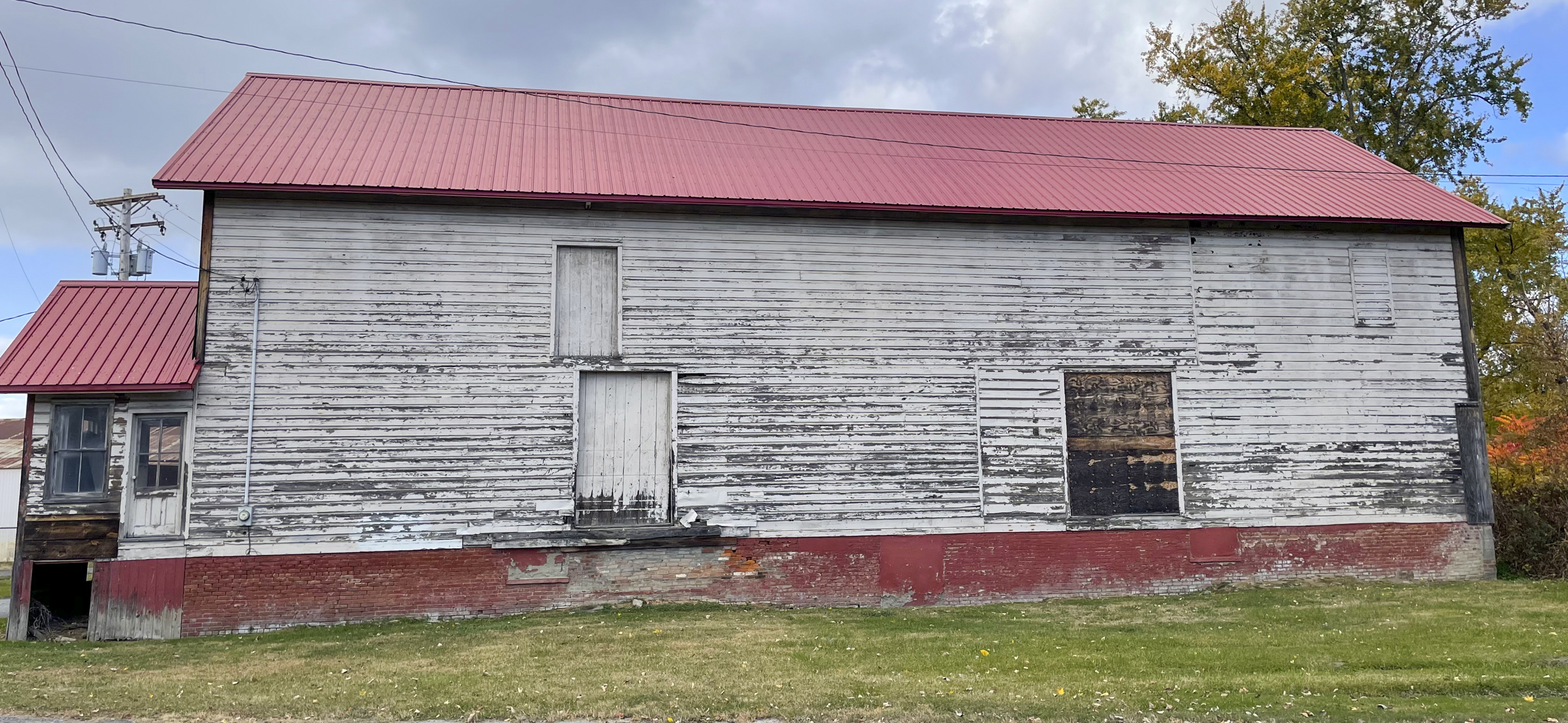
Dean's Mill in Coxsackie, New York


I have spent a fair amount of time over the past year in the northern Catskills of Greene County, NY, especially the area around Catskill, Athens, and Coxsackie* (cook-sahkee or "cook sake" as in cooking the Japanese wine,) NY. On one of my outings, I passed Railroad Avenue in Coxsackie on my way downtown and decided that sounded like a promising diversion. It was! I came upon the two structures shown herein, the largest being the old feed store and mill, known as Dean's Mill in its last iteration (Dean's Mill the business has moved to East Durham) and the smaller was "Geo. E. Van Vorst."

Coxsackie was on the West Shore Line which was part of several predecessor ventures that ultimately became part of the New York Central. For a brief history, you can visit this wikipedia page. Like much railroad history in the US, there were many players and several busts and acquisitions along the way. There is enough business in Coxsackie to make it an interesting switching layout/diorama or as part of a larger West Shore-themed layout. Gems like these are always worth a stop and I am sharing the images here in the hopes it might spur on someone's modeling efforts. Enjoy!

All images can be viewed in a larger format by clicking on the image

In this historic image, an early iteration of L. Bedell (later Dean's Mill) can be seen behind the station. The tracks are part of the West Shore Line


1920 Sanborn Map Co. Fire Insurance Map, Library of Congress. Note the red arrows pointing to the two structures/businesses that are the subject of this post, L. Bedell (later Dean's Mill) and Geo. E. Van Vorst. The map is oriented with north oriented down and left, as the arrow in the map indicates


This and the following images are of what is Geo. E. Van Vorst on the Sanborn map


Saturday, April 6, 2024

New York Central USRA Design Automobile Cars


Fayetteville, NC, Oct 12, 1952, Col. Chet McCoid photo, Bob's Photo

In 1922-1923, the Michigan Central added 4,000 automobile cars based heavily upon the USRA-design steel box cars that were the de facto standard box car of the NYC System from the 20s into the 50s. They had the same rather diminutive inside height (for an auto car) of 8'7". They were delivered in three groups: NYC Lots 440-B from Standard Steel (Hammond, IN, car nos. 96000-97999,) 464-B from American Car & Foundry (St. Louis, car nos. 98000-99499,) and 465-B from Standard Steel (Hammond, IN, car nos. 95000-95499.) They had auxiliary doors with a door opening of 10 feet. They were eventually renumbered into NYC reporting marks, series 189300-190999, 145400-146999, and 194000-195498.) Most (if not all) of the cars were built with Camel-Gilroy doors, like those shown on NYC 189735, above, and some cars, like NYC 189735, shown above, had their auxiliary doors sealed, making them into box cars. NYC 146479, shown below, had Youngstown doors and also received a replacement Murphy rectangular panel roof.

Fayetteville, NC, Oct 22, 1951, Col. Chet McCoid photo, Bob's Photo

Between 1930 and 1932, The NYC increased the height of many of these cars by adding plate steel sections at the top of the sides and raising the roof. An indeterminate number also received replacement Murphy rectangular panel roofs, as well, although photos show that many continued on with the Solidsteel roofs (lacking raised panels.) The raised roof cars were eventually assigned to series 194000-195498.

Charles Winters Collection

Paul Dunn photo, R. J. Burg

These three prototype images (above and below) illustrate how the cars appeared after the modifications. Note the Solidsteel roof and two extra Murphy end corrugations on the car shown below. 

crop of "Milwaukee Road, general view of part of Galewood Yard, Chicago," Jack Delano photo, FSA-OWI Collection, Library of Congress, call number LC-USW36-619


Years ago, I built a Westerfield kit to replicate one of the cars that continued on with its original 8'7" inside height, as shown above. While Broadway Limited released a specific version of the NYC System's USRA design box cars, Westerfield is still the only way to model many variants (including the most numerous varieties.) 

Sunshine Models also produced a kit to replicate the raised roof variants. These went out of production with the death of Martin Lofton. However, Yarmouth Model Works has resuscitated this model, with one-piece body casting.


I was fortunate to have one of the Sunshine kits in my stash and decided to start building it. As it's a flat kit, one has to assemble the sides and ends and then add the roof and floor to complete the basic assembly. I did all that, following my usual process, the most important part of which is to true up the sides first (equal length and square edges... it's been awhile since I have detailed that process, so I will post about that in the next couple weeks, with commensurate detail.) The biggest hurdle, as shown in the photos above, was that the lines of the peaks of the ends did not match that of the roof. To overcome that, I finessed things into place. My approach was to glue [ACC] the roof to one half of the top of the ends and also one side. You can see in the photo of the end of the car, how the roof is attached at the left, but the right portion is raised (not yet glued.) I let the half that was glued dry thoroughly and also augmented the joint with some 0.125" square styrene on the interior of the body where the side and roof abut. I then repeated this process for the other side. This resulted in a clean and strong assembly with the underside of the roof matching the peaks of the ends. I will continue this build in a future installment.

Friday, March 3, 2023

Flat Car Friday - New York Central 70-ton AAR Flat Car


While this image is far from great, it does display two things that I'd like to see more: loads of crates and NYC 70-ton AAR flats. Crates are a fairly simple load to create from styrene stock or the old Sunshine export crates load, if you have one. They are easy to customize by creating your own lettering and printing decals in black stenciling or having them printed by a third party, such as PDC. They are also simple to secure using Chartpack or similar tape to simulate the banding.

I also rarely see models of the NYC 70-ton AAR flat cars in HO. It cannot be a lack of offerings since Intermountain has produced quite nice replicas and Sunshine also offered kits that still appear on the secondary market and do not fetch exorbitant Sunshine prices since there is a good styrene alternative. Protowest also briefly offered resin kits for the 70-ton AAR flats, although they are a bit crude, in my opinion. Fine decals are also available from National Scale Car. With a fleet of 1,000 cars, they are significant flat car prototypes that warrant inclusion in just about any model fleet.

I plan to take my own musings to heart and complete one in the near future.

Tuesday, December 17, 2019

More Prototypes for Universal 5700XL Hand Brake with M2049 Hand Wheel


PFE R-40-20 45819, Baltimore, Maryland, Sept. 28, 1951, Col. Chet McCoid photo, Bob's Photo

I have been doing some additional sleuthing and have found several more prototypes that can use the Universal 5700XL Hand Brake with M2049 Hand Wheel as created in HO scale by Kadee. Here they are, with photos in some instances. This list is still a work in progress. 
Previous post may be accessed via this link.

  • Chicago and North Western Modified 1937 AAR Box cars nos. 71000-71998, 76900-77414 and 80252-81450 (all even nos.) Also, CNW 73154, even though the Hawkins Mod. '37 AAR data indicates that it shouldn't have this hand brake.
  • Chicago and North Western 50-foot Express Box cars nos. 68000-68048 (even) 
  • Chicago and North Western Hart Ballast Hopper cars nos. 13501-13999 (odd)
  • Chicago, Minneapolis, St. Paul & Omaha Express Box cars nos. 20000-20048 (even)
  • Erie Hopper cars nos. 28600-28899
  • New York Central Lot 694-B Automobile cars nos. 62300-62599
  • [I am quite certain that there are a lot more New York Central System (NYCS) box cars that used this power hand brake, as it seemed to the design of choice for the NYCS from the late 1930s to the mid-1940s; I am basing all listings upon photo sources and other verifiable materials.]
  • Pacific Fruit Express R-40-20 Refrigerator cars nos. 45701-46200
  • Pacific Fruit Express R-40-23 Refrigerator cars nos. 5751-6000, 7001-7500, and 47703-48202
  • Pacific Fruit Express R-30-21 Refrigerator cars nos. 64135, 64973
  • Pacific Fruit Express R-40-18 Refrigerator car no. 60417… maybe
  • Pacific Fruit Express R-40-24 Refrigerator car no. 68057
  • Pacific Fruit Express R-50-5 Refrigerator cars nos. 200367, 200375 (likely the entire series 200301-200375)
  • Union Pacific B-50-17 Box car 180931 — Ajax with Universal M2049 wheel
  • Union Pacific B-50-36 Box car 195381 (likely others, too)

 
  • Burlington Refrigerator Express 74000-74499 and 74500-74697 Emergency Refrigerator cars
  • Fruit Growers Express 38000-38199 and 38200-38265 and 38266-38373 Emergency Refrigerator cars
  • Western Fruit Express 66400-66499, 66500-66549 and 66550-66624 Emergency Refrigerator cars
  • Fruit Growers Express 38375-38499 Refrigerator cars
  • Fruit Growers Express 38500-38634 Refrigerator cars
  • Fruit Growers Express (FOBX) Overhead Bunker Refrigerator cars


Monday, November 25, 2019

Universal 5700XL Hand Brake with M2049 Hand Wheel


In my recent post on the Kadee early version of the 40' PS-1 box car decorated for New Haven, I noted the new Universal 5700XL power hand brake with M2049 hand wheel (and NOT the significantly more common M1704 hand wheel) on the model. Although it is incorrect for this particular New Haven PS-1 (or any New Haven car to my knowledge) it does have several applications. Here is a list of prototypes I have assembled (with photos in some instances) that I am sure is by no means exhaustive:
  • CNW Emergency box car (photo below)
  • CNW Modified 1937 AAR box car
CNW Emergency box car at left. Note top operated coupler
EJ&E Modified 1937 AAR box car at right. Note Barber S-1 trucks and Wine ladders
  • DICX 218 dry ice car (Mainline Modeler, March 1986)
  • EJ&E Modified 1937 AAR box car (photo above)
  • IHB 1937 AAR box car Lot 729-B
  • IHB Modified 1937 AAR box car Lot 730-B
  • MDT 500-series/8000-series refrigerator cars (Mainline Modeler, March 1986)
  • NRC 17000-series refrigerator cars (Mainline Modeler, March 1986)
  • NYC 50' AAR box car with end door Lot 693-B
  • NYC 10'0" inside height Postwar AAR box car Lot 737-B (many reassigned to Pacemaker service, photo below)
 
At left, the old way to simulate this style of Universal hand wheel, using a Detail Associates Ureco part, on a kitbashed model of an NYC Lot 693-B end door box car
Right, a postwar 10'0" inside height AAR box car from Lot 737-B transitioned to Pacemaker service
  • P&LE 50' AAR box car Lot 698-B
  • PRR X38A automobile car (photo below)
  • PRR X38B Emergency box car
  • SP and T&NO B-50-25 10'0" inside height 12-panel box car (car nos. SP 21500-21749; T&NO 54850-55199)
At left, a PRR X38A automobile car with Universal power hand brake and, at right, a closeup of the same hand brake on the lone X38B Emergency box car (note M2049 cast into the wheel at roughly 5 o'clock)
  • UP HK-50-5 Emergency ballast hopper (photo below)
  • some of the UP (and sister line) B-50-24 and -27 alternate center rivet (ACR) lightweight box cars may have used this version of the Universal hand wheel. Photos needed for verification
Union Pacific HK-50-5 Emergency ballast hopper


Wednesday, January 2, 2019

Wordy Wednesday - New York Central PS-1 NYC 169664


This photo of NYC 169664 seemed vaguely familiar to me when I looked at it a couple of days ago. Strip the paint, change the hand brake to a Miner hand brake, and then repaint it like Lake Superior & Ishpeming PS-1 LS&I 2242 that I profiled on this blog a few days ago and you would have the same car. They used the same New York Central-style placard boards, including their locations, the same welded-on roping loops, and the same arrangement of the lower corners, including push pole pockets, side sill angle sections, and "un-PS-1-like" uncoupling devices. So, as I modify my Kadee model of LS&I 2236, most or all of those changes apply to NYC 169000-170499 specifically depending upon the doors, as well as to NYC 170500-172499. The cars in the 169000 series were essentially from the same Pullman-Standard lot, 5965 for NYC 169000-170499 and 5965A for LS&I 2226-2275. Details for the NYC cars are noted below. If the 50 cars of the LS&I are a little too obscure for your tastes, perhaps the 3,500 built for the New York Central in 1950-1951 are more to your liking.


Note the New York Central paint data triangle at lower left of car side on NYC 170750. This is the earliest instance this blog author has seen of the paint data triangle in use. This car was built in February, 1951

Between 1950 and 1951 the New York Central received 3,500 40' PS-1 box cars from Pullman-Standard. The details are as follows:

*7-panel Superior door with third panel from top wider than other panels

There were also 1,000 cars delivered in 1948 and 500 cars delivered in 1952. These are each different and not covered in the data presented above.

Thursday, January 28, 2016

Interesting New York Central System Auto Car End

We humans are drawn to the unusual. It may be our natural programming for survival to spot the unusual or different things around us. Whatever the cause, many of us manifest that in our selections and choices of freight cars. We want vinegar tank cars, auto frame loads, three-, four- or even six-compartment tank cars, the PFE reefers that had the colors in the stripes in the UP shield accidentally reversed when painted by a shop, etc. However, the laws of probability and statistics dictate that as rarities, anomalies, and oddballs pile upon one another, they become more and more unrealistic. That doesn't stop us from craving them, though.
from Standard Oil of New Jersey photograph
This portion of the end of NYC 196551 was a very small portion of a photo of a worker tending to a UTLX tank car in a Standard Oil of NJ photo. My attention was captured by the large corrugation in the top of the end. It is roughly triangular in shape. I scanned the image to focus on this car.
It turns out that it is part of a group of 1,000 cars built by MDT in 1926-1927 and 1928 and assigned to series 53000-53499, Lot 540-B and 53500-53999, Lot 572-B, respectively. They had end doors, as shown above, plus 10' door openings and a cubic capacity of 3,544 feet. By the time of this photo, the car above had been renumbered into the series 196500-196999, a transition started for this series of cars in 1941 (the other series was renumbered into 196000-196499 at the same time).
Sirman Collection
MDT also constructed an additional 1,000 cars for NYC Lines road CCC&StL in two groups in 1928 and 1929. These cars share the same basic design, right down to the 3,544 cu.ft. capacity, but had 12' door openings instead. The first group was assigned to CCC&StL 91000-91499, Lot 578-B, and the second group was placed in CCC&StL 91500-91999, Lot 585-B. Beginning in 1937, they were merged into series NYC 58000-58999, and three short years later, in 1940, were assigned to NYC 67000-67787. In 1941 and 1943, they were split back into two groups, 203000-203499 and 203500-203999, respectively. It is unclear if the 1941 and 1943 renumbering resulted in mixing of the original lots.
For both types of cars, there were additional renumberings and conversions to box cars and plating of the end doors in the 1950s. As I develop my CAD capabilities, I will put this end door car, with its distinctive corrugation, on my to-do list. It's unusual and there were 2,000 cars with this end door design, making it less of an oddball car.