Showing posts with label Bill Welch. Show all posts

Thursday, October 24, 2024

Bill Welch's FGEX Consortium Book


Since the passing of Bill Welch, I have received many inquiries about the book that he was so passionately engaged in creating. I thought it probably a good time to share some insights into the status of that project. Many of you are aware that Bill handed that off to me when he realized that his time was growing short, even though it was already decided that I would publish it. Sadly, his time was shorter than we imagined and he passed before we were able to arrange for a proper discussion of what he had done, where the files were located, etc. The result is that I have been scouring his two computers and an external hard drive to piece together the parts of the book. Bill seemed to have believed in repetition, as there are many, many folders that are duplicated (maddeningly, not exactly duplicated) in various places on these drives. I continue my work of sorting through it. To put it succinctly, the project moves forward, although it is not yet press-ready by any stretch.

P.S. many have offered aid in the form of sorting, proofreading, etc. I appreciate those offers and when the time is right, I will gladly avail myself of those offers. However, it is still not yet that time so I appreciate the continued patience. Thank you

Sunday, July 31, 2022

Sunshine Models X28A/X29 Detailing with Bill Welch


When converted from auto cars, many of the X28A class cars received spliced doors as illustrated here. Bill used the kit door with a strip of 0.005" styrene and rivets to simulate the splice

Over the years, Bill and I had been working on several blog posts demonstrating some of his modeling efforts. Unfortunately, many of them will remain as unfinished projects due to the loss of Bill almost two years ago. It seems fitting to share as many of them as I can present, even in an unfinished state, as Bill's detailing was really the heart of his modeling efforts. What follows are some of the things he did to dress up Sunshine Models kits of the X28A and X29. The captions try to explain the images, which, as was usual with Bill's work, speak for themselves.

This is the "stock" Sunshine X29 with many of Bill's upgrades including a scratchbuilt placard on the door

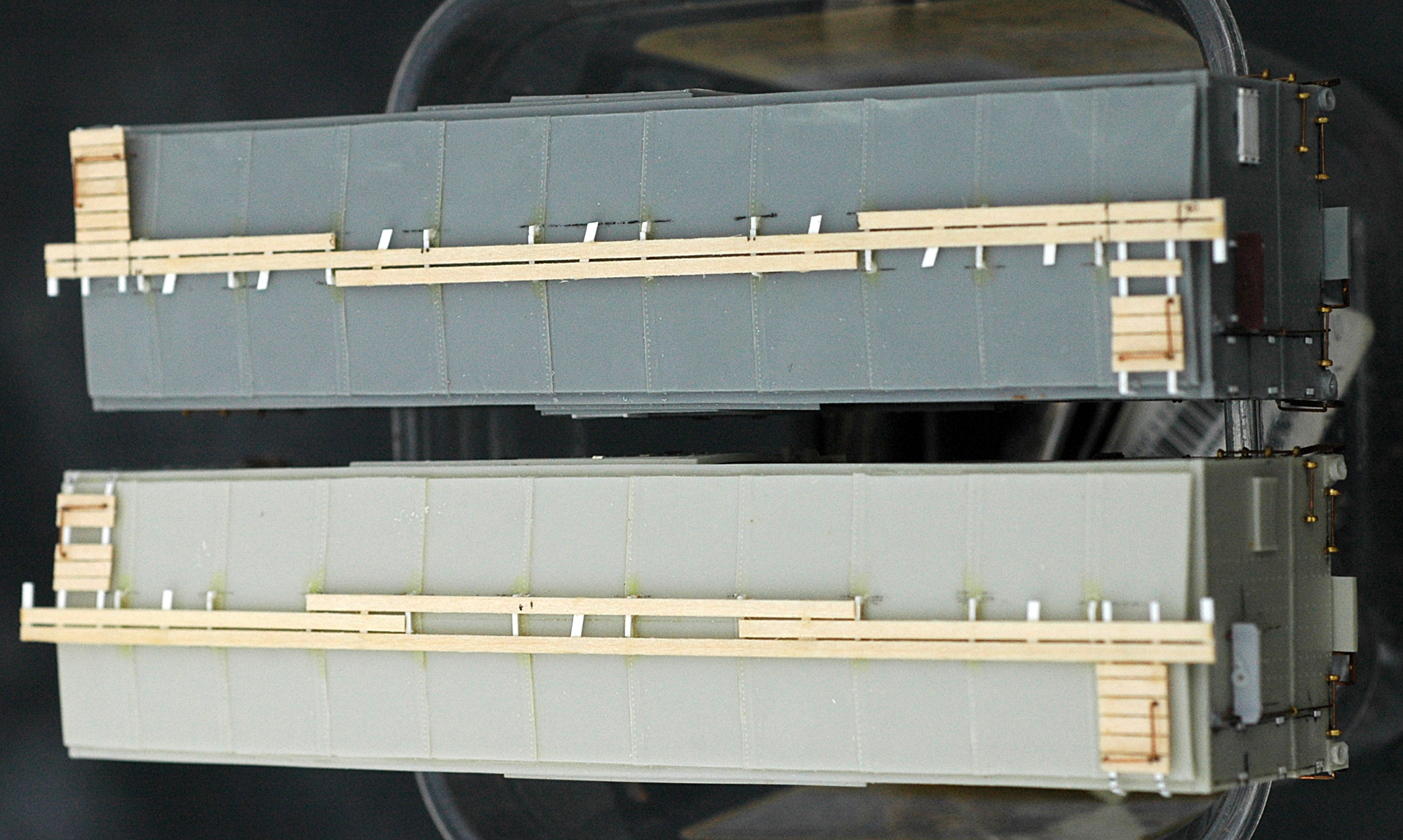
Bill frequently used wood strips for cars that had wood running boards. He would add many, to be painted the same color as the roof, and leave off a couple to be "unpainted" boards added as repairs. The "missing" boards here would be added after painting.

The corner grab irons on the roof had a long leg and corresponding hole in the roof, to be used to "pin" the latitudinal running boards in place

This image shows the lower left corner of the side of the X28A. Details include Tichy rivets at the body bolster, a Red Caboose route card board (from an X29 kit), brass cast bracket grabs (using the Red Caboose X29 parts as masters) and Yarmouth Scale Models sill steps pinned with brass

Here is the lower right portion of the X28A, including Red Caboose door stops and styrene mounting pads for the ladders

This is a closeup of the lower left of the side of the X29. The details are similar to the X28A shown above

The lower right of the X29

This image shows the B end of both the X28A, at left, and X29. Note the difference. in height.

This is a closeup of the brake step and pressure retaining valve on the X28A

Bill used Red Caboose ladders, but replaced the rungs with 0.010" styrene rod

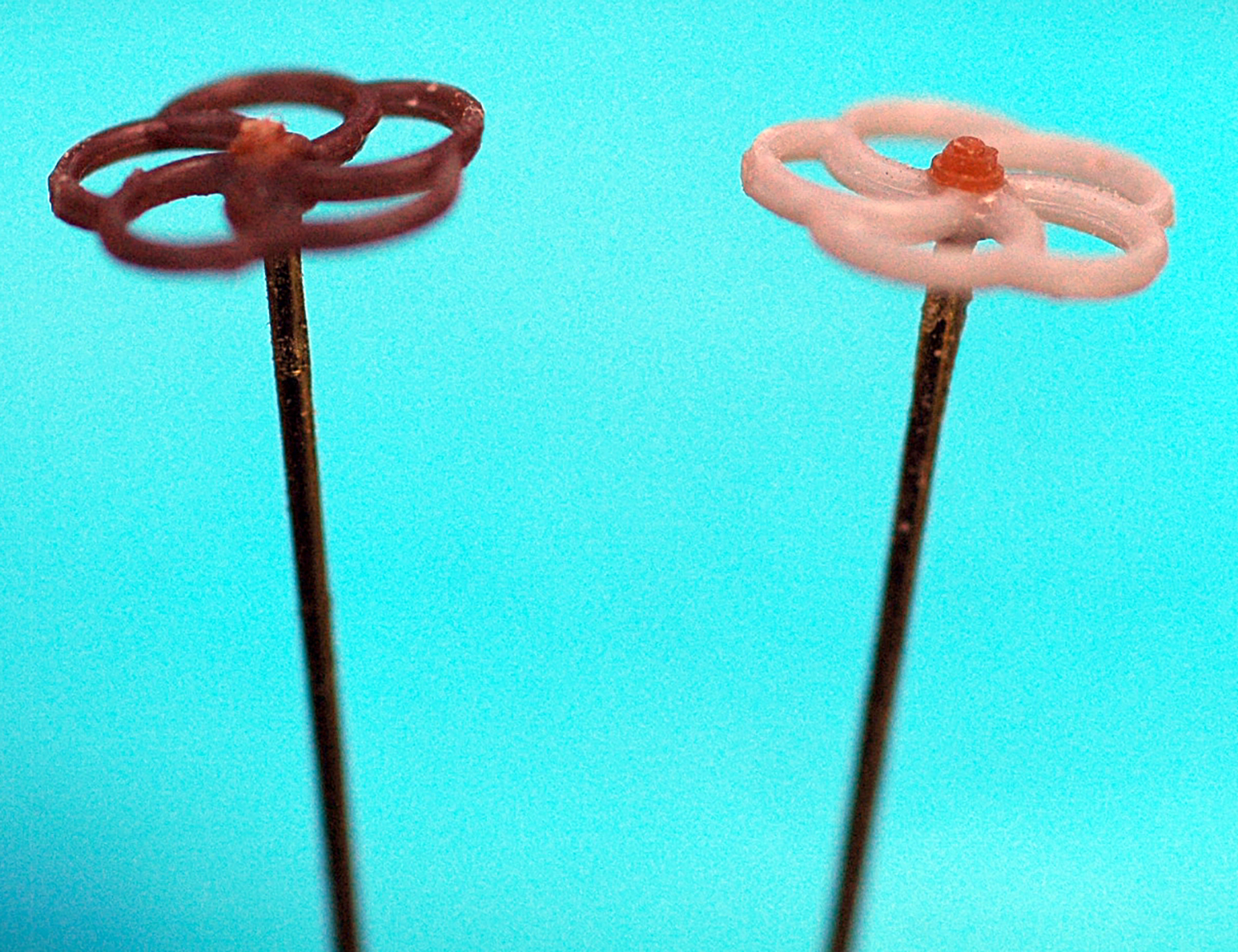
Bill added Red Caboose hand wheels with Tichy nut-bolt-washers (NBW) at the top


Monday, November 23, 2020

Bill Welch


Courtesy of John Golden

I lost one of my best friends on Sunday, November 15 when Bill Welch succumbed to cancer. He was a kind soul, a kindred spirit, and a companion of almost 25 years. 

I met Bill in 1996 at the Friends of the Freight Car dinner in conjunction with the NMRA convention at Long Beach. He and I were both new to the freight car "mafia" modeling community so we shared a bond as the slightly awkward entrants to a party where others knew each other well. From that point on, we were roommates at just about every RPM event we attended together, including more Napervilles, Cocoa Beaches and St. Louises than I can count, as well as other meets from time to time. We would often muse about our "Christmas morning" when the Sunshine sales room would open at Naperville, with all the new releases for that year. Before turning off the lights at night we would peruse each other's stacks of photos that we had acquired that day, making notes about ones we, too, wanted and discussing the modeling possibilities.

Bill shared my love for World War Two era aircraft (and modeling). We were also "tool guys" seeking the latest gadget to aid our modeling efforts. Baseball was another deep love in common and we both shared many conversations over the winters, close to our "hot stoves" discussing trades and signings and the fates of his Dodgers and my Red Sox. We spent countless hours discussing politics and policy, as well, both being passionately interested in the subjects. He was a "breakfast person," too, and I will always remember his quest to find good places for early morning grub wherever we were.

I will miss him deeply. He approached every day with a positive spirit and attitude and couldn't wait to share that with others. As a minister, it is interesting to note that some of his greatest sermons were about detailing models, overcoming the paralysis one can face when tackling a project, and his love of airbrushes and painting and releasing that zeal in others. Of course, he also preached about the Fruit Growers consortium. I am humbled to carry that torch to bring his work to fruition as a book. I am deeply honored to be able to make his vision and passion a reality for others.

There is a virtual celebration of Bill's life and legacy planned for December 9th (details will be shared at all the various groups.io lists, Facebook, and the Speedwitch site.) He touched many lives as a photojournalist, minister, and modeler as well as a friend to many.

Rest in Peace, my friend. I can't imagine the RPMs without you. I hope wherever you are, the Sunshine tables are filled with lots of new releases!

One of Bill's last projects

Sunday, November 27, 2016

Creating more realistic ladders in HO Scale

This guest post is courtesy of Bill Welch and highlights his love of upgrading details on freight car models...
It began innocently I thought. In 2015, I made the rounds of Cocoa Beach-Prototype Rails, Collinsville and Lisle (now the Chicagoland RPM) with a presentation entitled Xxtreme Modeling. In this presentation I spotlighted a model of one of the Tennessee Central’s (TC) steel box cars where I claim I improved several details including the InterMountain styrene ladders included in a resin kit from WrightTRAK, using Plastruct 0.010" styrene rod. (Grandt Line also makes 0.010" styrene rod but it is gray; Plastruct’s rod is white making it much easier to use for making new ladder rungs.) Then in late 2015 it became apparent that with the aid of my friend Andy Carlson, through his relationship with InterMountain (IM), I would be able to acquire more Red Caboose X29 and 1923 ARA kits. (The Red Caboose molds are now owned by InterMountain.) Given the possibility I could add to my stash of these kits, I decided I would finally build the several models I wanted based upon these kits. Meanwhile, I did much hand wringing because I realized I had not purchased any undecorated Branchline 40-foot Postwar AAR steel box car kits and was caught napping when they sold their line of freight car kits to Atlas. I wanted several of these to build for the various Ya’ll Road owners of these cars. Through friends and the Atlas website, I have been able to acquire enough kits to build the models I want and I have started working on a couple of Branchline kits (A&WP and WofA). I am also working on two Atlas 1932 ARA kits (Erie and M-I) and two InterMountain AAR 1937 Modified Kits (Southern and KO&G). So I guess that 2016 is my “Year of Styrene faux Steel" (Now clearly stretching into 2017, hah).
Photo 1
Okay enough background, now onto the subject of improving kit ladders. I have been scratchbuilding ladders now for several years when it is warranted. Especially with wood sheathed cars ladders tended to vary. This is how I became comfortable using the 0.010" styrene rod. The TC model (photo #1) was the first time I used Kadee’s very fine bracket grabs. (Yarmouth Model Works sells a drill template for these.) Once these were mounted on the car I knew the IM ladders furnished in the kit would not do with their now visually heavy ladders rungs or treads. Leaving the ladders on their sprue for stability and strength I used sprue nippers to cut off the molded-on treads (photos #2 & 3). 
Photo 2
Photo 3
I don’t remember now but I may have also used them to pinch off the bolt detail: Just as likely I used a trusty Single Edge Razor Blade (SERB) to do this. I used the SERB to cut the rod into several small sections and proceeded to glue the rod onto the stile using liquid Testors and a small brush, locating them using whatever vestige of the molded-on treads still existed. (photos #4 and 5)  
Photo 4
Photo 5
This goes pretty quickly and it is not difficult to get most of them in place at 90°. Where I miss getting them straight, it is easy to go back and wet a joint with Testors to loosen it and get it straight. I let the ladders dry overnight and then used my nippers to cut the excess rod. Once the model was painted I was very pleased with the result. (photos #6 & 7)
Photo 6 
Photo 7
Whenever possible, especially with something like steel cars of a standard design, I like to build two or more models at a time so that I can do the repetitive steps concurrently. Detailing underframes and building the brake system two-at-a-time is faster than one-at-a-time ultimately for example. This certainly applies to modifying kit ladders so I am working on several sets currently. I decided to change my approach a little bit, cutting the treads off at an angle so as to leave a little nub of styrene (photo #8). 
Photo 8
These nubs give me something to aim at when putting the bits of rod in place and also give the rod sections a small base of styrene, making a solid joint. This way some of the bolt detail on the stiles remains. The downside is that I need to cut each section of rod to the same length. Photos #9, 10 and 11 show the result on a set of B&O 7-rung ladders.
Photo 9 - the molded-on treads compared to the new 0.010" treads
Photo 10 - a completed ladder
Photo 11 - the new ladder on the model
Atlas makes things a little harder as the detail parts in their kits come cut from the sprues so I had to improvise a way to hold them steady while worked ladder for their 1932 ARA steel boxcars. Taping their ladders to metal ruler (photo #12) made it easy to hold them rigid yet the metal meant the ladder would not accidentally get glued to something. Photo #13 shows what the improved ladder looks like on the car side.
Photo 12
Photo 13

Photos #14 and 15 show a set of ladders for a Maine Central 1923 ARA boxcar with new treads in place with their mounting straps in place also. I am going to wait until I am ready to glue them in place to trim the ends and cut them from the sprue

Photo 14
Photo 15
Photos #16 and #17 show Red Caboose X29 and InterMountain AAR 1937 Modified kit ladders, respectively.
Photo 16
Photo 17
Photos #18 and #19 are Branchline Postwar AAR kit ladders in process and completed. This kind of work takes a little more time but for the present I like the result. You must decide for yourself if you like the results.
Photo 18
Photo 19