Showing posts with label R-40-25. Show all posts

Monday, June 15, 2026

PFE R-40-25 Completed


I recently completed the final weathering and detailing on the PFE R-40-25 pilot model for the Speedwitch parts set [previous post linked here.] I am extremely pleased with the outcome. The details turned out almost exactly as I envisioned, particularly the hatch cover supports, the ladders, and the underframe. I doubt I will ever look at another car with Equipco hatch covers the same way again. It's fun to see the details "pop" under some weathering.


Regarding weathering, I used a variety of dilute washes, beginning with Tamiya Brown Panel Line Accent Color on the roof, panel lines on the sides, and overall on the ends and underframe. I added Tamiya black paint to the fan shaft detail on the car sides and then removed most of it with a cotton swab. I used mineral spirits to slightly dilute the panel line wash on the sides. I sealed everything with a flat coat and added washes of artists' oils, including a dilute grey mix overall and a few heavier light grey streaks on the sides, especially under the hatch areas, as well as on the ends to simulate spray from the wheels of adjacent cars. I applied another flat coat and then used Bragdon powders on the sides (a light grey) and PanPastel Paynes grey on the roof, ends, and underframe. 


The chalk marks are from National Scale Car


Sunday, May 31, 2026

Pacific Fruit Express R-40-23/-25/-26 from NERPM


Mostly completed weathered R-40-25

I presented a discussion about the PFE's 10,000 strong postwar reefers in the R-40-23, -25, and -26 classes at the recent NERPM. The presentation can be accessed via the Speedwitch Files page.

Tuesday, April 28, 2026

PFE R-40-25 off to the paint shop


The steps, ladders, and side sill and bolster support tabs match the prototype

I posted about the prototype PFE R-40-25 class a little while back. Here are some photos of the model that I snapped before it went off to the paint shop...

The goal with this parts set is to not only fix the issues of the Amarillo/Intermountain offering, but to bring the rest of the model up to 2026 standards. The Intermountain R-40-23 tooling is almost 32 years old!

Ordering is open for these and for once, I actually have more than just a handful ready to go!

Look at those "open" hatch supports and straps that prevented damage to the hatches when fully open

The ladders mount to the edge of the roof, just like on the prototype

The rests to support the hatches when fully open are etchings added to the roof seam caps, as per the prototype


The brake gear arrangement is modeled exactly after the prototype, right down to the brackets and manual "pin" adjuster


The crossbearers are "open" and crossties have the channel shape of the as on the prototype's welded underframe 


Friday, April 3, 2026

Pacific Fruit Express R-40-25 Refrigerator Cars


The placard held by the gentleman at center reads, "Here she is boss. She looks mighty fine and so will the other 499.The crew that built her." This is presumably the Colton, Calif. PFE shop crew

For modelers, the PFE R-40-25 class has taken a back seat to the more numerous R-40-23 and different, e.g. visually interesting, R-40-26, with flush mounting ("plug") doors. The R-40-25 class was 3,000 cars total, nos., 2001-5000, built in 1949 at the PFE's Los Angeles (2001-3350,) Colton (3351-4000,) and Roseville (4001-5000,) shops. The Intermountain models of the R-40-23 went a long way toward filling the needs of postwar Transition era modelers. In cooperation with Intermountain, the Amarillo Railroad Museum offered R-40-25 kits based upon the R-40-23. While this is certainly a good path to follow, it resulted in models that incorporated several errors, both large and small, that make these kits stand-ins for discerning freight modelers.

The B end of R-40-25 no. 2001. Of note are the uppermost main rib, with flat bottom, the narrow pressed rib at the top, and the arrangement of the side ladder, attached to the sill step at the bottom, which is in turn attached to the bottom of the side sill as well as the attachment of the ladder stiles at the top, using curved pieces of metal connected to the roof. The side ladders are not actually attached to the car sides at all.

End from an R-40-25 kit

Resin end from Speedwitch

Incorrect (and poorly rendered) lettering on Intermountain/Amarillo R-40-25

The largest of the errors are in the ends and the as-delivered lettering. The ends of the -25 class were an iteration of the improved Dreadnaught end and different than those of the -23 class. Changes included the incorporation of a small, rectangular stiffener bulge at the top of the end and revision to the main top rib, making it straight across its bottom and shallower in relief from the surface of the end, compared to the other five main ribs. The Amarillo ends tooled by Intermountain ignored the change to the top main rib and the small rectangular rib appears too proud from the surface of the end and not wide enough from top to bottom.

PFE R-40-25 no. 4246 as it appeared soon after repainting at Tucson, Ariz., in May, 1953

The other major error is the lettering on the as-delivered cars. In 1948, the Union Pacific medallion was changed from red, white and blue to black and white. This change was missed for years by researchers and modelers alike. It was only after I started to see the medallion in color photos and then shared that info and consulted with Dick Harley that the error was revealed. There is no blame in this, but it doesn't change the fact that the models are incorrect on that detail. Fortunately, there are now decals that correct that issue, from National Scale Car.

This image was recorded at a time of day when the sun's light was low, affording a great view of numerous details, especially the underframe.


The other issues are more nuanced and involve finer points of detail. Here they are in no particular order:

  • the side ladders should be integrated with the lower sill steps and attached to the edge of the roof via a trapezoidal, curved piece of plate (the Amarillo/IM -25 cars took a half-stab at this issue)
  • the side sill supports ("tabs") should be shaped differently; additionally, the Intermountain long tabs under the doors do not have a flat surface, but a wavy one due to the molding process
  • the welded underframe is quite distinctive (on the -23, -25 and -26) and the Intermountain underframe is rather simple
  • the drains for the bunkers are very crude on the IM kit
This is a stop frame screen shot from a video on the PeriscopeFilm channel on youtube... that I cannot find now to provide the title! [if I do, I will update this post.] However, it is a great illustration of the black & white '1948' Union Pacific medallion.

A little more about the '1948' PFE painting and lettering... in 1948, the word "VENTILATED" was dropped from the stenciling between the two medallions. If looking at a black & white photo, that change is a fairly good yardstick to determine if the UP medallion is red/white/blue (VENTILATED REFRIGERATOR) or black & white (only stenciled with REFRIGERATOR.) However, that is not a hard and fast rule, as I have found a few examples of cars stenciled with "VENTILATED REFRIGERATOR" and having black & white UP medallions. These examples are likely artifacts of errors immediately after the change was implemented. [note: what I have never encountered in photos, and I have closely examined a LOT of color photos, is a single instance of a car with only REFRIGERATOR and a red/white/blue UP medallion... if you have a color photo illustrating this, I would love to see it.]

While PE 1614 was the focus of this image, the PFE reefer behind it and to the right is adorned with the scheme used on PFE reefers between 1948 and the beginning of 1950. The reefer visible at left carries the scheme introduced in 1950, the included "RAILROAD" in the UP medallion.

What I can state definitively is that the UP medallion used between 1948 and 1950 with the words "UNION PACIFIC" was black and white and NOT red/white/blue.

This image, while cropped, shows three cars with the 1946-1948 scheme (red, white & blue UP medallion on middle car,) 1948-1950 scheme (black & white UP medallion on right car [which also has "VENTILATED," likely a stenciling error by the painting and lettering crew]) and the post-1950 UP medallion, with "RAILROAD," on the car at left.

The timing of this post is because I am currently at work on the pilot model for a parts set to correctly model the PFE's R-40-25 class of cars. Details about that will follow in a separate post covering the models.

Again, apologies for the watermarks in the images, but the pirates get me down so this is my only recourse

Thursday, October 16, 2025

Where we are at...


I am typing this from an almost horizontal position. I was supposed to be arriving at Naperville today, but my balky back made other plans. So, I type this from home. It's been a couple months or so since I started things back up in earnest, including casting. As the "RPM season" sets in, I thought it a good time to share a little bit about what's coming over the next few months.


Some old Speedwitch stuff turned up: DT&I gondola, MEC ARA box car parts, NYC stock car roof and 50' combination rectangular and diagonal panel roof (some prototype details here.)

Parts sets have proven to be a good way to dip my toes in the casting pool. I mostly learned a few things about what shape of mold works best for me and how I like a few varieties of silicone. I am adding a couple wrinkles to the existing offerings. First, for the ATSF Bx-34 parts I have added the 1959-1970s scheme, illustrated in the photo at the top of the page. In addition, I have added Shadow Keystone decals covering 1950s+ schemes for the PRR X32A parts

This and the following three photos are of the R-40-25 parts


On the parts front, there are also a couple other offerings nearing release. The first is the PFE R-40-25. This set is intended for an undecorated Intermountain R-40-23 kit or any Amarillo/Intermountain PFE R-40-25 that is NOT the delivery scheme as the UP medallions on those cars are incorrect (I will share info on that when these parts are released.) The sets include correct resin ends and etched parts to correct/upgrade the underframe, side sill details, ladders, hatch cover supports, steps, etc. [there is a companion set for the R-40-26 that is in the works, as well; see undeframe photo below.] The other parts release is for the ITC 1937 AAR box cars with AC&F Carbuilder's ends and also includes resin details, etchings, and decals.

R-40-26 underframe floor casting... board-by-board!

Illinois Terminal AC&F Carbuilder's end for 1937 AAR box car (pre-production before changes)

Photo illustrating the extremely subtle ripples in the side sheathing of the PRR X43A

I am also charging ahead with some full kit offerings. The first is the Milwaukee 50' single sheathed auto cars that I teased awhile back. It will be released November 1st via the Speedwitch site (all decals, etchings, trucks, and other parts are already in house so they will ship immediately!) Another project is the Pullman-Standard-built Central of Georgia 10'0" inside height Emergency box car (PS if you have National Scale Car's set for the A&WP/WofA/Georgia, those decals will work on this model, as well.) If the CofGa offering proves popular, I will add Birmingham Southern, as well. I also have three PRR cars in the hopper: the G28, X43A and X45. The G28 is a project that I started years back. It will be a showstopper, with full underframe detail... and the underframe was a unique welded design with very interesting crossmembers so it bears full attention! The X43A was a 40', mostly postwar AAR design car, with welded sides. I have created patterns with extremely subtle waviness to the sides that I am extremely pleased with and they were unusual in the PRR universe in that they were delivered with black roofs. The last of these three is the X45, a proprietary PRR design for a 50' welded box car. I again added waviness to the sides and the Pennsy proprietary details, including the underframe, are really cool. 
The last of the full kits, but by no means least, and listed in its own paragraph, is a Western Pacific flat car built by AC&F in 1942 that is a fully 3D printed offering. It is spectacular. More details to follow on this gem...

A final tease... several years back I presented a clinic including details about scratchbuilding board-by-board patterns for single sheathed cars. I have been fruitlessly looking for those patterns for over a year. I thought they were lost in the past year's move. Well, a few weeks back, they were presented to me. Turns out I had sent them to someone along with a bunch of other stuff and they were returned! Here is the end for the car in question. IYKYK 


Thursday, March 9, 2023

Update on Etchings from Presentation

 During my presentation at the latest Hindsight 20/20, I alluded to the fact that due to the shipping delays in receiving my test etchings due to the Royal Mail hack from late December, I could not inspect and assess what I had received. I spent a few more hours looking at some of the parts, and have a few photos to share.

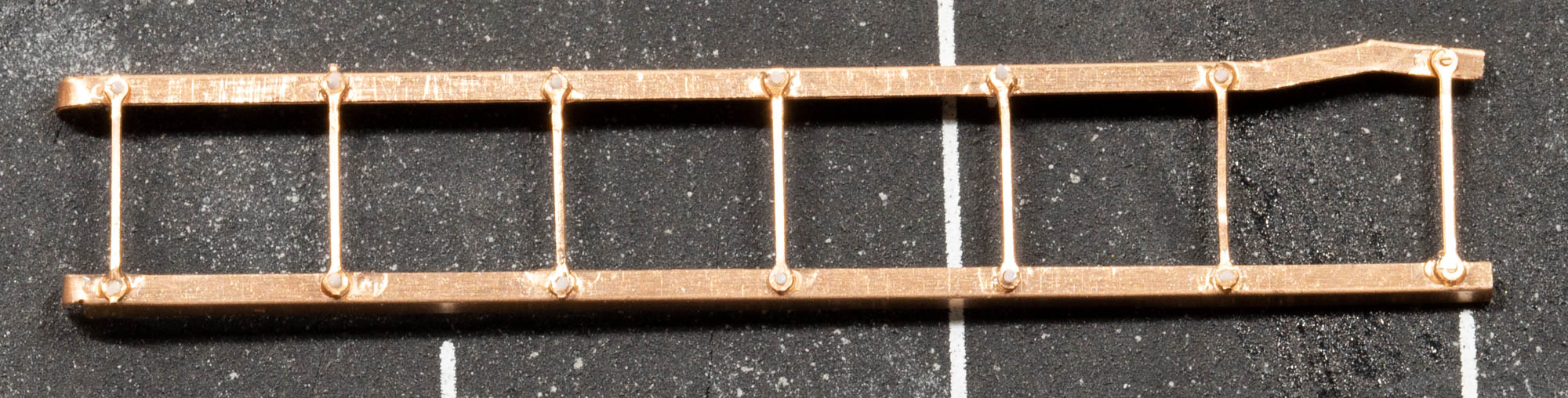
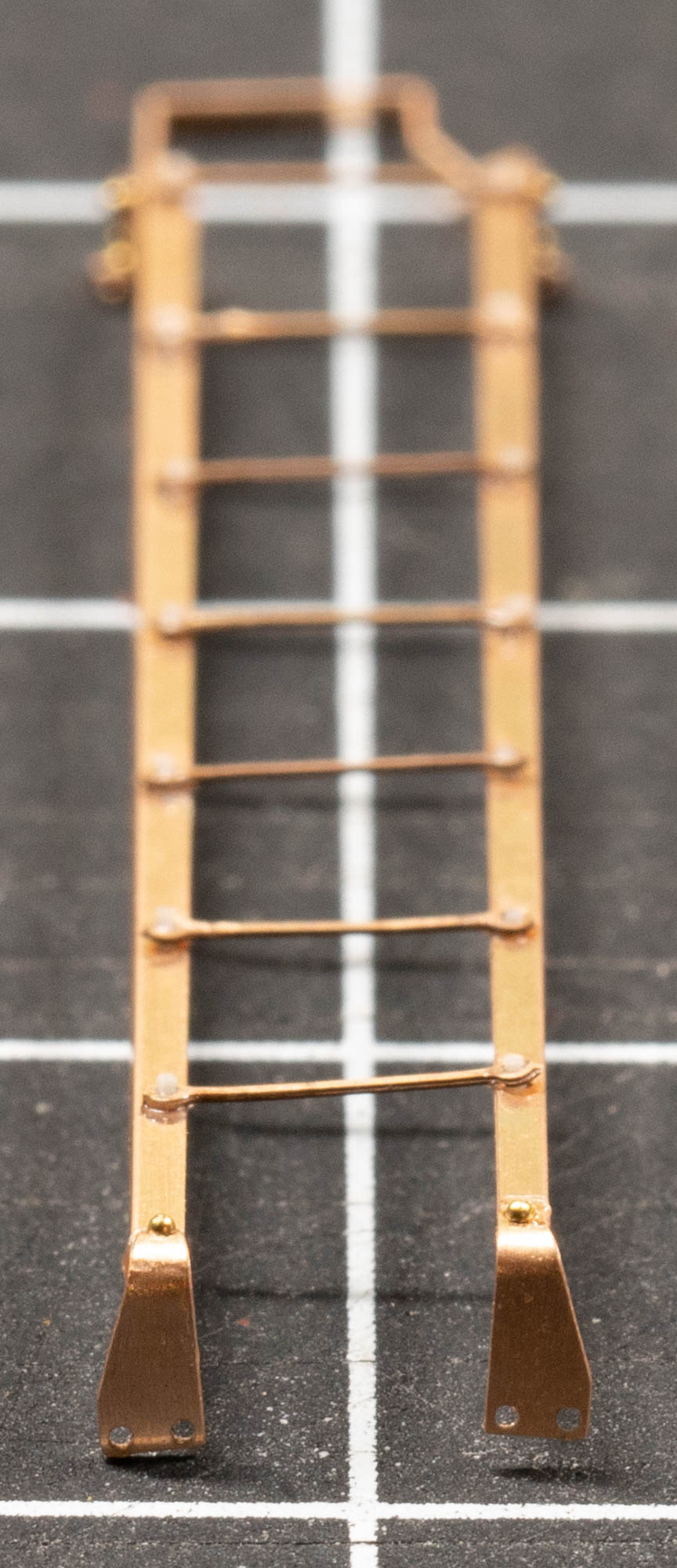
The first photos are of the ladders for PFE R-40-25/-26 reefers. The primary difference between the two is the -25 class used traditional ladders with treads (rungs) riveted to the ladders stiles while the -26 used Wine-style ladders where the rungs had bends that fit into holes in the stiles, that once attached to the car held the rungs in place. What is displayed here is the -25 riveted style. Compare the prototype photo, above, to the etchings shown below. The sill steps were attached to a bracket that was also integral to the bottom of the ladder stiles, with the entire assembly attached to the bottom face of the side sill in two locations.


The next group of photos are of etchings for a Chicago and North Western PS-1 auto car. Common to all but the earliest PS-1s, that arrangement featured an integral ladder stile, sill step, and bracket attached to the bottom of the side sills, similar to the R-40-25 shown above. [the prototype photo below illustrates this arrangement on a Maine Central PS-1 box car]

There was an interim style of end ladder on PS-1s, with a "jog" in the lower portion of the right stile. Early PS-1s had straight stiles, while later ones had the same "jog," but with two wider bottom rungs, as opposed to one. [note: I could've done a better job bending the little jog to make it straight!]

The last parts I will highlight are two types if zee bars. Most PS-1s had crossmembers that were 4" zee bars. An etching to replicate that is shown in two views. The other simulates a 3" zee bar that will be used to replicate the stringers between the body bolsters and end sills. The photo illustrates the cross section. Etchings such as these have many applications as zee bars were quite common. Until I have more to report...