Showing posts with label book. Show all posts

Thursday, October 24, 2024

Bill Welch's FGEX Consortium Book


Since the passing of Bill Welch, I have received many inquiries about the book that he was so passionately engaged in creating. I thought it probably a good time to share some insights into the status of that project. Many of you are aware that Bill handed that off to me when he realized that his time was growing short, even though it was already decided that I would publish it. Sadly, his time was shorter than we imagined and he passed before we were able to arrange for a proper discussion of what he had done, where the files were located, etc. The result is that I have been scouring his two computers and an external hard drive to piece together the parts of the book. Bill seemed to have believed in repetition, as there are many, many folders that are duplicated (maddeningly, not exactly duplicated) in various places on these drives. I continue my work of sorting through it. To put it succinctly, the project moves forward, although it is not yet press-ready by any stretch.

P.S. many have offered aid in the form of sorting, proofreading, etc. I appreciate those offers and when the time is right, I will gladly avail myself of those offers. However, it is still not yet that time so I appreciate the continued patience. Thank you

Wednesday, February 8, 2023

Stock Cars and a book


A pervasive myth among model railroaders is that stock cars were not freely interchanged and did not roam to any great degree. While I would absolutely grant that the average stock car was not interchanged in the same manner as a box car, stock cars did travel off line, sometimes great distances. I love the photo above from the Harrisburg, Pennsylvania area ca. late 1947 (Kalmbach Memorial LIbrary, Boob Charles Collection; prints available). In it, there are a couple PRR stock cars visible, but there are also three Santa Fe, one Union Pacific, one Missouri Pacific, and several other stock cars that I believe are SP/UP, but cannot be more definitive. The same collection also has images of two Northern Pacific stock cars. Stock was moved around for many reasons, providing license for modelers to include a variety of stock cars in operating sessions. To that point, I want to also highlight a phenomenal resource to understand the movement, handling, and operations surrounding live stock.


Steve Sandifer's Live Stock Operations: History, Equipment, Facilities & Modeling (published by the SFRHMS) presents the interesting and complex world of live stock shipping in a densely illustrated and cited work that should be in the library of every model railroader who even tangentially brushes up against live stock shipping. While it uses the Santa Fe as a backdrop, much of live stock shipping was governed by other agencies, meaning that what applied to one railroad applied to all. The book covers everything related to these shipments including things that happened before and after the railroad was involved. It is truly a fascinating glimpse into one of the more interesting aspects of railroading operations and history. It also includes material about modeling Santa Fe equipment and stock facilities. Even if you are not a Santa Fe modeler, you can easily justify having one or two (or more for some) cars as the Santa Fe fleet of stock equipment was enormous.


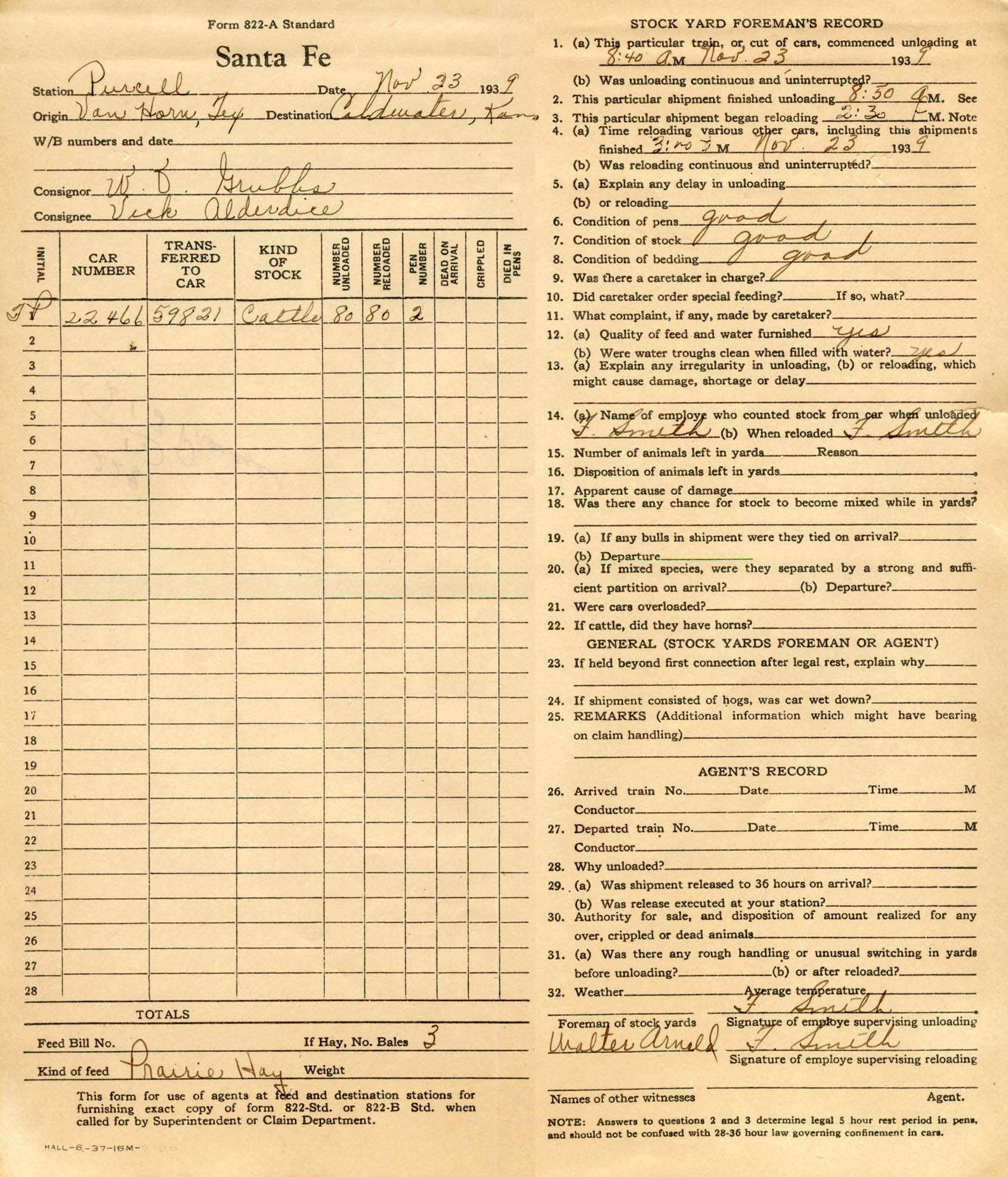
Years ago, Stan Hall graciously sent me copies of Santa Fe switch lists related to stock moves, as well as a small number of original switch lists and Stock Yard Foreman's Records. I am including scans of the originals here for reference. They are a great companion to the material in the book. Enjoy and please support this great book effort!


Sunday, December 30, 2018

Down by the Feed Mill by David Hanks


There are many things in railroading, both prototype and model, that are dripping with character and nostalgia. Right at the top of the list are the elevators and mills that to this day generate carloads and revenue for the railroads. Many towns had elevators and even more towns had mills, either to process grain for various forms of human consumption or to provide feed for the livestock that was present on seemingly every farm, regardless of size, either for production for consumption or just to have a few animals on hand for eggs, milk, and meat.

I like to have more than a cursory understanding of the things I am attempting to model. To educate myself about the grain industry, I purchased Jeff Wilson's The Model Railroader's Guide to Grain (2015, Kalmbach Books,) part of the excellent Guide to Industries Series from Kalmbach (all authored by Jeff Wilson, as far as I know.) In my online research, I also stumbled across Down by the Feed Mill by David Hanks. I had my local independent book shop order a copy, although it may be ordered directly from the link (and Amazon, as well, although I prefer to support the publishers and local book shops whenever possible.)

I knew as soon as I opened the book that it was money well spent. It is a gorgeous homage to the ubiquitous feed mill. Granted, Mr. Hanks focused on mills located in the southern half of Michigan's lower peninsula. However, that in no way diminishes this book's value. It includes beautifully reproduced art quality images of mills as well as many photos of the inner workings of these interesting structures, providing an education in the function of the mills.


The book is broken into a few sections. The first focuses on three old mills, the second profiles four repurposed mill structures, and there is a gallery section with an incredible number of images, followed by an informative section with a wealth of general information about mills.

I highly recommend this book not because it will help my (and your) prototype railroading pursuits, but because it is a beautiful dedication to one of the foundational elements of our communal history. It is simply a fantastic book to have present on a coffee table.


Down by the Feed Mill: The Past and Present of America’s Feed Mills and Grain Elevators

by David Hanks
208 pages, hardcover with dust jacket
copyright 2017, David Hanks
published by Schiffer Publishing
ISBN: 978-0-7643-5293-5
240 images, color and black & white
$34.99