Showing posts with label Rapido. Show all posts

Saturday, March 2, 2024

Northern Pacific GS Gondolas


Two prototype photos, Minnesota Transportation Museum or Minnesota Historical Society (uncertain,) courtesy of James Dick and Aaron Gjermundson

After Springfield, I had posted some info about the PRR G22 gondolas, including the upcoming Rapido offerings and other HO scale models, and followed up with my G22 modeling efforts. What I forgot to do was post about the Northern Pacific GS gondolas that are also coming from Rapido featuring a joint effort with the NPRHA (links to gondola and wood chip car reservations.) The NP had two groups of virtually identical cars built in 1940 by Pressed Steel (car nos. 50000-50499) and by the NP's Brainerd, Minnesota shops (car nos. 50500-50749.) The photos directly above and below are of the series built in 1949 by the NP. The earlier cars are quite similar, with the biggest differences being trucks and hand brakes. The car displayed here had ASF A-3 Ride Control trucks and Superior hand brakes. The model displays a car with cast steel double truss sideframe trucks and Ajax power hand brakes.


Diagram for the 50000 series built 1940

The cars in this series were equipped with Scullin (50000-50249) and ASF (50250-50499) truck sideframe castings, although they both follow NP casting pattern FS-589, making them virtually identical in HO scale (the prototypes would have had data cast into the sideframe that is legible in HO, but not from more than a few inches away.) Draft gear included Cardwell-Westinghouse NY-11-E (50000-50099,) Miner A-22-XB (50100-50299,) Peerless H-1 (50300-50399,) and Waugh Gould No.43 (50400-50499.)

Diagram for the 50500 series built 1949


Test shots for the models were on display at Springfield. The actual designs were developed in conjunction with noted historian and modeler Rick Leach and the NPRHA, assuring a high degree of accuracy. As can be seen in these photos, the model is a faithful replica of the prototype. While these did see varied service on the NP, like all gons, they did wander and could be seen just about anywhere. They lasted well into the 1970s.

Thank you to Aaron Gjermundson for providing information and photos about the prototypes and to Jim Dick for also adding information and clarifying details.


Monday, July 10, 2023

Rapido Southern Pacific B-50-15 HO Scale Models


As noted in the text, the width of the sheathing boards is not correct for the B-50-15

I recently posted about the Southern Pacific (SP) and Texas & New Orleans (T&NO) classes B-50-15 and B-50-16 single sheathed box cars. I have since received the two Rapido HO scale models that I ordered and wanted to share my thoughts. Both of my models are -15 cars (I did not order -16 models as my understanding is that Rapido did not tool a separate side and underframe for the -16 cars, making the -16 models dimensionally inaccurate; your tolerance for such a difference may be greater than mine and I am sharing the information for reference.) The following paragraphs provide additional detail and context, but overall, I believe that these are generally a qualified miss for the single sheathed cars and a qualified hit for the steel sheathed cars, based upon my two models. For the composite cars, I recommend finding a Sunshine car on the secondary market or buying directly from Westerfield. 

The radial roof is quite well rendered...

I will start by highlighting what I consider to be the good features of these models, in no particular order. The radial roof on the model of SP 14780 is excellent. The diminutive size of the fasteners at the ends of the roof seam caps is extremely delicate, in keeping with how they should be presented in HO scale. The Viking roof on SP 15235 is no less impressive. [additional information uncovered about the Murphy radial roof - crimp missing on models]

... as is the Viking roof

The Murphy ends are also well rendered with good representation of the seven and nine corrugations in each end panel. I also appreciate the fine carriage bolt head detail in corrugations 1, 6, 11, and 16 (counting from the bottom of the end). These carriage bolts were used to secure lumber nested into the depressions of the corrugations to which the interior wood lining was attached.


The details are overall quite good. Specifically, Rapido has done well with the sill steps, grab irons, Carmer cut levers, hand brakes, and ladders [note: the ladder rung/tread widths match the 18" dimension of the ladders on the -15 class cars; the -16s used ladders that were slightly wider with 20" wide rungs/treads. I assume that Rapido did not tool different ladders for just the -16; if I am in error and Rapido did, in fact tool ladders with 20" wide rungs for the ladders on the -16 cars, I would welcome that info in the comments section below.] 

Detail of prototype truck on B-50-15 SP 32451, Bob Charles Collection, NMRA/Kalmbach Memorial Library

Truck on model; note paint blob on sill step

While I find the Rapido proprietary truck bolster/screw arrangement to be bit tedious, I do find the T-section trucks to be well-rendered and good representation of the prototype truck. I will swap out the "fat" 0.110" tread width wheelsets with 0.088" tread width wheelsets. The paint blob in the photo was present on three of the eight sill steps on my two models.

As noted in the text, the square should not be present on either model

Also, generally well done is the lettering in terms of adherence to Southern Pacific style and size, as well as the SP freight car color. However, it is at this point that I will start with my reservations about these models. While the style of the lettering is good, the substance is more mixed. My rebuilt steel sheathed model of SP 15235 carries a reweigh date of March, 1936, but uses "SOUTHERN PACIFIC" in the reporting marks (as opposed to "SP" or "S.P."), not introduced until 1946, resulting in a lettering anachronism. Also, all of the models I have seen carry a 1.5" white square as part of the repack stencil. This square indicated that a car had waste retainers in the journal boxes. SP paint and lettering (P&L) diagrams don't indicate the date revisions were added to diagrams, but among my numerous photos of SP freight equipment, the earliest evidence I have for one of these rectangles is 1951, creating more anachronisms in P&L on my models.

The rivets on the flanges of the center sills are not correct and should be removed

The underframe is generally a solid effort, but I do have a couple nits to pick. Again, if you purchased a -16 model, know that the truck spacing is correct for a -15 and not a -16 (32'3" on a -15 vs. 31'3" on a -16.) The truck spacing on the model is a perfect match for a -15 at 4.448" according to my calipers, within 0.005", a negligible amount and well within the margin of error for my manual caliper skills! The first nit is that Rapido added rivets to the bottom flanges of the center sills (those closest to the rails; see photo above.) There are no rivets on the bottom of the center sills (the top did have rivets as the cover plate was riveted to the flanges of the center sills.)  This is likely due to misreading of the orientation of the drawing/blueprint. The other nit is that while I have yet to determine the exact number, based upon my research, the majority (if not all) of the -15s were built with a "three-lever" brake arrangement, with a main lever at the cylinder, a significantly smaller lever attached by chain to the main lever and just in front of it (closer to the 'B' end of the car) plus the 'dead' lever, nearer the 'A' end of the car. Rapido opted for a more conventional "two-lever" arrangement. It also appears that all of the -16s had the "three-lever" arrangement, as well. Photos do show that some cars were modified to two-lever arrangements, although I have no info about which cars specifically nor do I know the criteria that dictated the change.

Before you tune out or skip this paragraph, please read my comments here entirely as the most substantive issue is the board width, not how they are rendered by Rapido! My biggest gripe, and what makes the model of the composite-sided car a loser for me, is the sheathing. And, yes, I am aware of the debate about how single sheathed board joints are rendered and while I think the lines/gaps between the boards look unprototypical, that is a different issue than the one I raise here. My issue is that Rapido has somehow completely missed that these cars had 3-1/4" width boards. By my measurement, the boards on the model of SP 14780 are five scale inches wide. The model has 21 sheathing boards spanning approximately 1.201" or about five scale inches per board. Across that same span (approximately 104.6 inches on the model when converted to 1:1 scale) the prototype would have had 32 boards. The Rapido model has too few boards by a sizable margin. 

While the reweigh date and location as well as the repack and brake test stencils should be updated to result in a correct model, the overall impression of the steel sheathed car is favorable

I do want to touch upon the model of SP 15235. By swapping out the model's KC brake system for an AB schedule system (included as spare parts in the box) and by updating the reweigh date/location and the brake test and repack stencils, the model will be a solid representation of the prototype. The side sheathing issue is moot since the car represents a steel sheathed car and the other issues can be fixed. While I did not purchase any, the steel sheathed cars that represent head end and Overnight service cars should also be good models of the prototypes.

To summarize, I believe that with the wood sheathed cars in this project, Rapido has generally missed the mark in several ways and my steel sheathed car is not without its nits to be picked. Some of the errors are unforced and appear to be the result of research or quality control, such as the paint blobs on the sill steps. However, the most glaring for me is the sheathing board issue and that one is a show stopper. I see no fix for that and will continue to use other options for wood sheathed cars. [I would like to have a correct B-50-16 and have everything I need to pursue that project.] I am disappointed that for cars that cost me in excess of $65 each when shipping is included, there are so many compromises and errors to be fixed, in light of the fact that there is good information about these cars available.

Tuesday, June 27, 2023

Southern Pacific Lines B-50-15 and -16 Box Cars


several members of the B-50-15/-16 classes, early 1950s, ebay "grab" image, photographer not known

Recently, there has been considerable discussion in forums and social media about the forthcoming Rapido SP Lines HO scale B-50-15 and -16 box cars. I thought it a good time to post some information about the prototypes. I am also including recent photos of the models, while avoiding any conjecture about the accuracy of what Rapido may or may not have produced until I actually have the two models that I ordered in my possession.

B-50-16 SP 37352 in Los Angeles ca. 1936-7, Michael Urac Collection

The design of the cars was a derivative of the American Railway Association's ARA 4D design for a single sheathed box car. The SP (as well as the Santa Fe in the Bx-11/-12/-13 classes) constructed cars that were taller than the ARA design. The SP modified the ARA underframe, as well. One other important feature is that the cars used 3-1/4" sheathing boards, which was not unheard of, but was far less common than 5-1/8" or 5-1/4" boards.

B-50-15 T&NO 53395 in Los Angeles ca. 1936-7, Michael Urac Collection. Note the different Camel-Allen door hardware, common to the T&NO cars

I have included a table herein that I created using the excellent Southern Pacific Freight Cars Volume 4: Box Cars (revised edition) by Anthony Thompson (2006, 2014, Signature Press, although Signature ceased operations at the end of 2022; copies can be found on the secondary markets.) Also, there are many photos, including detailed images, from the Michael Urac Collection on Focus on Freight Cars, Volumes One and Nine from Speedwitch Media (note: Vol. Nine is being reprinted and will be available again by July 1, 2023.)

SeriesQty.Blt.BuilderClassRoofTrucksDoors
SP14480-15229750
1925
Standard Steel Car
B-50-15
Murphy Radial
Bettendorf T-section
Camel no. 32
SP15230-15979750Chicago-Cleveland Viking
ML&T36210-365093001925-6T&NOB-50-15Murphy RadialArch barCamel-Allen
ML&T53060-535595001925Standard Steel CarB-50-15Hutchins Dry LadingBettendorf T-sectionCamel-Allen
SP20000-204995001926SP - SacramentoB-50-15Hutchins Dry LadingColumbia Steel T-sectionCamel no. 32
SP31560-32659600
1926
Pullman Car Mfg
B-50-15
Chicago-Cleveland Viking
ASF T-section
Camel no. 32
SP32160-32659500Hutchins Dry Lading
SP37340-378395001927-8SP - SacramentoB-50-16Chicago-Cleveland VikingColumbia Steel T-sectionCamel no. 32
SD&A7000-700231927SP - SacramentoB-50-16Chicago-Cleveland VikingColumbia Steel T-sectionCamel no. 32
T&NO53560-53959400
1927-8
SP - Sacramento
B-50-16
Murphy Radial
TCI&R Co. T-section
Camel-Allen
T&NO53960-54059100Youngstown steel with Camel-Allen no. 35 fixtures

Notes:

  • all B-50-15 were built with Murphy corrugated ends, 7 corrugations in the top panel and 9 in the bottom
  • all B-50-16 were built with Dreadnaught ends, 3 main corrugations in the top panel and 5 in the bottom
  • some, but not all of the B-50-15s, were equipped with small lumber doors in the A end of the cars
  • Kingpin-to-striker distance on the B-50-15 was 5'0" vs. the B-50-16 distance of 5'6". The structural members on the sides were relocated and adjusted to accommodate this difference
  • edit: notes about the Murphy radial roof
B-50-15 SP 14721 displays the postwar Overnight scheme of black car with yellow & black SP medallion above the reporting marks and red, yellow & black Overnight logo on the right side of the car. Note the power hand brake and ASF A-3 trucks. The stencil to the left of the door reads, "RETURN TO NWP"

These cars also enjoyed a period of notoriety due to rebuilding and special paint schemes for use in head end and "Overnight" LCL (in conjunction with SP subsidiary Pacific Motor Trucking [PMT]) services. Beginning in late 1935 through early 1936 and continuing through late 1941, 472 cars were modified. This included specialties for passenger service, as well as steel sheathing in place of the wood for most cars. Head end cars were painted dark olive with gold lettering while the "Overnight" cars were painted black with Daylight orange lettering and trim. The story continued including suspension of the Overnight LCL service during the war as well as postwar repaintings once Overnight LCL service resumed, but more detail is best left to the excellent Thompson book.

Steel sheathed B-50-15 SP 15294, ca. 1940, Charles Winters Collection

Steel sheathed B-50-16 SP 37356, ca. 1950, Paul Koehler Collection

In addition to the cars that were steel sheathed as referenced above, 930 class B-50-15 and 200 class B-50-16 box cars in general freight service were steel sheathed. Between 1950 and 1956, 775 more cars from these two classes were steel sheathed and also received replacement Murphy panel or diagonal panel roofs.

B-50-15 SP 20197 in cement service (note small hatch near left end on roof) ca. 1954, Col. Chet McCoid photo, Bob's Photo. The bulkheads fitted in these cars are illustrated in the Thompson book

San Diego & Arizona Eastern 7000 was one of three B-50-16s on their roster, San Diego, CA, Oct. 2, 1954, Will Whittaker photo

ebay "grab" of right side of an SP B-50-16

Sunshine Models offered an extensive line of SP and T&NO B-50-15 class HO scale kits that covered almost all known variations of the cars. These still appear on the secondary markets and have become (relatively) affordable in light of the Rapido announcement. Westerfield has also re-released many of these in one-piece body castings. Bill Welch authored an article about using the Sunshine Models kits to replicate T&NO B-50-13A and B-50-15 box cars in Prototype Railroad Modeling, Volume Three.

Photos of the Rapido models recorded at the 2023 NERPM are included below. These should still be considered test shots and not "final" models.


Thursday, February 16, 2023

First Look - Rapido Union Tank Line 10,000 gallon X-3 design tank car

Hartford, ca. 1947, Kent Cochrane photo

The long-awaited UTLX X-3 tank cars from Rapido Trains have shipped from Rapido and retailers. Given the other UTLX tank car models and kits I have (including X-3s) I only ordered one undec. Here are my very initial thoughts. These sentiments will no doubt evolve as I build my model.

Courtesy of Bill Welch from Howard Ameling collection

The Rapido model represents the 10,000 gallon, single compartment X-3 variant produced in 1919-1920, with over 8,000 total cars produced. This car is characterized by narrow spacing of the two valves on the dome, built-up 6-rivet bolster design, straight-shaped end sills, and 54" diameter domes. For more details, UTLX Steam Era Tank Cars by Stephen Hile is a highly recommended resource and is the "bible" on the UTLX tank car fleet.


Fayetteville, North Carolina, December 2, 1951, Col. Chet McCoid photo, Bob's Photo

I have included several photos of the model to highlight some of the details. The overall impression is of a high degree of fidelity to detail, with many finely rendered small parts including many in metal. The undec model does comes partially preassembled, as shown in the general photo. Finer details are left to the modeler.

The ladder on the Rapido car is of the "abbreviated" style, terminating at the handrail. Contrast to the "full" ladder shown on UTLX 35552, with ladder extending to the underside of the dome step. Also, note that like on most X-3s, the step is located only on the left side of the car. The photo of UTLX 37430 illustrates the lack of a ladder and step on the car's right side.


The Rapido model reflects a car fitted with AB-schedule brakes. The placement and details closely match those shown on UTLX 3552. The cylinder and reservoirs are quite nice replicas, while the AB valve is a bit simple, a shame given that it is the part most prominently seen on a model under typical conditions.

The trucks are well-detailed and match those of the prototypes well. Compare to those on UTLX 36907 in the photo of New Haven Y-3 0-8-0 3406.

Rapido has also done a good job at capturing two of the most distinguishing traits of these X-3s: the tank supports/saddles with the trademark triangular web and the wood platforms at the ends of the tanks between the end and stub side sills.

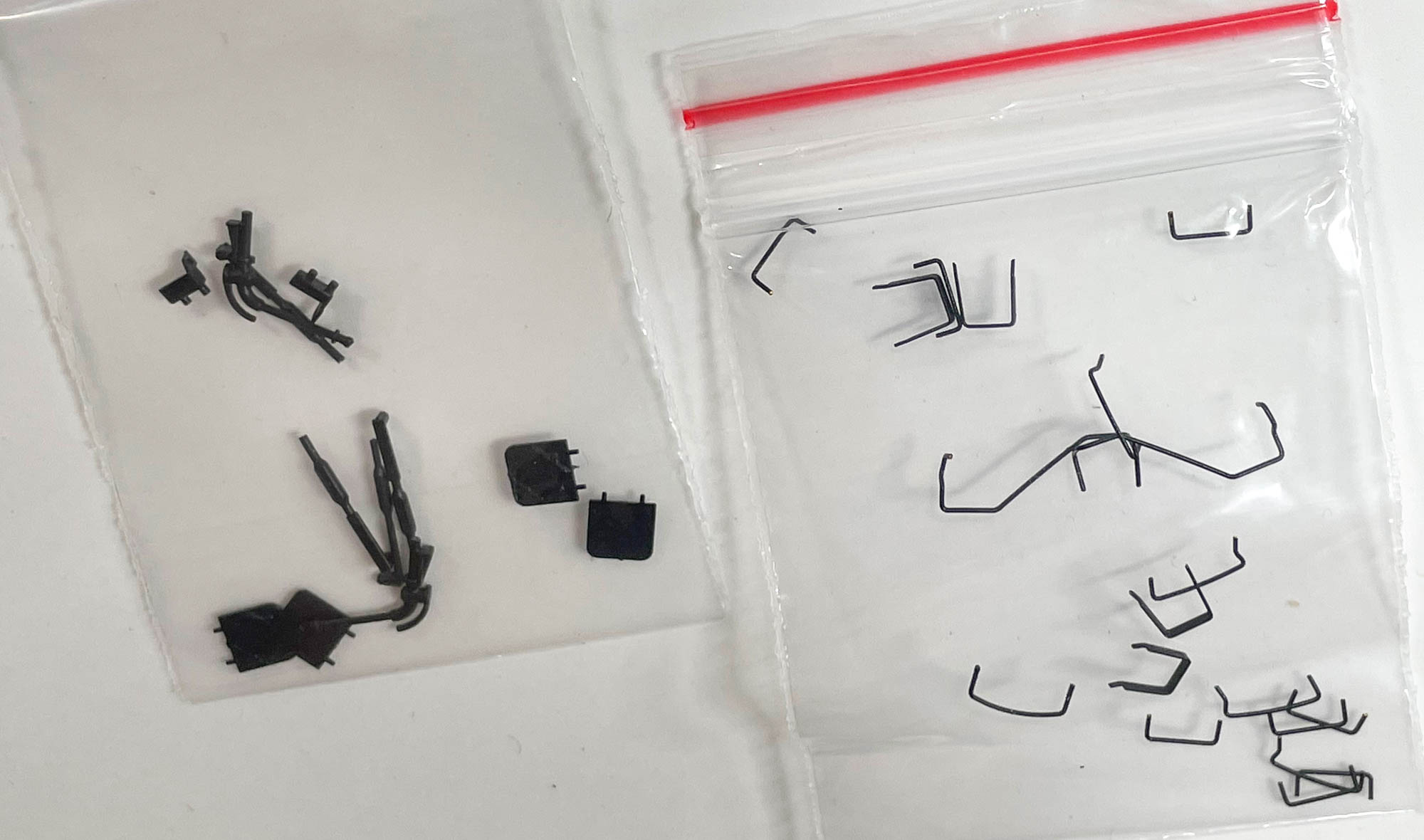
The details to be added by the modeler, including grabs, uncoupling devices, placard holders, etc., are secured separately in tiny zip bags for safe keeping. The placard holders match the style used on almost all UTLX tank cars, a nice touch

I will be detailing and lettering this model over the coming months using the decal set from National Scale Car. Follow this blog to be notified of updates.

Wednesday, June 17, 2020

An additional silver lining in the Rapido X31 announcement


One of the additional benefits of Rapido's announcement of the PRR X31A box and auto cars is that we should have two additional finely detailed power hand brakes in HO scale. One is the Equipco 3160 model with E-312 hand wheel, as shown above on PRR X31A 69308. Because it was offered in the early 1930s, applications of this hand brake are few (at least I haven't come across many in my research). The three I have found are:

  • Some of the late Dreadnaught end PRR X29 box cars
  • Several members of the early X31 family
  • NdeM 1932 ARA box cars 60000-60599 (see above)


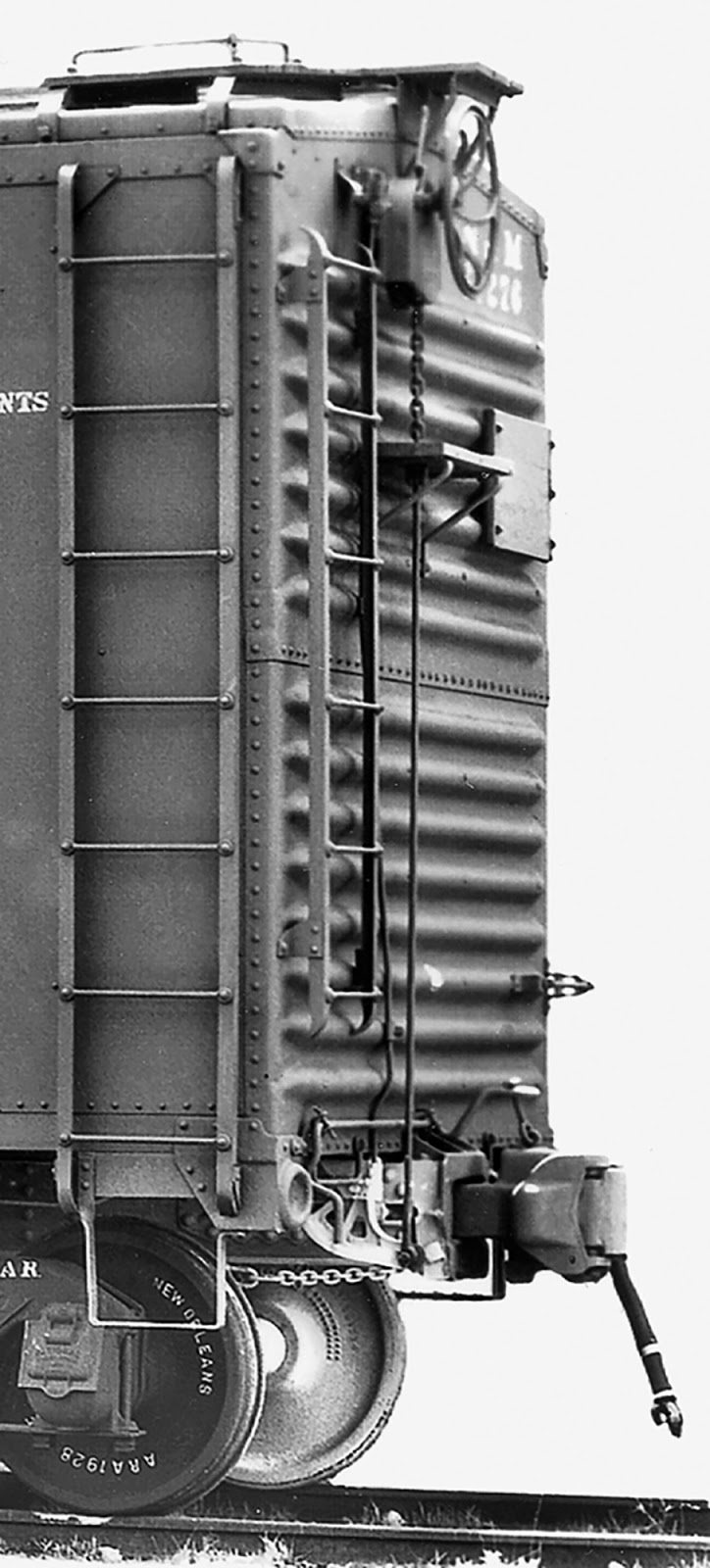
The other power hand brake that will be produced is an early Ajax power hand brake (there were many subtle changes to the housing over the years, so which version will be produced is not known by me) with no. 3059 hand wheel, which had only four "spokes" in the center - see above. The 3059 hand wheel has been offered for years by Intermountain, but is heavy in detail, so a finer version is most welcome, as its adoption was wide and deep.


Now, Rapido, why not do the Universal 5700XL with M1704 hand wheel that was used on many members of the X31A family (please)

Note: I did provide reference materials to Rapido for this project, but have not been consulted about the models, including any test shots of pre-production models.

Yes, it had been a long while since my last post. More on that in a post in the near future...