Showing posts with label double sheathed. Show all posts

Friday, February 28, 2025

Something a Little (maybe not so little) Different


Al Armitage photo, Ron Morse Collection

One of the nice things about Springfield is catching up with friends.  I had a chance to see Scott Kritzky and Terry Van Winkle. Awhile back, I had offered mostly encouragement, but also a bit of prototype reference material to Scott for one of his projects. He shared the fruits of his labor with me at Springfield. He and Terry have produced a beautiful set of O scale ends for the Southern's 'SU' thirty-six foot truss rod box cars. Having them eliminates the most difficult obstacle to modeling one of these numerous cars. Well done and I can't wait to see what they conjure up next, perhaps even in a smaller size... maybe 1:87.1?!

Some of these cars also enjoyed a renaissance on the Lancaster & Chester in the postwar years

All blemishes, smudges, scratches, etc., are my fault entirely and not a reflection of the quality of these parts!


Friday, February 21, 2025

Frisco Double Sheathed Auto Cars

"Heading Down Winding Stair," Frisco 1332 pulling a 35-car freight train down the south side of Winding Stair Mountain near Talihina, Oklahoma, June, 1948, George Preston photo posted February 8, 2025 by Richard Crabtree on the Facebook group: Frisco Rails Across Oklahoma. Note that the car side appears smooth, but there are no notations of steel-sided cars in this group, meaning this would be double sheathed siding

By the Transition Era, double sheathed auto cars were very much a rarity, with the Rio Grande's 50-footers being the most obvious exception. Another interesting example making it into the Transition Era was the Frisco's 40-foot prototype built by American Car & Foundry before World War One and improved over the years. I saw the photo included above on the Facebook group, Frisco Rails Across Oklahoma, and was immediately curious about the first car behind the tender, as it was clearly not a standard forty-foot auto car. I recalled some chatter about Frisco auto cars on the groups.io Steam Era Freight Cars list (search "SLSF 152203 DS auto car" in messages) from a few years back and searched the archives. I have synthesized and augmented that information below.


Two AC&F builder's photos from Westerfield AC&F CD containing lot listings and builder's photos

"Amphibious DUKW cargo truck being unloaded from one of the hundreds of thousands of freight cars which carried victory cargo to San Francisco Port of Embarkation" from the book Gateway to Victory profiled by John Barry at his blog

Around 1937, the cars were rebuilt to incorporate Dreadnaught steel ends (4/5 square corner on the B end and 3/5 end doors on the A end,) Youngstown corrugated steel doors with Union Duplex fixtures, and "Hutchins Dry Lading Riveted" (trade name for the Murphy rectangular panel roof used on these cars, not to be confused with a Hutchins "Dry Lading" roof, very common in the 1920s.) Also, note that the height was increased by the addition of a side plate section above the existing car side, of undetermined shape, although likely zee bar. This section was further bolstered by diagonal shapes with a triangular opening "inside" the angle formed by the two surfaces they supported. These improvements are shown in the image above.

There were a little over 200 cars still in service in late 1951, at which point they were rapidly retired, with only 96 cars listed in the January, 1953 edition of the Official Railway Equipment Register.

West Bottoms, Kansas City, circa late 1940s

detail from previous photo, showing two of the cars in question

Circling back to my original thought: double sheathed auto cars were rarities in the Transition Era. Modeling such cars in HO scale presents an opportunity to include something different in the fleet. I am at work on completing the effort begun by Bill Welch to create patterns for the 50-foot Rio Grande cars, so that box is nearly checked. These Frisco cars would be a compelling "scratchbash" candidate and a complement to the Rio Grande cars. There are parts out there to address many of the components, although there are issues with most. The roof is easy as there are many options. The side plate and braces (or whatever ids actually is can be scratchbuilt.) The ends are a little more difficult, but can be kitbashed from a variety of sources, but the 3/5 end door A end would require "surgery" of an existing part, either the resin end from Yarmouth or a bash from a Proto2000 car. The doors are also a challenge as Union Duplex fixtures are still not offered for many Youngstown configurations/sizes. The sides could easily be scratchbuilt from Everegreen siding. The underframe would be a complete mystery absent drawings, but who would know what's right and wrong on a model? The center sills are straight, making things a little easier. It would be a fun and very challenging project....

Much of the story was compiled by Eric Lombard and shared on the groups.io list referenced above. There are still gaps in information so any solid leads, photos, etc., that can be shared can be added to this post.


Tuesday, April 2, 2024

Rock Island USRA 40-ton Box Cars and Rebuilds


As-built, but upgraded with AB-schedule brakes, ca. 1947-1948

The Rock Island received a rather large allocation of 2,500 USRA Specification 1003-B forty-ton, double sheathed box cars. They came from several builders and were assigned to the series 155000-157499. The Rock Island rebuilt two blocks of 400 of these cars in their Armourdale (1936) and Blue Island (1940) shops, creating all-steel cars assigned to the 134000-134799 series. The underframes, ends, and Andrews trucks were retained, although the ends were augmented with small 'blank" sections to increase the height, resulting in a 5/5/blank/5 Murphy configuration (from bottom to top.) New sides from Youngstown Steel and Murphy rectangular panel roofs were applied. They also received Youngstown doors with early Camel Roller Lift fixtures, AB schedule air brakes and power hand brakes. Interestingly, the Rock Island actually continued to operate a greater number of "un-rebuilt" cars than were rebuilt. 

Note that the Rock Island also received some secondhand rebuilt CNW USRA box cars, but those are not the subject of this post.

ca. 1949, courtesy of the late Bill Welch; other info not known by me

This photo illustrates some of the features, including steel sides of eight, irregularly spaced panels, Youngstown doors, AB brakes (with all three main components on the same side of the center sills,) and Andrews trucks. Note the retention of grab irons instead of ladders. These Rock Island cars had the recessed side sills typical of steel-sided cars rebuilt from wood or composite cars.

Ogden, Utah, May 30, 1959, Will Whittaker photo

In the 1950s, the Rock Island sold cars to the Ft. Dodge, Des Moines and Southern, with very little change in appearance, except the diamond emblem and reporting marks.

Why am I posting about this? Well, over the past several weeks I have been working on one of the Sunshine Models kits for these prototypes. There are a few details that I am opting to change as part of my build. They include:

  • add rivets to exposed angle at end of car sides (more on this in subsequent posts; see photo below)
  • the kit's doors have later-style Camel Roller Lift fixtures. I am going to replace this detail with an early-style hardware
  • Grabs will be created by bending 0.008" wire
  • Running boards will be scratchbuilt from strip styrene to achieve a gap between the boards
  • I will use a Universal power hand brake and wheel to more closely match the prototype
  • Decals to be printed from my own artwork (the Sunshine lettering used a generic sans serif font for the majority of the stenciled data that is a poor match for the Rock Island's lettering)
Progress to this point has involved assembly of the major body parts and little else. I can report one issue that I encountered: the rectangular-shaped underside of the kit's resin roof casting was too long to easily fit into the car body. Instead of what would have been a fairly tedious process of removing resin material from the underside of the roof casting, I put the resin roof casting aside to use on a project where it fits into a car body and instead used a far more easily modified styrene part. The photos below illustrate the removal of material to facilitate a good fit, showing both modified and unmodified IMWX/Red Caboose parts. More details to follow in subsequent posts...


The visible "end" of the side that is nested in the angle formed by the side and end had rivets on the prototype. These will be simulated with decal rivets on the model. Also, note the "blank" end panel added to the rebuilds, as noted in the text above


Wednesday, February 13, 2019

Wordy Wednesday - Delaware & Hudson 36-foot Double Sheathed Box Car D&H 23659


Al Armitage photo, late 1940s
Delaware & Hudson 23659 is highlighted in “Wordy Wednesday” for several reasons. Foremost, it is an extremely interesting car. For modelers of the postwar era into the 1950s, finding 36-foot box cars to model is always a challenge (I will present a subsequent post covering a roster of some of my favorite early 1950s 36-foot box car modeling possibilities). When the Canadian Fowler patent single sheathed cars are excepted, the field of 36-foot candidates shrinks markedly, particularly for West Coast modelers. These D&H cars are suitable subjects for modeling, as many were still around in the early 1950s.

The prototypes were acquired in 1907, 2,800 cars in total. They were progressively rebuilt between 1924 and 1936. Improvements included Hutchins Dry Lading roofs, new ends (indented Hutchins) or refurbishing of the composite or facsimiles of the ‘Indestructible’ ends, replacement trucks, AB schedule brakes (eventually), Ajax power hand brakes to most cars, if not all, and Wine ladders. 

The other main reason for profiling these cars is that they are unusual prototypes, but would not be extremely difficult to replicate through judicious use of kitbashing and/or scratchbuilding. One could either scratchbash the models using an Accurail 1300 or 1700-series car as the starting point* or scratchbuild most of the model. Either means would yield an attractive result.

My plan is to model one of the cars following the latter approach. I will scratchbuild most components, fabricating the sides, ends (‘Indestructible’ as shown in the photo), and underframe and use a spare resin casting of a Hutchins Dry Lading roof. I will chronicle my efforts for publication in some medium. Decals will be made available for those wishing to collaborate virtually.

*I seem to remember that years ago John Nehrich kitbashed at least one of these cars using an MDC model as the starting point. I have a copy of the article somewhere and once I locate it, I will publish a separate post with the details. I think it was in Railroad Model Craftsman and I believe it included drawings, likely from the late Chuck Yungkurth.

Monday, December 24, 2018

Finishing NP 10975 - Rapido Northern Pacific 10000-series Double Sheathed Box Cars, Part 2

I posted a brief writeup of the Rapido Northern Pacific 10000-series double sheathed box car almost two months ago (link to that post here). Since that time, I have made a few upgrades to that model and painted, lettered, and weathered it. This post describes the details associated with all of that. As I stated in the original post, it is an extremely fine model right out of the box. The changes highlighted here are ones that simply suit my tastes.


Most of the upgrades were performed on the ends, with the majority of those specifically on the B end. I replaced the running board supports with styrene to create more realistic details. I replaced the original retainer with a Precision Scale retainer valve with 0.008" wire "pipe". The brake staff was secured to a pivot support. Finally, I reworked the push pole pockets to create a more dished, stamped look, as on the prototype.


On the A end and the doors, I replaced the handles with ones fashioned from 0.010" wire, filed flat on the outer surface. The last upgrade was the replacement of the stock wheelsets with 0.088" tread width sets with 1.005" long axles.


The preparation and painting of the model followed my normal regimen. All metal and engineering plastic surfaces were lightly blasted with 200-grit aluminum oxide. I primed all surfaces, using Tamiya surface primer for the first time (link to my thoughts on it here). I painted the sides Rust (no. 4675) from the Model Master Acrylic line of paints. I masked the sides and painted the roof, ends, underframe, truck sideframes, and wheelsets Tamiya acrylic flat black. In preparation for decaling, I applied a light coat of Future (now Pledge) floor wax, creating a glossy surface.

I lettered the car* using decals I created myself and had printed by PDC of Canada specifically for this model. I reserved part of the capacity data, the reweigh location, the brake test, and repack stencils to be added during the weathering process. I also added a few chalkmarks prior to weathering.


I weathered the model using PanPastel and Bragdon powders. On the roof, ends, and underframe, I used brown, light grey, and Payne's grey. On the roof, I also interspersed this with some "blobs" of light grey paint applied with a Q-tip to simulate the beginnings of paint failure on some of the panels. I used the same powders on the sides, but applied them progressively: first, I applied small pieces of masking tape over the stencil areas referenced in the previous paragraph followed by powders that were then sealed with clear flat. I removed the masking from capacity, reweigh, and brake test stencils and added those along with more chalkmarks, another clear flat coat, followed by more weathering and yet another clear flat coat. Lastly, I added the repack stencils and more chalkmarks. Everything was sealed with a final flat coat.


Rapido has produced a beautiful model of a very significant prototype that belongs on most layouts. Bravo and I can't wait to see what is next from north of the border!

*the lettering layout doesn't exactly follow the standards for this car. The arched Northern Pacific and capacity data are slightly shifted to reflect photos of car NP 10975. Variations in the layout of lettering on actual equipment are not uncommon... remember, the shop crews were humans, not robots!

Friday, November 2, 2018

Rapido Northern Pacific 10000-series Double Sheathed Box Cars


The Rapido Northern Pacific 10000-series double sheathed box cars have been eagerly anticipated by HO scale modelers since they were announced a couple years ago. Their arrival is yet another example of a signature car being produced in injection molded styrene, although this is the most esoteric, with previous cars such as the B&O Wagontop and Milwaukee Ribside box cars representing highly recognizable prototypes. The NP cars are no less significant, but are certainly more subtle. The fact that they even exist in a medium other than resin reminds of moments when my late friend Richard Hendrickson would say, “these are the good old days.” We are being confronted with riches we never imagined.

The roof is the finest version of the NP style produced to date
Certainly the most distinctive feature of these cars and for that matter, most NP house cars of the 1920s, was the trademark radial roof, with extremely narrow seam caps. Rapido has quite faithfully and delicately replicated this characteristic. Accentuating the roofs are finely rendered "wood" running boards (note: I prefer styrene over wood, particularly laser cut wood).

The lumber door detail is captured nicely on the model
The car body is no less well-detailed. Rapido expended great effort to correctly simulate the grooves on the double sheathed wood siding. The result in convincing. The doors, including the top tracks for the hangers and the guides are nicely recreated in scale, as well. The Murphy ends with seven corrugations in the top panel over eight in the bottom are nicely detailed. The lumber door in the A end is faithfully replicated.

Note the spring-like tensioning device that was common on NP brake arrangements
The difference-maker in a car at a $50 price point is the detailing. The cars feature wire grabs, with the lower ones on the side and end ladders incorporating the hybrid “straight-drop” configuration of the prototype. The two grabs at the left of the side and the hybrid grabs appear to be of a different material and are also about 0.002" thinner diameter wire, approximately 0.011"-0.012" vs. 0.013"-0.014".

The Miner 'Ideal' lever style hand brake is extremely well done. The pipe from the pressure retaining valve is large
The Miner ‘Ideal’ lever hand brake is a thing of beauty that I hope will be made available as a separate part. One area of criticism (and it is common with most manufacturers’ models) is the pipe for the pressure retaining (“retainer”) valve. It should be about 0.008". It is significantly more pronounced on the model, no doubt in the interest of durability and moldability. It is an area I will improve. The sill steps are exceptional, being fashioned from metal, and following the shape and contour of those on the prototype.

Note the finely rendered sill step and the hybrid "drop-straight" grab iron
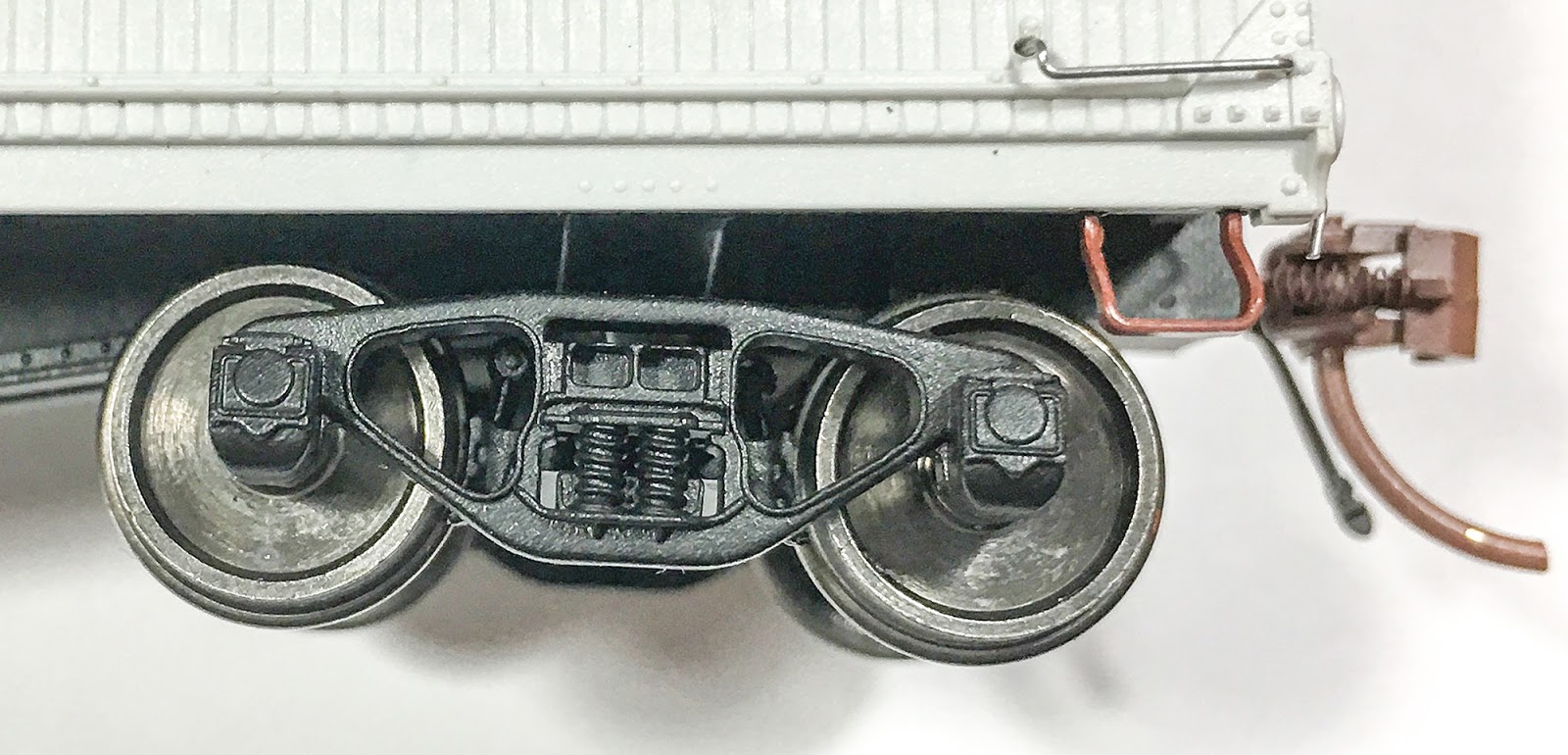
The trucks are the only other area where I can express reservations. While they include separate brake shoes and generally follow the prototype, the detail is a little soft in comparison to the offerings of Tahoe Model Works, Kato, Kadee or Tangent. I would like to see this area improved on future Rapido offerings. The truck mounting is also a little "wonky". Even with the screws fully tightened, the trucks had a loose quality. Perhaps the integral screw-washer arrangement as well as the mounting post mitigates this in operation. Nonetheless, it doesn't seem all that "tight". I hope that my concerns are overcome in practice and operation by clever engineering. One other nit: I would encourage manufacturers to lead the push to 0.088” tread wheelsets. They operate the same as code 110 sets. Make the change!


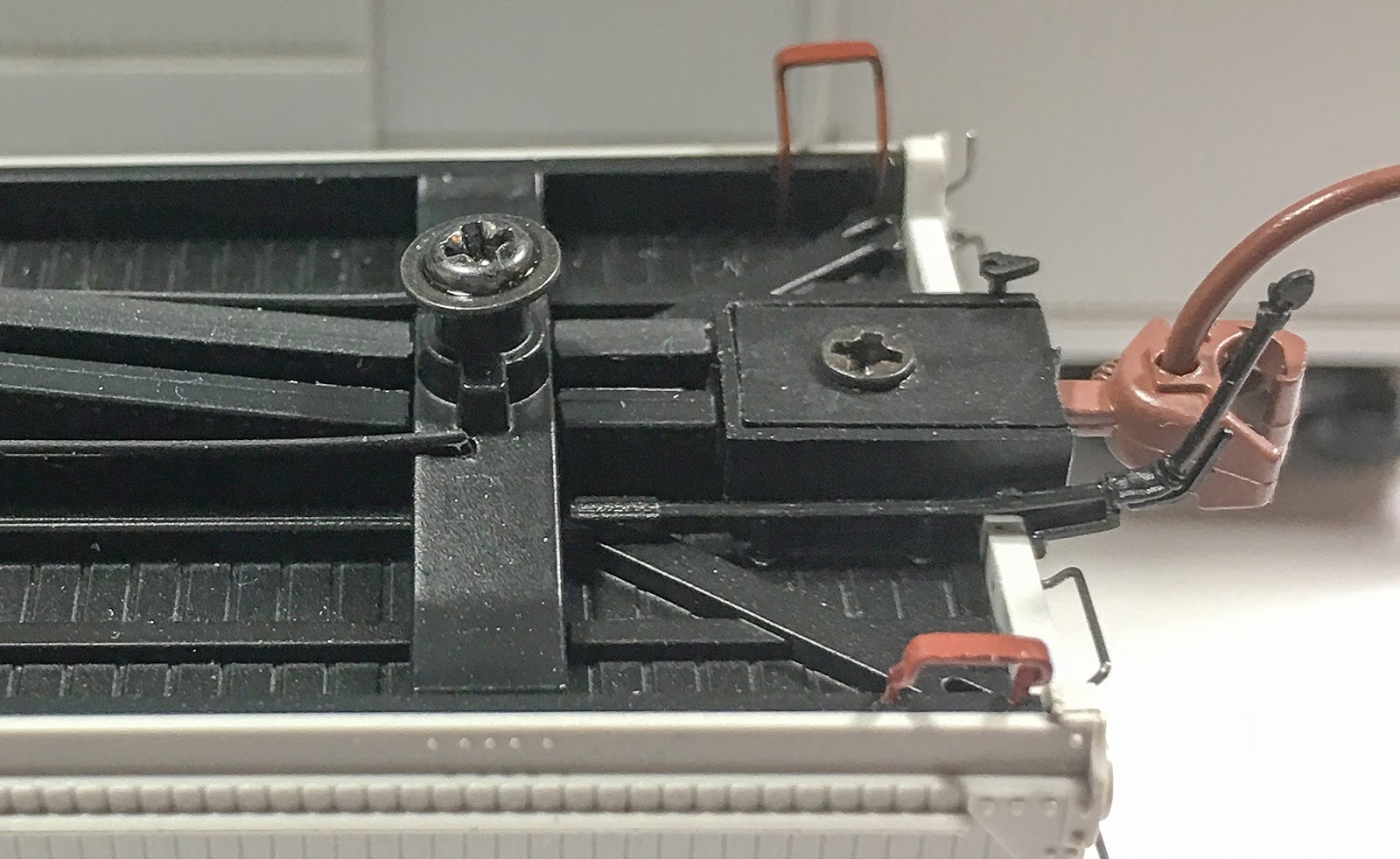
The AB brake system as added to these cars circa the 1940s is faithfully replicated. While the styrene piping and rodding are compromises, they are rendered as delicately as can be expected. A nice touch is the NP tensioning mechanism visible as a spring-like device in the detail photo included above. Rapido has done a good job at capturing the layout of the prototype. Kudos here!


Rapido is to be commended for producing a fine model of a significant prototype. If online comments are any indication, they are already sold out. I hope it is an indication of success.

I purchased a pair of undecorated models and am waiting for decals (one model to have and a just-in-case extra). I will highlight the finished model in a subsequent post after I paint, letter, and weather it. I will also document the changes and enhancements I make. Yes, there are a few to be made...

Wednesday, October 31, 2018

Wordy Wednesday - Northern Pacific Double Sheathed Box Car NP 12315

West Jackson, Mississippi, March, 1947, Harold Vollrath Collection
Between 1923 and 1932 the Northern Pacific Railway added 4,500 double sheathed box cars to its roster. The cars came from a variety of builders, including five hundred from the NP’s own Brainerd, Minnesota shops. They were the largest single block of cars on the road from the late 1920s through the early 1940s, when the NP’s ambitious program to acquire and build AAR steel box cars gained momentum.

The NP’s 10000-series box cars were reminiscent of the USRA double sheathed box car design. They had double sheathed tongue-and-groove wood sides and the fishbelly center sill underframes that were characteristic of many car designs of the period. That the NP chose this design is interesting since they received no copies of the USRA forty-ton design.  However, the NP did have a history of ordering forty foot double sheathed cars, albeit of truss rod underframe design. The 10000-series cars were slightly different dimensionally from the USRA design. The inside length was a non-standard 40’9”, versus 40’6” for the USRA design and the inside height, at 8’8”, was several inches shorter than the USRA cars.  All cars were delivered with the NP’s trademark radial roof and the road’s preferred hand brake, the Miner Ideal lever-style brake. The first 4,000 cars received the Murphy corrugated end, with seven corrugations in the top panel and eight in the lower panel. The last 500 cars received Dreadnaught ends, with three main corrugations in the top end panel over five in the bottom. The last 500 cars also came with several other less noticeable modifications. They were equipped with different doors, one additional grab iron on both the sides and ends, an altered brake lever arrangement, diagonal straps on the lower car sides and secondhand Andrews trucks of a design common (and perhaps unique) to the NP. Many of these trucks were replaced in the postwar era.  All cars had lumber doors in the A-end.

The cars were not modified significantly over their service lives. The major modification consisted of replacement of the ‘KC’ brakes with ‘AB’ brakes during the 1940s. The other modification was the replacement of the trapezoidal brackets that connected the sides to the ends with longer straps. This change occurred in the 1950s. The cars were initially delivered with the arched ‘Northern Pacific’ lettering and white stenciling. During repaintings in the late 1930s and into the early 1940s, this was augmented with the small Northern Pacific black, red and white Monad herald. In the late 1940s, the slogan ‘Main Street of the Northwest’ was added below the Monad. Finally, in the early 1950s the Monad size was increased to 48”. For more information about the prototype, refer to John Barry’s article, “Post WWI Forty-Ton Box Cars” in the Summer 1994 issue of The Mainstreeter, the publication of the Northern Pacific Railway Historical Society.

The reason for highlighting this photo and these cars at this moment? The release of the Rapido HO scale versions of these cars. My thoughts on these cars coming within the next day or two…


Tuesday, May 22, 2018

"The Jack Burgess Files" No. 1 -- Northern Pacific Box Car NP 40513


Many, many years ago, Jack Burgess offered me a modest collection of slides to do with as I saw fit. The subject matter of these images is freight equipment photographed by Jack circa the late 1960s, mostly in the Newark, California (East Bay) area. His intention was to document cars that he would one day model. Fast forward to the present. I thought this blog would be a suitable forum to share Jack's images. I consulted Jack to obtain his blessing to post the images here, along with corresponding information about the prototypes. This is the first of what will be several groups of images.


The image above is from my copy of an NP diagram book. As noted in the information, this class consisted of 520 box cars built by Pacific Car & Foundry in 1937, car nos. 9480-9999. The cars employed typical traits and specialties for the day, including Dreadnaught ends with square corner posts, ARA/AAR-design underframe, "Murphy" rectangular panel roof, wood running boards, Ajax power hand brakes, Westinghouse AB-schedule air brakes, and Youngstown corrugated steel doors with 'early' Camel Roller Lift fixtures. The one feature that made these cars unusual was the use of double sheathed wood over underlying steel structural members for the sides. As a side note, these NP cars were quite different structurally from the GN's numerous double sheathed cars built between 1937-1942.


By the time NP 40513 was photographed at Newark, California in June, 1968, the placard boards on the doors and ends had been lowered, as shown here and the car was no longer in the original 9480-series. It had also been repainted, likely at least two times, the latest featuring the "Main Street of the Northwest" slogan and five-foot Monad medallion with "RAILWAY".

The lighting of this image illustrates the sharp corners of the square corner post Dreadnaught ends. The bottoms of two of the structural steel members may be discerned along the side sill, directly below the "Street of" portion of the slogan, to the right of the door track.

Jack also climbed up to record this view of the Murphy roof and wood running boards. The rivets on the sides of the seam caps are quite evident.

Thank you to Jack for sharing his work.