Showing posts with label structures. Show all posts

Friday, November 8, 2024

Dean's Mill in Coxsackie, New York


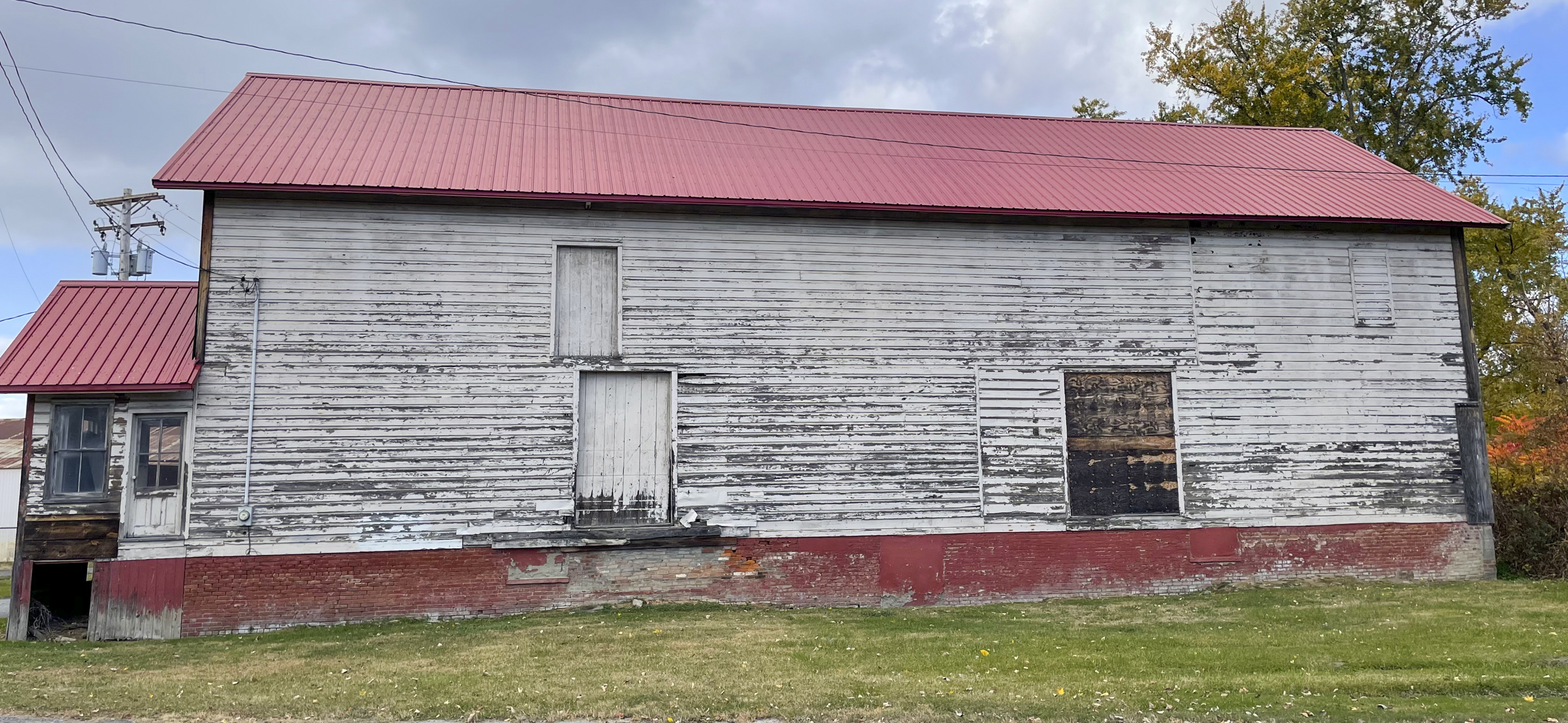
I have spent a fair amount of time over the past year in the northern Catskills of Greene County, NY, especially the area around Catskill, Athens, and Coxsackie* (cook-sahkee or "cook sake" as in cooking the Japanese wine,) NY. On one of my outings, I passed Railroad Avenue in Coxsackie on my way downtown and decided that sounded like a promising diversion. It was! I came upon the two structures shown herein, the largest being the old feed store and mill, known as Dean's Mill in its last iteration (Dean's Mill the business has moved to East Durham) and the smaller was "Geo. E. Van Vorst."

Coxsackie was on the West Shore Line which was part of several predecessor ventures that ultimately became part of the New York Central. For a brief history, you can visit this wikipedia page. Like much railroad history in the US, there were many players and several busts and acquisitions along the way. There is enough business in Coxsackie to make it an interesting switching layout/diorama or as part of a larger West Shore-themed layout. Gems like these are always worth a stop and I am sharing the images here in the hopes it might spur on someone's modeling efforts. Enjoy!

All images can be viewed in a larger format by clicking on the image

In this historic image, an early iteration of L. Bedell (later Dean's Mill) can be seen behind the station. The tracks are part of the West Shore Line


1920 Sanborn Map Co. Fire Insurance Map, Library of Congress. Note the red arrows pointing to the two structures/businesses that are the subject of this post, L. Bedell (later Dean's Mill) and Geo. E. Van Vorst. The map is oriented with north oriented down and left, as the arrow in the map indicates


This and the following images are of what is Geo. E. Van Vorst on the Sanborn map


Sunday, June 26, 2022

Valley Fruit


I acquired this image of Valley Fruit in Pharr, Texas via ebay a couple years back. I have included a rather large scan here for the consideration of others. Given that I am replicating fruit packing operations, it provides me with lots of context and fodder for modeling. The date appears to be the late 1940s based upon the comments of Bill Badger (see in the comments section -- thank you Bill!) 

There are several details that stand out to me. First, the variety of vehicles, both in terms of types and ages, is interesting and worth noting when selecting vehicles to add to such a scene. I am also interested by the layout of the main packing structure. It appears that the then current loading dock was added after the main structure had already been in use, and was an add-on as operations grew. By main structure, I am referring to the facade with "VALLEY FRUIT CO." emblazoned in red as well as the rest of the structure behind that facade. The even newer addition at far right could be replicated as part of an even larger scale model operation (note that it appears that this business handled tomatoes and possibly other fruits and vegetables, as well.) 

The whole scene is worth consideration as a modeling subject for anyone needing such a facility on their layout. I suspect that the Walthers Valley Citrus Packers would be a good kit to use as a starting point to kitbash this, along with some scratchbuilding or kitbashing with other models. Enjoy!

Tuesday, December 3, 2019

Types for Lettering on Structures and Other Layout Signage


One of the things I am always on the lookout for is interesting types (“fonts”) that I can use to create specialized lettering. I have been particularly attuned lately as I have become more focused on structures. “Simple” sans serif types of the 1930s and 1940s have a more stylized look than the basic computer "fonts" of today. When I see a model structure that is to represent a period (e.g. late 1940s) structure, yet uses Arial or Helvetica for the sign that has the name of the business, it doesn’t look correct to my eye; it has a simple, anachronistic quality that screams, “I’m a model!”

The photo above of Utah Ice & Storage Co., May 9, 1928, by Harry Shipler/Shipler Commercial Photographers, is from the Utah State History project hosted by the University of Utah's J. Willard Marriott Library. While the PFE R-30-2 (at right) and R-30-13 reefers are interesting, my attention was also drawn to the lettering on the building at right in the image (for a better view, click on the image and note the red rectangle around the lettering.) I replicated the characters by tracing using a tight crop of the image, as shown below (the 'J' is a composite of the 'I' and 'S' while the 'O' is derived from the 'C'.) I plan to use the characters to letter a structure of an ice plant on my proto-lanced layout of Jefferson (based on Medford,) Oregon.


The two photos below (March, 1957, Chula Vista, Calif., Col. Chet McCoid photos, Bob's Photo,) illustrate another example of an interesting type that can be used for structure lettering. I initially purchased the photos for the subjects, a PFE R-30-9, above, and R-40-4, below, but stumbled upon the sign in the background. I found the style of the lettering compelling and I have need for a feed mill/ag supplier in Jefferson. So, after cropping, I pulled the images into Illustrator and created the "Willis-Burr Co." as seen below. I will finish the lettering for the details (Fertilizer, etc.) at a later time, but what's here illustrates my point.

The options for lettering are limitless and I have several others to be generated. Note that there are many font purveyors with period types available for download that can be used for these purposes. I tend to favor fee-based fonts over free downloads as I don't trust freeware to not have other malicious software embedded into it (my own cautious nature.)


Speaking of decals, I have two new sets for freight cars. They are D215 for the Virginian's 1916-built single sheathed box cars and D216 for the Minneapolis & St. Louis's ARA-design single sheathed cars built in 1930. Both have "cuts" in the lettering to accommodate surface details as on the prototype.


Thursday, February 21, 2019

California Pacific Utilities Gas Company in Medford, Oregon


A little while back, I posted about some of the pieces of Medford, Oregon that I intend to replicate in my proto-freelanced town of Jefferson, Oregon. One of the industries I intend to add is the California Pacific Utilities Gas Company. The bit of the Sanborn Map containing it is shown here. I have been trying to trace the company history to no avail (I haven't tried that hard yet; my assumption is it was rolled into Pacific Gas & Electric at some point). 


While I have the ca. 1950-1951 Sanborn Map, I also have the 1956 aerial survey photo. A lot changed in those five years. The map and photo provide plenty of information for a very strong replica of this industry. One thing that has eluded me is knowing what tank car lines served this industry. In the absence of a definitive answer, I plan to go with a "market" solution involving many providers including Tidewater, Anchor, and Warren as well as some "generics" such as UTLX and SHPX.


The actual structure will be mostly scratchbuilt and combined with tanks from Walthers (they were discontinued for a time, but are currently available). In addition to the photos, I am referencing the article "Model a Propane Bulk Plant" by Paul Dolkos in the Model Railroader special issue, How to Build Realistic Layouts.

I hope to have this completed by the beginning of summer. Stay tuned...

Wednesday, November 28, 2018

Wordy Wednesday - Shell Filling Station


Shasta County, California. Filling stations close up as the tourist trade decreases, June, 1942, Lee Russell
As I begin my preparations for construction of a modest switching layout, I have been taking increased note of things that will be valuable references. It is little surprise that anything that will aid in my construction and detailing of structures and the scenes in which they’ll reside gets attention. I stumbled across this photo on the FSA-OWI photo site hosted by the Library of Congress. It is a defunct filling station in northern California (extreme northern, relatively close to Oregon, where I am modeling). Granted, the gasoline sales portion of the station and the accompanying equipment appeared to have been removed by the time this photo was recorded in 1942. Note that in the background at left is what to all appearances is a functioning gas station.

Nonetheless, there is still a great deal to be gleaned from this photo. Architecturally, the photo illustrates a large portion of the structure of the overhang that sheltered patrons while pumping gas. Details include the embellishments at the junctions of the roof line, support post beams and other areas. These were not only attractive features, but also served to tie together and strengthen the structure at critical points. As was quite common, the roof line of the shelter (and the shelter itself) was oriented to bisect the 90-degree angle created by the intersection of the streets.

Details abound. The large SHELL sign atop the shelter would be a great touch to add to a model, including the support wires, extending to the roof eaves. The Quaker State lube service sign is another add-on to accent the scene. Finally, while every window in this scene has one, likely due to the “hibernation” of the station’s gas dispensing operations, the signs promoting the Russell Bros. Circus in Redding (California) on June 27 are a great detail that adds “life” to this scene, and could be similarly replicated on a model, albeit in maybe one or two signs.

The great thing is that there are numerous commercially available 1920s vintage gas station kits that follow this general design, but that could be easily and minimally modified using a photo such as this one to make it “one’s own” so that visitors to the layout will appreciate its uniqueness rather than mentally noting that the gas station is the same one seen on many layouts.