Showing posts with label refrigerator car. Show all posts

Wednesday, August 5, 2026

A few things from St. Louis

New York Central System Historical Society

I brought home a few things from the St. Louis RPM. The first is a Sunshine Models kit of a Northern Pacific fifty-foot heavy insulation refrigerator car. I missed these when originally offered and managed to find one at the Resourced Rails table at the meet. The prototypes were built by the Despatch Shops in East Rochester, New York in 1946. At the time they were unusual for their length as well as the extra insulation for frozen food shipments. The kit looks like a fun project. I will create my own decals with NYC-style typeface stenciling to match that of the prototype. PS - you can order high res scans for $5 each of these cars at the NYCSHS site (links here and here) A more thorough post about these prototypes will follow at some point.


The next of the loot is a Monon container gondola offered by Forbes Train Models (Doug Forbes.) It's a 3D print of the prototype. Doug also offers a few other versions of the cars. The modeler adds the details such as grabs, wire, trucks, couplers, etc. The first page of the instructions, including Doug's email is included below. These are well-rendered straightforward kits, but are designed to allow varying levels of detailing, from basic up to completely tricked out. The images above are the 3D-printed body with a shot of Tamiya fine surface primer (aerosol can.)

From Dave Hussey's PBase gallery... link below

Last and out of era for me is the Cannon & Company kit for the Northern Pacific's 5300-series combination door waffle cars from Pacific Car & Foundry, kit FC-5015. I know it's too modern for me. However, I have always liked the premise of these kits (as well as the Modeler's Choice line) and relish the challenge of building one up someday. Link to Dave Hussey's PBase image gallery for the prototype and model.

Monday, June 15, 2026

PFE R-40-25 Completed


I recently completed the final weathering and detailing on the PFE R-40-25 pilot model for the Speedwitch parts set [previous post linked here.] I am extremely pleased with the outcome. The details turned out almost exactly as I envisioned, particularly the hatch cover supports, the ladders, and the underframe. I doubt I will ever look at another car with Equipco hatch covers the same way again. It's fun to see the details "pop" under some weathering.


Regarding weathering, I used a variety of dilute washes, beginning with Tamiya Brown Panel Line Accent Color on the roof, panel lines on the sides, and overall on the ends and underframe. I added Tamiya black paint to the fan shaft detail on the car sides and then removed most of it with a cotton swab. I used mineral spirits to slightly dilute the panel line wash on the sides. I sealed everything with a flat coat and added washes of artists' oils, including a dilute grey mix overall and a few heavier light grey streaks on the sides, especially under the hatch areas, as well as on the ends to simulate spray from the wheels of adjacent cars. I applied another flat coat and then used Bragdon powders on the sides (a light grey) and PanPastel Paynes grey on the roof, ends, and underframe. 


The chalk marks are from National Scale Car


Tuesday, April 28, 2026

PFE R-40-25 off to the paint shop


The steps, ladders, and side sill and bolster support tabs match the prototype

I posted about the prototype PFE R-40-25 class a little while back. Here are some photos of the model that I snapped before it went off to the paint shop...

The goal with this parts set is to not only fix the issues of the Amarillo/Intermountain offering, but to bring the rest of the model up to 2026 standards. The Intermountain R-40-23 tooling is almost 32 years old!

Ordering is open for these and for once, I actually have more than just a handful ready to go!

Look at those "open" hatch supports and straps that prevented damage to the hatches when fully open

The ladders mount to the edge of the roof, just like on the prototype

The rests to support the hatches when fully open are etchings added to the roof seam caps, as per the prototype


The brake gear arrangement is modeled exactly after the prototype, right down to the brackets and manual "pin" adjuster


The crossbearers are "open" and crossties have the channel shape of the as on the prototype's welded underframe 


Friday, April 3, 2026

Pacific Fruit Express R-40-25 Refrigerator Cars


The placard held by the gentleman at center reads, "Here she is boss. She looks mighty fine and so will the other 499.The crew that built her." This is presumably the Colton, Calif. PFE shop crew

For modelers, the PFE R-40-25 class has taken a back seat to the more numerous R-40-23 and different, e.g. visually interesting, R-40-26, with flush mounting ("plug") doors. The R-40-25 class was 3,000 cars total, nos., 2001-5000, built in 1949 at the PFE's Los Angeles (2001-3350,) Colton (3351-4000,) and Roseville (4001-5000,) shops. The Intermountain models of the R-40-23 went a long way toward filling the needs of postwar Transition era modelers. In cooperation with Intermountain, the Amarillo Railroad Museum offered R-40-25 kits based upon the R-40-23. While this is certainly a good path to follow, it resulted in models that incorporated several errors, both large and small, that make these kits stand-ins for discerning freight modelers.

The B end of R-40-25 no. 2001. Of note are the uppermost main rib, with flat bottom, the narrow pressed rib at the top, and the arrangement of the side ladder, attached to the sill step at the bottom, which is in turn attached to the bottom of the side sill as well as the attachment of the ladder stiles at the top, using curved pieces of metal connected to the roof. The side ladders are not actually attached to the car sides at all.

End from an R-40-25 kit

Resin end from Speedwitch

Incorrect (and poorly rendered) lettering on Intermountain/Amarillo R-40-25

The largest of the errors are in the ends and the as-delivered lettering. The ends of the -25 class were an iteration of the improved Dreadnaught end and different than those of the -23 class. Changes included the incorporation of a small, rectangular stiffener bulge at the top of the end and revision to the main top rib, making it straight across its bottom and shallower in relief from the surface of the end, compared to the other five main ribs. The Amarillo ends tooled by Intermountain ignored the change to the top main rib and the small rectangular rib appears too proud from the surface of the end and not wide enough from top to bottom.

PFE R-40-25 no. 4246 as it appeared soon after repainting at Tucson, Ariz., in May, 1953

The other major error is the lettering on the as-delivered cars. In 1948, the Union Pacific medallion was changed from red, white and blue to black and white. This change was missed for years by researchers and modelers alike. It was only after I started to see the medallion in color photos and then shared that info and consulted with Dick Harley that the error was revealed. There is no blame in this, but it doesn't change the fact that the models are incorrect on that detail. Fortunately, there are now decals that correct that issue, from National Scale Car.

This image was recorded at a time of day when the sun's light was low, affording a great view of numerous details, especially the underframe.


The other issues are more nuanced and involve finer points of detail. Here they are in no particular order:

  • the side ladders should be integrated with the lower sill steps and attached to the edge of the roof via a trapezoidal, curved piece of plate (the Amarillo/IM -25 cars took a half-stab at this issue)
  • the side sill supports ("tabs") should be shaped differently; additionally, the Intermountain long tabs under the doors do not have a flat surface, but a wavy one due to the molding process
  • the welded underframe is quite distinctive (on the -23, -25 and -26) and the Intermountain underframe is rather simple
  • the drains for the bunkers are very crude on the IM kit
This is a stop frame screen shot from a video on the PeriscopeFilm channel on youtube... that I cannot find now to provide the title! [if I do, I will update this post.] However, it is a great illustration of the black & white '1948' Union Pacific medallion.

A little more about the '1948' PFE painting and lettering... in 1948, the word "VENTILATED" was dropped from the stenciling between the two medallions. If looking at a black & white photo, that change is a fairly good yardstick to determine if the UP medallion is red/white/blue (VENTILATED REFRIGERATOR) or black & white (only stenciled with REFRIGERATOR.) However, that is not a hard and fast rule, as I have found a few examples of cars stenciled with "VENTILATED REFRIGERATOR" and having black & white UP medallions. These examples are likely artifacts of errors immediately after the change was implemented. [note: what I have never encountered in photos, and I have closely examined a LOT of color photos, is a single instance of a car with only REFRIGERATOR and a red/white/blue UP medallion... if you have a color photo illustrating this, I would love to see it.]

While PE 1614 was the focus of this image, the PFE reefer behind it and to the right is adorned with the scheme used on PFE reefers between 1948 and the beginning of 1950. The reefer visible at left carries the scheme introduced in 1950, the included "RAILROAD" in the UP medallion.

What I can state definitively is that the UP medallion used between 1948 and 1950 with the words "UNION PACIFIC" was black and white and NOT red/white/blue.

This image, while cropped, shows three cars with the 1946-1948 scheme (red, white & blue UP medallion on middle car,) 1948-1950 scheme (black & white UP medallion on right car [which also has "VENTILATED," likely a stenciling error by the painting and lettering crew]) and the post-1950 UP medallion, with "RAILROAD," on the car at left.

The timing of this post is because I am currently at work on the pilot model for a parts set to correctly model the PFE's R-40-25 class of cars. Details about that will follow in a separate post covering the models.

Again, apologies for the watermarks in the images, but the pirates get me down so this is my only recourse

Thursday, November 27, 2025

URTX Postwar Reefers and a Teaser


This is one of the first group of cars with the Dartnot end. GATC photo, Bob's Photo

Like the other major refrigerated car fleet operators, Union Refrigerator Transit bolstered its fleet in the postwar years through the addition of new equipment. URTX was owned by General American so naturally the cars were constructed at the company's East Chicago plant. The 1,000 cars were forty-foot steel cars with some interesting details. 

The deep crossbearers and some of the brake arrangement is visible in this excellent image. Bob's Photo

As can be seen, they had horizontal steel sheathing, with two sheets per half of the side (one overlapping the other at the edges) riveted to U-section flanged ("hat" section) structural steel members. The cars were also equipped with the Duryea Cushion underframe. The last group incorporated an unusual roof with two "flat" panels adjacent to the end panels with the hatches (most cars had one such flat panel.) All had air circulating fans, as well. General American seemed to have a preference for the Barber S-2 truck design and these were equipped with that type of truck.

Sept. 16, 1949, Vancouver, BC, Walter E. Frost, City of Vancouver Public Library

The ends were also either Dartnot (no smaller intermediate corrugations in the end panels; see image at top of page for a good view) or a combination of Dartnot/Improved Dreadnaught designs. The photo of URTX 37754 below illustrates this second "hybrid" type.

This car, URTX 37754, was equipped with the hybrid end as described in the text. Bob's Photo

Photos seem to indicate that as built all of these cars were leased to the Milwaukee Road, although in the absence of conflicting/supporting photos or information, I cannot state that definitively.

This car in service to Iowa Beef Packers, ca. late 60s, illustrates the full length side sill reinforcement applied to many cars in the 1960s

In later years, the side sills were augmented by full length support sections instead of the tabbed sections as built. Many were also leased to meat packers and emblazoned with large colorful schemes, although some remained decorated with the tilted Milwaukee emblem. There was an article in the September, 1999, Mainline Modeler by Loren Martens that included drawings of the second group of cars.

The teaser: years ago, George Toman created sides and one of the end styles used on these cars and Ryan Mendell created the parts for the Duryea underframe. I contributed with the other end and the roof with two flat panels at each end. Next year, I will be offering kits for both designs incorporating all these cool parts. Watch for the announcement. Thanks to George and Ryan for their usual phenomenal work!

Side with horizontal steel sheathing panels

Center of side with accurate door hinges

Duryea underframe components

Dartnot type end

"Hybrid" end

Roof with two flat panel sections at each end

Thursday, March 6, 2025

Interesting Armour Refrigerator Line Car Detail

ca. 1936, San Francisco, courtesy Bill Welch

Armour had a sizable fleet of refrigerator cars for the transportation of meat (in different stages of processing.) There were many cars like the one shown above, with steel center sill underframes with truss rods or pressed steel crossmembers. Armour also leased cars from Mather to augment the fleet and in the late 1940s, Armour added 2,000 all steel cars from AC&F to begin the shift to more contemporary design standards.

However, the purpose of this post is to highlight an unusual detail of these 11000-series cars. All of the other Armour wood reefers were equipped with typical sill steps that were attached to the bottom of the side and extended straight down from there although the right step usually had two rungs, like that shown here.) The rather interesting detail on the cars in the 11000 series is that they had two sharp 90 degree bends to nest around the bottom of the lower corner strap angle and side sheathing, as well as the common half twist, as can be seen. Crops of both sill steps are shown below to illustrate this feature. Yet another nuance to add to your Sunshine Models kit when you build it... 


Wednesday, February 19, 2025

Refrigerator Car Roof Surfaces

Collection of the late J. P. Barger

Having crews work on "bare" roof surfaces presented a seemingly risky endeavor, especially when the surfaces were smooth and wet, such as those on steel-roofed, ice-cooled refrigerator cars. One means to make things a little less perilous was to apply something rough and/or textured mixed with the paint applied to the roof. A common additive was crushed slate granules. This added (and noticeable) texture provided a more sure-footed surface for crews. These two photos illustrate that to good effect. The photo above is the roof of a PFE R-40-20. The texture is quite evident (click on the image to see a larger, more detailed view.) Contrast the surface texture of the roof and most of the hatch cover with the more smooth rectagular-shaped surface in the middle of the Equipco hatch cover (the stencil notes that, "THIS HATCH COVER MAY BE LOCKED FROM INSIDE OF CAR.")

The roof and hatch covers on Santa Fe rebuilt refrigerator car 9161 from class RR-43 are similarly textured.

Santa Fe photo, courtesy of the late Richard Hendrickson

While it may be difficult to effectively capture in HO scale, it is definitely noticeable compared to the other surfaces on the car. Happy modeling!

Thursday, July 7, 2022

Bangor & Aroostook RS-4 Refrigerator Cars


Providence, RI, June 1958, Col. Chet McCoid photo, Bob's Photo

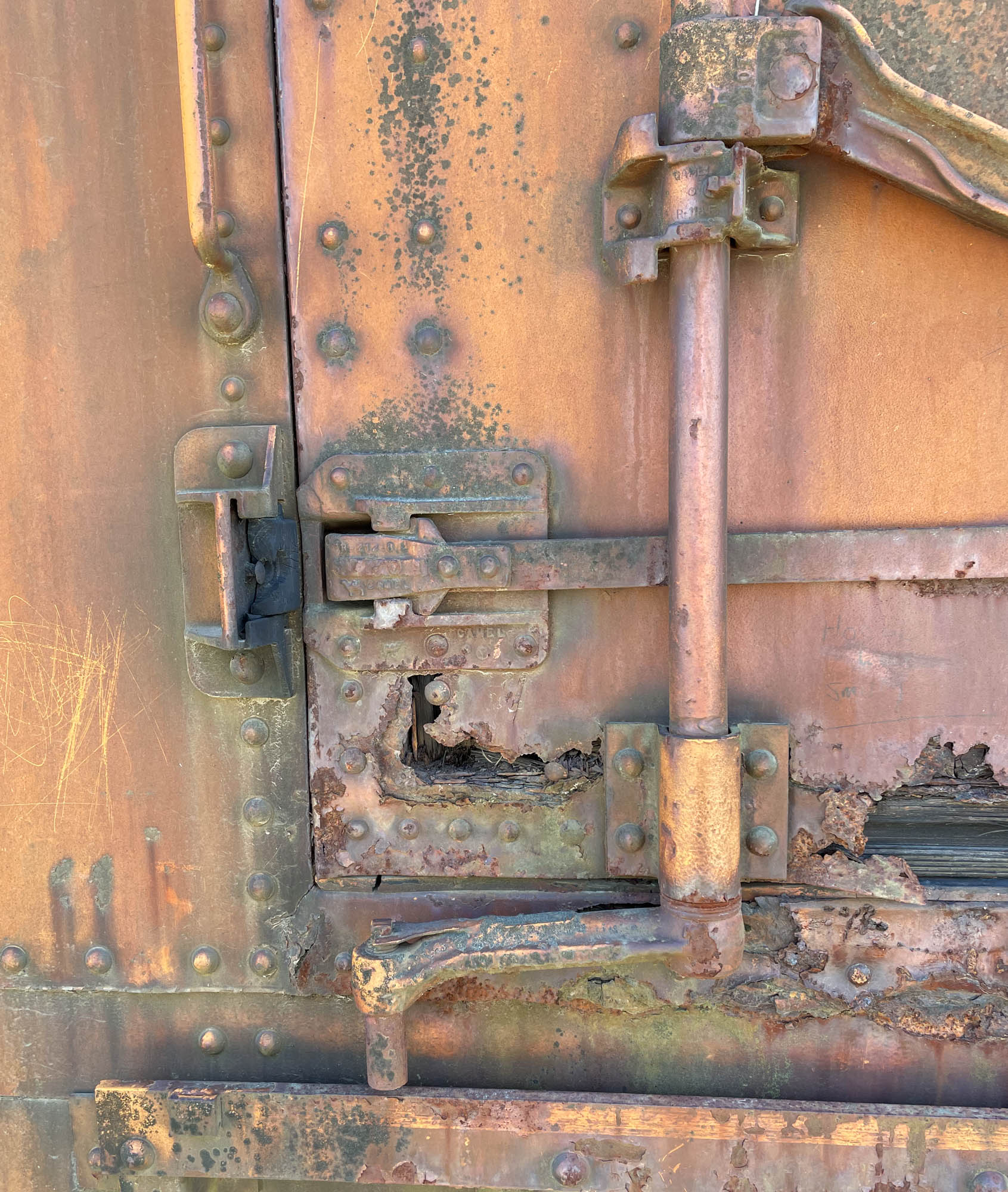
While on vacation in Jonesport, Maine, we ventured to Machias to pick up a few things. Adjacent to the old train station are two freight cars: a Maine Central PS-1 as well as a Bangor & Aroostook class RS-4 reefer. This group of BAR cars was built in 1955 by Pacific Car & Foundry's Renton, Washington plant and placed in series 8000-8349. The photo above is of a car from the same class a few years after it was constructed.


The reefer is entirely derelict at this point, its doors inoperable and the brake gear having been removed at some point. However, there are a wealth of details that can still be viewed, offering a quasi time machine. Here are some of the details that I recorded, mostly of the Camel hardware for the Camel flush-mounted ("plug" doors):

All of these photos are of details. This shows the door latching and roller mechanism. The actual rollers have been disconnected and will be shown in a separate photo. You can see there they were located in the prototype image shown above

This is part of the mechanism for the door locking hardware. This is second generation hardware not present on the earlier BAR flush door reefers that were effectively clones of the PFE R-40-26 


The placard boards dropped into a frame of sorts

This is a "Cheeper" defect card holder (or a copy thereof). Defect card holders were located on the right side of the car. The tube held the defect card (when needed)

The defect card holder with the door rotated upward to access the tube

Side view of the opened door and hollow tube

The door rollers, having been detached from the door hardware at some point

The right hand door stop

Alternate view of the right hand door stop. Note the hard, rubberized insert for cushioning the impact of the door sliding against it

View of the intersection of the floor stringers and the crossbearers as well as the train line pipe

View of the crossbearer and crosstie and the stringers

The remnants of one attachment point for the reservoirs which had been removed, as well as the welded plates that strengthened where the lower crossbearer cover plates meet the center sills

These cars (as well as PFE cars) carried this admonition about the risks of the insulation catching fire! The grabs on these cars (and the earlier R-40-26 clones) used this style grab as opposed to the more common (for the era) bracket style