Wednesday, November 20, 2019

Transition Era Texas Oil (Texaco) Tank Cars - Part One


In 1935 the sizeable Texaco tank car fleet, just under 6,000 cars strong, was sold to General American and leased back to Texaco. The reporting marks remained unchanged, using T.C.X. However, throughout the 1940s, as cars were repainted, the billboard "TEXACO" scheme was abandoned in favor a simple black car with only the basic information, like that shown on TCX 6852 shown above (Hamlet, North Carolina, October 14, 1951, Col. Chet McCoid photo, Bob's Photo.) 

TCX 6852, built in April 1929, also illustrates a couple of other details worth noting. The AC&F 10,000 gallon Type 27 tank cars built in the late 1920s had shorter, fatter tanks, similar to those of the Type 21 design, albeit with three instead of four courses and four tank bands. TCX 6852 is an example of such a 10,000 gallon Type 27. After about 1930, 10,000 gallon Type 27 tank cars featured longer, narrower tanks with only two tank bands. Another interesting detail are the Dalman two-level trucks without Barber lateral motion devices.


TCX 7892, built in May, 1927, is another AC&F 10,000 gallon Type 27. It illustrates the billboard scheme, with silver tank and black stenciling. I also included this photo because the details of the Texaco dealer (along with the Signal dealer at left) are notable for modelers, including the pumps, barrels, sign, etc. Will Whittaker photo at Woodland, California, December 17, 1939.


TCX 4154 also effectively illustrates the simplified post-GATC takeover scheme. It was built by Petroleum Iron Works in May, 1927. Hamlet, North Carolina, October 14, 1951, Col. Chet McCoid photo, Bob's Photo


This last photo is included because it illustrates an interesting Texaco detail stenciled on the ends of cars. Note the rectangle at the right of the tank head (end) containing "F" over "10". TCX 6852 above has "R" over "10", TCX 4154 has "R" over "8" and TCX 7892 also has "R" over "10" on the head. The numbers almost certainly refer to the tank capacity with "8" = 8,000 gallons and "10" = 10,000 gallons. While it is supposition the "F" might refer to fuel while the "R" could refer to refined products. No doubt, one of you can offer some additional details and/or corrections. Photo by Esther Bubley in Casper, Wyoming in 1948.

Information about decals for the GATC era to follow in Part Two

Monday, November 18, 2019

The Anatomy of a Tank Car - General American

The following pamphlet is something that I have in my collection of various materials. As noted from the cover letter, it was sent to Franklin Creek Refining of Franklin, PA, by Garland Smith, Manager, Repair Sales, of General American Tank Car. The photo above is a GATC Type 30 tank car, like the type profiled in the pamphlet. Photo from my collection


Wednesday, November 13, 2019

Wordy Wednesday - Omaha, Nebraska May, 1948


Click on the images to see a larger view.

This photo is interesting to me for a number of reasons. The unusual PFE painting arrangement on the -16 rebuild is one, but the other is that as an early 1950s modeler, I am on the lookout for 36' box cars that I can credibly include in my fleet; this photo shows two such candidates. The photo was recorded by Lee Russell for the CB&Q in May, 1948 in Omaha. The Rock Island freight terminal is visible, as well as the Bekins warehouse, among other structures. A couple of Rock Island truck trailers can be picked out flanking the PFE R-30-9 reefer in the background. Photo from the Newberry Library


PFE - R-30/40-16 - With 3,554 cars (nos. 73001-76554) the -16 rebuilds were the second largest group of PFE rebuilds, after the -9 classes. They employed Murphy solid steel roofs (with rectangular panels, as shown here) and retained wood ends. The extremely interesting detail in this photo is the 1946 style UP medallion by itself on the car side. According to PFE painting specifications, this style of medallion was always to be paired with an SP medallion, with both on each side of the car. This is a highly unusual, if not unique, application. HO scale models of the -16 rebuilds were offered in resin by Sunshine Models as well as styrene by Pacific Freight Enterprises

PFE R-30-24 67179 - the final group of rebuilds of the late 1930s and 40s were the -24 classes. They were unusual for the use of 'Harborite' exterior plywood sheathing (some other rebuilds of the era used this as well, notably many -9s refurbished during the same late 1940s period.) There were 2,610 -24s in total (nos. 65921-68532.) They were the only rebuilds to use Improved Dreadnaught ends and the last cars also received diagonal panel Murphy roofs. Preco FG-41 or FK-2 mechanical fans were installed, as well. Almost all of the -24 rebuilds used "built-up" 30-or 40-ton underframes, as the vast majority of the Bettendorf underframe cars were rebuilt in earlier classes. HO scale models were offered in resin by Sunshine and the MTH PFE reefer, while decorated as a steel car, closely resembles a -24.


WP 20529 - Western Pacific received 350 Modified AAR box cars from Mt. Vernon Car Manufacturing Co. in 1945, nos. 20201-20550. They had Youngstown Steel doors, Apex Tri-Lok running boards, Barber S-2 (20201-20350) or ASF A-3 Ride Control (20351-20550) trucks, and Royal Type F brake regulators. The placard boards were lowered fairly quickly, as illustrated by the one shown on the door of WP 20529 above. Sunshine Models offered resin kits and Intermountain has styrene versions of these cars.

UP 79420 - B-50-6 The Union Pacific and Southern Pacific both rostered large fleets of double sheathed box cars constructed to a (mostly) standard design. The UP purchased over 7,500 cars from various builders, constructed between late 1910 and 1913. The UP cars were interesting as the UP rebuilt many cars with Murphy or Dreadnaught ends, extending the service lives of many through World War Two. Thereafter, numbers dropped significantly, with most gone by 1949 and none in revenue service in 1953. UP 79420 is a B-50-6 with Dreadnaught ends, still in service in May, 1948 and adorned with the 'Road of the Streamliners' and 'Serves all the West' scheme. Westerfield offers HO scale resin kits to build all known variants of these numerous cars.


D&H 24062 - These cars were profiled in a previous post. Since that posting, I have located the article from the November and December, 1987 issues of Railroad Model Craftsman.

CN 523497 - This cars was one of the over 16,000 postwar AAR-design box cars purchased by the CN between 1947 and 1957. CN 523497 was from a 1,500 car order (nos. 522500-523999) from Canadian Car & Foundry delivered in 1948. They featured pre-War Youngstown steel doors, 4/4 Improved Dreadnaught ends with a shorter top rib, Murphy rectangular panel roofs, Barber S-2 spring plankless Stabilized trucks, Ajax power hand brakes, and 8-rung ladders with integral sill steps on both sides and ends. Intermountain has produced the correct end in styrene, as well as Speedwitch in several mini-kits (Erie and P&WV postwar AAR box cars.)


L&N 11147 - Louisville & Nashville rostered a large fleet of 36' double sheathed box cars during the Steam Era. L&N 11147 was part of a group of 500 cars built in 1923 by Mt. Vernon Car Manufacturing Co., nos. 11000-11499. Sunshine offered HO scale kits for some cars and there have been articles over the years about kitbashing models, usually beginning with the MDC model as a starting point. There is another HO scale resin offering in the works.

ATSF 272464 - Bx-46 (272000-272977, 978 cars) rebuilt in 1945 from Santa Fe's ARA-design double sheathed box cars in classes Bx-9 and -10. There were also rebuilds in classes Bx-41 (270000-270134, 134 cars; from Bx-8), Bx-42 (270500-271033, 534 cars; Bx-9/-10), Bx-45 (271600-271949, 350 cars; Bx-8), and Bx-49 (272978-273914, 937 cars; Bx-9/-10). The Bx-49 cars were different in that they employed postwar 'Improved' Dreadnaught ends.

UP B-50-20 - The UP converted 886 of the A-50-6 class automobile cars to box cars in 1934-1935 (500 cars, nos. 350000-350499) and in 1940 (386 cars, nos. 350500-350885). The cars were distinctive for their size and single sheathed style structural members, but with steel where wood boards were normally used. Westerfield offers HO scale resin kits to replicate these distinctive cars.

Monday, November 11, 2019

Benchwork!


I decided to post a couple photos that will serve as ground zero for my extremely modest apartment layout. I have benchwork in place! Yes, it's prefab and yes, there's not much to it. I have to make some embellishments and customizations. It is my hope that many of you will see what I have done and it will stir you to get started on something. What I am doing is quite modest, but it is better than the alternative and it gets me in the game. I will post more in the coming couple weeks about how I customize this setup. I am modeling a medium sized town. Absent secondary tracks, the mainline run through is approximately 160". Have to start somewhere, right?

Yes, that is a fine Spanish Tempranillo that you see...
Yes, for those of you with keen eyes, it is Ikea's Ivar shelving. However, I will be incorporating several customized wrinkles that should make interesting. Track plan coming, too.... stay tuned!

What you see so far are:
7 - 20" X 70" side frames
9 - 20" x 33" shelves
6 - 17" x 33" shelves
1 - 89" corner post
2 - 30" corner shelves (I will be adding one more, at least)

One of the many wrinkles that I will be incorporating is eliminating the posts between the top shelves so that I have a continuous unobstructed flat layout surface, as well as making a custom accommodation for lighting. Also, the top shelves are at about 50" which is a little high for some tastes, but I am tall...

P.S. I know I need a few shims and yes, I did think about putting adjustable levelers into the bottom of the legs. However, I am in an apartment and want to be sensitive to marking the floors, so it will be old school cedar shims for now.

Thursday, November 7, 2019

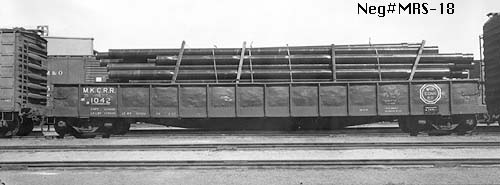
McKeesport Connecting Railroad 1000-series 50-foot Gondolas

ACF Industries, Hawkins/Wider/Long Collection
The McKeesport Connecting Railroad was part of the U.S. Steel family of railroads and its very modest fleet of cars reflected that affiliation. It received 100 fifty-foot gons from American Car & Foundry in 1941 that were similar to cars received by other USS roads. The cars were placed in the 1000-1099 series. They had fairly low sides, steel floors, fixed Dreadnaught ends, and fishbelly center sills, among other details. They were painted in a decidedly gray (not black) color: Scully #320 black graphite and as delivered featured a Pratt & Lambert "Vitralex" red circle as part of the company monogram.


The cars did have some unusual details, many of which are called out in the graphical photo overlay above. Note the grab arrangement in the in service photo below.

John W. Barriger National Railroad Library flickr site, TRRA of St. Louis album
Funaro & Camerlengo offers HO scale resin model kits for these cars. There are a few details that need to be addressed/corrected for an accurate model:

  • Grab iron mounting arrangements at corners of sides and ends (note that these were simplified for many cars by the early to mid-1950s; scratchbuild on model)
  • USS-style towing loop/jacking pads and route card holders (spare etchings from Speedwitch B&LE box car kit)
  • Universal 5700 XL power hand brake with M1704 wheel (from Intermountain covered hopper kit)
  • Collapsible stake pockets (model includes them; prototype did not have them; will model a car with a load to hide interior, but must remove rivets from exterior of sides)
  • Red circle in the as-built scheme (small custom decal project!)
I will highlight the modeling of a car in coming posts. Here are photos of my model in its current state (not very far along!):
Reservoirs and AB valve installed and piped with 0.010" wire
Floor glued in place; not collapsible stake pockets (not correct for this prototype)
Etchings for towing loops/jacking pads and route card holders

Other photos:
MKCRR 1029 - Ed Wilkommen Collection of Lake States Railway Historical Association - note replacement Equipco hand wheel
MKCRR 1042 - Jack Whitmeyer Collection (small image)

I plan to bring this to Cocoa Beach as a finished model, including pipe load

BIG thank you to Ed Hawkins for his help with the prototype information

Wednesday, November 6, 2019

Wordy Wednesday - PFE R-30-12 & -13 Grab Irons

PFE 21919 with with five straight grab irons above the side sill at right edge of the car side, built Feb. 1923 straight grab irons at right edge of the car side, built Feb. 1923, reconditioned July 1938, courtesy of Bill Welch
The PFE R-30-12 and -13 reefers were incredibly numerous (11,900 -12s and 7,654 -13s plus 2,775 Western Pacific cars built to the -13 design*) and I've even written about them, but it was not until yesterday that I became aware of the fact that they had different numbers of grab irons depending upon when built. Granted, I had never looked that closely since I do not need any in my model fleet. Nonetheless, it's an interesting detail that I had not seen profiled. Credit goes primarily to Al Hoffman for spotting the trend and Ed Hawkins for digging into details with Al.
PFE (WP) 51340, also with five straight grab irons above the side sill at right edge of the car side, built July 1923, Rosedale, Kansas, Joe Collias Collection
The Western Pacific contributed 2,775 cars to the PFE fleet, including PFE 51340 shown above, with with five straight grab irons above the side sill at right edge of the car side.


PFE 36430, an R-30-13, built July 1926, with six straight grab irons above the side sill at right edge of the car side. Michael Urac Collection
Beginning with cars built ca. 1924, an extra grab iron was added at the right edge of the car side. It is an interesting change that the model manufacturers have not incorporated into their offerings. They have (understandably) hewed to one or the other number of grabs, but not both. Red Caboose, chose six, as shown below, on the factory lettered PFE 26219 as modeled by me over a decade ago. Yet another detail to be considered... informed is forewarned, especially for you 1920s to mid-1940s modelers!


*Pacific Fruit Express (Thompson, Church, Jones, Signature Press) makes reference to some number of the cars being built to the -12 design, which is certainly plausible, but to my knowledge, no photo documentation of such cars has surfaced for review.

Sunday, November 3, 2019

Moloco Barber 70-ton S-2-A trucks

Santa Fe Ft-V Emergency Flat Car ATSF 91500 used Barber S-2-A 70-ton plain bearing trucks
Moloco Trains recently released 70-ton Barber trucks in both plain bearing S-2-A as well as plain and roller bearing S-2-C versions. As I type this, the 70-ton S-2-A version in narrow wheel tread width are out of stock. I hope they will run more. I ordered enough pour moi, but they could be useful to others.

Closeup of the truck on ATSF 91500
The truck is beautifully tooled and they rolled quite well right out of the bag. They include brake shoes and are up to the standards set by Tahoe Model Works. I do have one criticism. The part where the bolster sits in the sideframe is quite fragile and many of the 29 pairs that I received have damage of varying degrees, with some being unsalvageable.

The Moloco Trains Barber S-2-A 70-ton plain bearing truck
There was a sister truck to this one with a vertical web in the center of the bolster that would make an excellent follow-on companion to these, should Moloco be so inclined. They are to be praised for producing such a beautiful truck.

I am in the process of compiling a list of prototypes that used these and will post at a later date.