Showing posts with label New Haven. Show all posts

Tuesday, March 5, 2024

New Haven 1937 AAR Box Car completed build


A three-quarter portrait of New Haven 1937 AAR box car NH 31297.


When I left off on the New Haven 1937 AAR build, I was preparing to blast the model for painting. With that step done, I added rivets in places where they might be blown off during blasting. You can see them in the photos above and below at the side sill support tabs, the grabs on the ends, the ladder mounting brackets, the sill steps, the door handles, and on the door tracks, where I simulated the flat rivets using 0.5 mm discs punched with the RPToolz punch and die and 0.005" styrene. One thing I forgot (and did not go back and add once I started painting) were the three rivets per side sheathing panel used to attach side nailing post clips! Oh well...


I airbrushed the car body with Polly Scale Light Freight Car Red thinned with Liquitex Airbrush Medium. The doors, trucks, and couplers were airbrushed with Tamiya flat black. Everything was given a coat of Quick Shine Floor Finish, again with the airbrush, to create a glossy surface for decaling. I used Speedwitch (now National Scale Car) New Haven box car decals as well as chalkmarks. The photo above illustrates the model after the basic decals had been applied and areas that would not be weathered as part of the first steps were masked.


In the first step in weathering, I added a light wash of burnt umber along the bottom of the car, using odorless mineral spirits to dilute the oil paint. This was "crept" up the side a little, as illustrated in the photo above. It's a subtle effect.


Next, I added some weathering effects to the upper portion of the car. I created streaks using a blend of Payne's Grey and Titanium White artists' oils. I dabbed small amounts of the paint on to spots on the side and then diffused and drew them down the car side to create streaks. 


I also made the decision to simulate some paint failure on several of the galvanized metal roof panels. This was done by applying a mix of Payne's Grey, Titanium White, and Cerulean (Blue) in several places. They appear stark in the photo above, but I did "integrate" them into the overall look of the model as the weathering process progressed.


I added some powders to create an overall effect as well as blend the previous steps. On the sides, I added Bragdon's Grimy Grey powder, which is fairly muted once under a flat coat. I also augmented this with some targeted application of Pan Pastels Payne's Grey. The photo above shows these after they were sealed under a flat coat.


I also added the same two powders to the roof, but in greater strength to add grime as well as mute and blend the paint failure patches.


I removed the masking tape from the capacity and reweigh location and added those decals, as shown, reflecting a reweigh at the New Haven's Cedar Hill facility in March, 1949. 


At the same time, added some "fresh" paint failure again using the mix of Payne's Grey, Titanium White, and Cerulean (Blue) to arrive at a satisfactory color. 


I applied another dilute wash of Payne's Grey thinned heavily with odorless mineral spirits and added the repack and brake test stencils, as well. The photo above illustrates the completed right side of the car.


The B end of the completed model...


I applied one more "coat" of powders to the roof to mute the areas exhibiting simulated paint failure. I am mostly satisfied with this effort, although I still think I can improve upon it. I will post some further thoughts about this in the next couple weeks as part of a separate post about paint failure.


The completed left side of the model... I am quite pleased with the overall end result. The New Haven script scheme is one of the iconic box cars of the era. Having a good representation of it will add plenty of context and character to the fleet.

Friday, January 5, 2024

New Haven 1937 AAR Box Car


While the Western Maryland Baldwin-built I-2 Decapod and its train are no doubt the subject of this image, the color of the New Haven 1937 AAR box car immediately behind the tender is illustrated nicely. Cash Valley, Cumberland, Maryland, Bob's Photo

It's amazing what almost 20 years can do to the approach to a model. I added some detail to this kit a loonngggg time ago and it has languished since. Earlier this year, I pulled it from the pile of in-progress kits and decided to use it as a test bed for some of my detailing efforts.

Circa early 1945, Al Armitage photo, Ron Morse Collection

First, a little about the New Haven's fleet of 1937 AAR box cars. By the early 1940s, the New Haven box car fleet was on borrowed time. It consisted of thousands of thirty-six foot box cars rebuilt in the second half of the 1920s from cars that were built between 1903-1912. To provide a little context, by the early war years, these cars were so rundown that the War Production Board authorized their mass scrapping, even while forcing just about every other railroad to keep their equipment running. In the face of the cars' condition as well as the increase in traffic resulting from the war, the New Haven added 1,000 1937 AAR box cars in 1941 and an additional 2,000 in 1944. Like many blocks of cars built during the war years, they featured a hodgepodge of specialties. I chose to model a Pullman-Standard 1944 product with Superior 7-panel doors and a Miner power hand brake, narrowing my car nos. to 31000-31349 or 31500-31649.

Bob's Photo

This Norman E. Kohl photo of a NH '37 AAR that had come off the rails affords an excellent view of many of the end details, including the unusual placard board and the bracket for the angle cock/air hose. 

The basis for this build is the IMWX/Red Caboose 1937 AAR box car with W-section, round corners, a match for the NH's '37 AAR cars. There are a couple issues with the underframe that I chose to ignore. First, the original '37 AAR cars had two stringers, one on each side of the center sills. Later cars had four, two on each side of the center sills. When tooled, IMWX tried to have their cake and eat it too, so the two stringers on each side of the center sills are not correctly spaced. The other issue is that an option for buyers was to employ stringers between the bolsters and end sills, instead of diagonal bracing, as on the model. The NH's 1944-built cars (and perhaps the '41 cars, as well) used stringers instead of the corner braces. On to the things I did choose to update...


As previously noted, I did not modify the stringers and corner braces on the underframe (if you do wish to go that route, I suggest that you consult "New Haven's first steel boxcars," from the December, 1996 issue of Railroad Model Craftsman, by Ralph Harris.) I did replace the brake equipment with a Detail Associates AB brake set, styrene levers and dead lever bracket, Tichy turnbuckle "clevises," chain, and styrene and vinyl brake component brackets plus Grandt Line nut-bolt-washers on the reservoir lugs, plus Tichy wire for the piping and rods. The draft gear (coupler pockets) are Moloco parts with 1-72 screws.


On the sides, I made a few upgrades. The bolster tab sections (added after I glued the center sills/bolsters to the car body, making the endeavor a little more challenging!) are etchings from my own artwork that capture the "notched" look of the tab sections favored by Pullman-Standard. The door tracks are 0.002" brass sheet cut and bent to represent an angle. I opted to add this detail because the door tracks and hardware for Superior doors is quite different than for Youngstown doors and manufacturers have largely ignored this, opting to replicate Youngstown features. After adding the door tracks, I applied brackets along the side sill supports behind the door tracks. The last bracket is also part side sill support tab, as shown. These features were fabricated from styrene. I scratchbuilt the "ramps" and "stops" for the door latches using styrene. They are fairly crude, but are better than nothing! The placard and route card boards on the doors were scratchbuilt from styrene to match the NH-style ones used on the prototype (I didn't have actual dims so these are my best guess.) Note that the placard boards on the doors and ends are different. The door handles were also fashioned from styrene. They are too long, but do impart some texture that is lacking on the stock IMWX/Red Caboose doors. The final door detail I added is the locking mechanisms pilfered from a Detail Associates Superior door parts set.

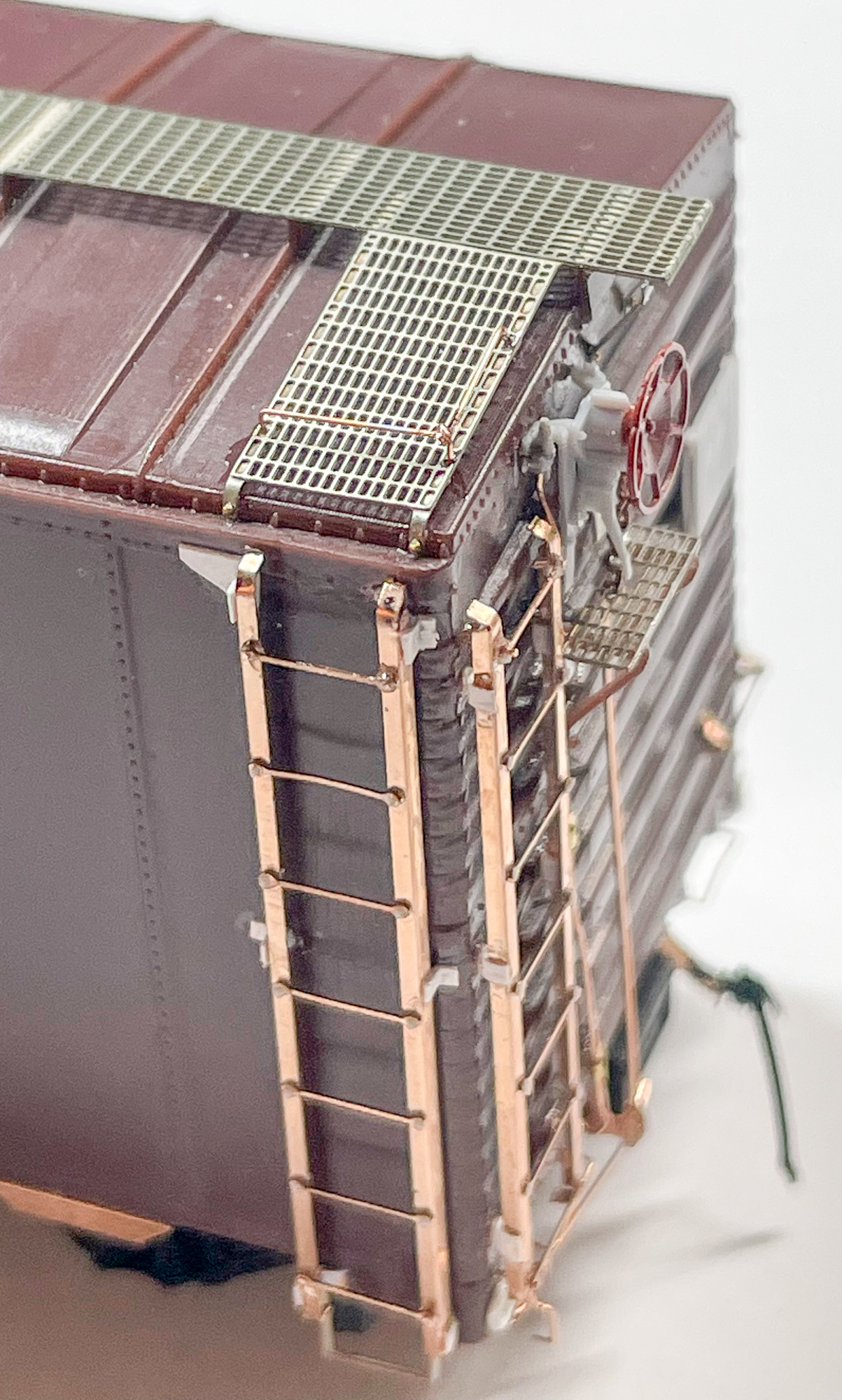
The roof received very minimal change and upgrade. The kit includes wood running boards. The prototype I am modeling was equipped with an Apex Tri-Lok running board (and brake step.) I used etched parts from Yarmouth to replicate this. For the corner grab irons, I used 0.008" wire for the grabs and the corner eye bolt-like fixtures. Before adding the running board, I carefully drilled holes (no. 80 bit) in the "legs" that curve down to the eaves to be able to pin these legs into the roof edge. I also trimmed the legs to an appropriate length. The running board was affixed with Barge cement thinned with MEK (~50/50) augmented with ACC applied with a pin.

I replaced all of the ladders and hand holds with finer parts. The bracket grabs at the left edge of the car sides are Kadee parts (use a Yarmouth etched drilling guide to save yourself some headaches!) The ladders and treads (rungs) are etched parts from my own artwork supplied to PPD and etched in phosphor bronze. They are extremely close to scale-sized and are durable. A little bend here and there looks highly prototypical, as the rungs on the prototype were beaten up over time, as well. The sill steps are from Yarmouth and are designed specifically for this model. The end sill grabs are 0.008" wire (I filled the holes before drilling newer, much smaller diameter ones.) The right edge bracket grabs on the ends are also from my own etching artwork.


For the end details, I again used very little from the kit. Brake step supports are a combination of the kit's with 0.005" styrene. The power hand brake is a Miner housing from Tangent with a Kadee hand wheel. I added chain and 0.012" wire from the housing to the bell crank. The bell crank is from Detail Associates and the "clevis" is also one of my etchings. The pressure retainer valve is a styrene part from Precision Scale with 0.008" wire plus "brackets" created from 0.001" brass. The angle cock/air hose parts are from Hi-Tech Details with brackets created from phosphor bronze scrap from etched parts (the leftover "fret" material.) I used this because it is more rigid than brass. The brackets have pairs of no. 80 holes drilled in each end and a no. 68 hole for the main parts. I secured these brackets to the end sills with "rivets" from Scale Hardware. The angle cock/air hose parts are secured to the brackets with 0.006" wire threaded through the holes and around the angle cocks. The uncoupling devices were bent from 0.010" wire. The brackets for these are also from my own etchings and those are attached to styrene added at the corners. I also added push pole pockets created from round styrene discs punched with an RPToolz punch and die. These push pole pockets were dimpled witha drill bit and the outer edges shaped to replicate the prototype.

The next step is to blast the model with 600-grit aluminum oxide in preparation for painting. This prep will be done to the metal and engineering plastic details, including the trucks. After that, I have a bunch of rivets to add (I save these for post-blasting to ensure none are blown off in that step.) Then, it's off to the paint shop, but that's for Part Two in this journey...

Tuesday, May 30, 2023

Bill Aldrich

Image from Kalmbach/MR digital access

In our lives, we all meet a small number of people who seem to do everything well, always send handwritten thank you notes, and charm every person who crosses paths with them through their grace. Bill Aldrich was such a person. Like many, I had my introduction to Bill through the September, 1980 issue of Model Railroader. At the time, I was thirteen and while ignorant of much, I was smitten with the New Haven and knew that I wanted to achieve the fidelity to detail that Bill did on much of his layout. I read and re-read that issue of MR and still have the well-worn copy on my shelves, even after digitizing my magazine collection. Sadly, I learned of Bill's passing in September, 2022, via the NHRHTA's most recent Shoreliner.

A scratchbuilt I-1 Pacific in Shoreline service on Bill's final layout


For those who aren't familiar with Bill, here are a few details, courtesy of my own experiences and information as well as Don Valentine's writing in the Shoreliner. Bill was born in 1929 in Cranston, Rhode Island. During college, he actually commuted to MIT on the New Haven! He continued his studies, earning a PhD in metallurgy in Germany. His career started with positions for both the New York Central and a stint with the New Haven. He moved on to Warnaco (a source of comradery for us as I was also an employee of Warnaco for a spell) where among other things, he worked on incorporating Lycra into clothing, as well as seeing its benefits as a way to simulate lineside wires that would stretch, but not break if accidentally pulled.

He also ended up as a Brigadier General in the Army Reserves and taught at the War College. Upon his full retirement, he was a docent at Gettysburg, where he lived the final years of his life. I visited several times and was treated to some one-on-one ops sessions on his last layout (another MR cover story, January 2001) as well as visits to the Gettysburg battlefield infused with Bill's expert commentary, plus entertaining dinners at local establishments. I always thanked Bill for these visits as well as his input on New Haven steam projects I was consulting on by sending some of the resin freight car kits I produced under the Speedwitch banner. It was gratifying to receive a letter from Bill a few weeks after sending these kits with photos of the completed models in service on his layout.


Bill was perhaps known best for his exceptionally detailed steam locomotives and passenger cars, including full interiors. Below are photos of a few of his fine steamers. Rest in peace

Reworked AHM model to replicate the New Haven's three-cylinder Y-4 class 0-8-0 switchers

Scratchbuilt model of one of the New Haven's R-2a Mountains


Another scratchbuilt gem, an I-4 class New Haven Pacific

Bill reworked a Bachmann 2-8-0 to replicate one of the New Haven's ex-Central New England "Bull Moose" Consolidations


Thursday, November 28, 2019

A visit to the Valley Line

PDX-2 on the Shailerville Bridge at Haddam, Connecticut

Last weekend, I had the pleasure of operating on Chris Adams's HO scale layout (Valley Local blog) that replicates the New Haven's Valley Line from Wethersfield to Old Saybrook, roughly following the Connecticut River from Hartford to Long Island Sound. Chris has done an amazing job at recreating many of the signature scenes and industries along the line, circa the late 1940s. As someone who spent a good chunk of his youth in Wethersfield and thought long and hard about modeling the same line in the same era, I have always had a soft spot for this layout.


The freight house and the Chapman Company at Old Saybrook

I was tasked with operating the local freight, PDX-2, from Fort Yard in New London via Old Saybrook and up the line to East Haddam on October 13, 1948. Power was one of the New Haven's new Alco RS-2 road switchers, no. 0510. I didn't take that many photos (I was absorbed and forgot!) I thoroughly enjoyed operating the local, with its switching duties at Old Saybrook, Essex, Deep River, and Haddam. The layout operates flawlessly, allowing one to focus on the operational tasks and not worry about distractions from electronics, derailments, etc. The attention paid to not only the track and maintenance as well as the visual aesthetics results in a satisfying experience. 

Thank you to Chris for a great experience with good company. I can't wait until I am called to the duty roster again.


The passenger station and interlocking at Old Saybrook, looking west, towards New Haven and New York. The Valley Line branch is the diverging track in the foreground.

Thursday, November 21, 2019

Kadee Early PS-1 40' Box Car

Earlier this year, Kadee released an early version of the Pullman-Standard PS-1 40' box car. As seen in the photos, they tooled an entirely new car body with details to match the early versions. The basic model is shown here in New Haven livery (Kadee did an excellent job capturing the NH's freight car red color, as well as the black doors.)


The most notable differences are on the sides with the tabs and sill sections below the actual side sills. Notice not only the bolster sections within the green-rimmed rectangles, but also the sections that span the area below the doors. The early version is shown at top above (the NH car), while the undecorated car is one of the previously released models that replicates the cars circa 1949 and later. There were many subtle variations in these details prior to 1949. Kadee's model is tooled to represent one flavor, with 6" ship channel tabs at the bolsters, 6" x 3-1/2" bulb angle reinforcements under the doors, and 4" x 3-1/2" rolled angles at the crossties.

The early version of the roof on the newest Kadee car is shown at top, while the later 1949 roof is shown on the model at bottom. The difference is the absence of the corrugation in the end panels on early (roughly pre-1949 built) cars. Both iterations have riveted seam caps (there were prototypes with welded seam caps).

The early PS-1 end is shown at right. Note the absence of trapezoidal stiffeners at the top, the three-point bracket grab at right, and straight stiles on the ladders, as well as the grab below the ladder on the early New Haven car. Also, of interest is the Universal power hand brake, particularly the wheel, which is stunning and has never been offered in HO. Unfortunately, it is not correct for the New Haven's Universal hand wheel as shown on the prototype below. 


The underframe shown above is from the New Haven model. Unfortunately, it is not correct for early cars, as Kadee did not tool a new underframe. Early cars used what were essentially welded AAR underframes. The PS-1 welded underframe, similar to that shown on the model above, was introduced in 1949. The main difference was that in 1949 there were only four stringers total, as opposed to the six on the Kadee model, a 1951 introduction.

Wednesday, November 14, 2018

Wordy Wednesday - New Haven 0-8-0 3430 at Hartford


This photo has always been a favorite of mine for a few reasons. Given my affection for freight cars, the nice string of interesting cars is an immediate draw for me. However, as compelling for me is the location. I grew up in the Hartford area so I have always had an attraction to its railroad-related history. Of particular interest has always been the large Morgan Street freight house and the tracks near it. This train is making its way from Hartford towards its crossing of the Connecticut River and its duties in East Hartford. I will post an exceptional photo of the Morgan Street freight house and yard in a future installment. That photo alone should provide all the motivation one needs to replicate it as a switching layout. The photo is reproduced below with numbered callouts to aid in identification of the subjects. Interestingly, the locomotive and every identifiable piece of rolling stock with the exception of the MILW gon, P&LE box car and the flat car was or is available in HO scale (references noted in parentheses) 


1 — New Haven Y-3 0-8-0 — The New Haven had 10 USRA versions of the 0-8-0 followed by an additional 25 copies purchased after the war, nos. 3400-3434. (W&R brass or Proto 2000)
2 — Chicago and North Western Emergency box car with Youngstown doors and Viking roof (Sunshine Models or Intermountain)
3 — Milwaukee Road composite gondola; class not known
4 — Pittsburgh & Lake Erie  ‘late’ tall New York Central USRA-design steel box car
5 — Santa Fe Bx-38 Emergency box car (Sunshine Models or Intermountain)
6 — Delaware Lackawanna & Western rebuilt steel automobile car (Yarmouth Model Works)
7 — Seaboard Air Line G7 composite gondola (Sunshine Models)
8 — Southern Railway 1937 AAR box car (IMWX, Red Caboose or Intermountain)
9 — unidentified flat car with tractor load
10 — Canadian Pacific Fowler box car (Westerfield)
11 — New York Central USRA-design steel box car (Westerfield or Broadway Limited)
12 — American Refrigerator Transit wood refrigerator car (Sunshine Models)

Wednesday, September 12, 2018

"Wordless" Wednesday - one of my favorite images

Westbound below highway overpass at Hopewell Junction, NY, Col. Chet McCoid Collection 
I don't normally "do" Wordless Wednesday posts. However, I have been wanting to post some of my favorite images, so I am starting what I endeavor to be fairly regular Wednesday posts of my favorites. This one will not be quite wordless. Why do I love this image? I love the 2-10-2 wheel arrangement, I love the NH's 2-10-2s and this is my favorite image of any 2-10-2 anywhere. The scum on the boiler adds character. To me, the NH 2-10-2s that were rebuilt with Boxpok drivers have an extra bit of character. Finally, that house in the background begs to be modeled. All in all, a classic image...

Thanks to Randy Hammill for digging up the details on the photo when I couldn't lay my hands on my copy of New Haven Power by Jack Swanberg.

Sunday, September 9, 2018

A Visit to the Valley Line

The passenger and freight stations at Old Saybrook
In conjunction with the annual NHRHTA annual reunion in Essex, Connecticut, Chris Adams hosted an operating session on his HO scale New Haven Railroad, prototype-based layout. The layout replicates the New Haven's Valley Line from Hartford to Old Saybrook. Chris has done an amazing job at recreating the highly "modelable" Valley Line, with its freight-only operations circa the late 1940s and has interspersed a great train-watching venue at Old Saybrook. The southern terminus of the Valley Line was at Old Saybrook, where the sleepy freight-only stretch had to integrate with the multi-track chaos of the high-speed thoroughbreds speeding passenger trains up and down the Shoreline between Boston and New Haven and on to New York. For those of you wishing to know more, Chris is a prolific blogger at The Valley Local.
The first industries on the layout: Wethersfield Lumber and Ballantine's (beer) with "Hartford" in the distance
I was fortunate to receive an invitation to join the crew and reported for duty on Saturday at approximately 3:30 PM. If you do not have the pleasure of knowing Chris, there are two things to highlight: he is optimistic to a fault (and that cheery disposition can't help but rub off on those around him) and he is also hyper-organized. These organizational skills manifested themselves in the form of several aids that arrived via links and emails, including links to Crew Info and Conductor's Notes, both incredibly helpful tools. Chris makes it extremely easy to assimilate into the line and its operations. He even sent a "Crew Memo" for the date, October 7, 1948, that highlighted what was occurring on that actual date in history!
Valley Coal is another Wethersfield industry
I was tasked with manning RS-2 0510, a practically brand new locomotive, with conductor Jim Fellows on HDX-7, the Valley local (Hartford to Middletown). We gathered our paperwork and set out from Hartford with great enthusiasm. The Valley local handles switching of industries in Wethersfield, Rocky Hill/Dividend, and Cromwell on the way to Middletown. We ended up running to East Haddam/Deep River to drop cars for the train operating north from the opposite end of the line. Jim and I spent an enjoyable couple of hours switching the various industries.
The "Goff Brook Farmhouse"
I am in no position to be critical of anybody's layout, given that I have nothing to show myself in that arena! What I can do, however, is give praise where it is due. While Chris's layout is not yet complete, what is there is right on target. Operationally, there is nothing to report, which is exactly how things should be. The locomotive ran flawlessly, including excellent, realistic sound. All the cars tracked perfectly, no doubt due to the trackwork as well as attention to the cars themselves. There were no electrical issues. In a nutshell, things just ran... perfectly.
Drone's or bird's-eye view of Rocky Hill
The other element is the structures and scenery. This happens to be one area of layouts where I have rather strict standards as a viewer. To me (and this is my personal viewpoint) there is little more distracting than structures that look as if they are sitting on the layout rather than being part of the layout. Chris has skillfully integrated his structures into the layout. Additionally, there are many subtle details that create an overall sense of "scene". Look at the image of the Goff Brook Farmhouse. Note the coloration in the road, the grasses, underbrush, and trees. It takes skill and a good eye for detail and Chris has it (if you click the link in the caption of the photo, you can find out how Chris modeled the house.)
Alternate view of Rocky Hill
Thank you to Chris for hosting and to the other attendees for an extremely enjoyable several hours. I look forward to another opportunity to work the Valley.